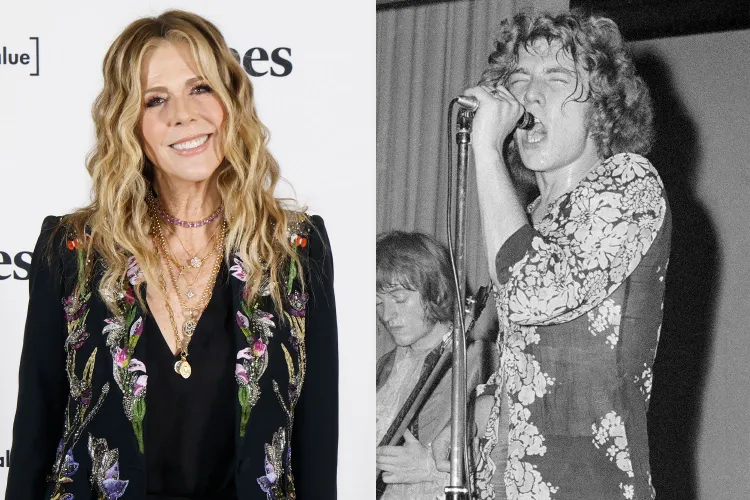
Rita Wilson has shared a memorable story about an embarrassing moment that happened while she was attending a Led Zeppelin concert, revealing how an unexpected fall left her with more than just a bruised sense of dignity. The actress, producer, and singer recalled that she “faceplanted on the pavement,” describing an incident that ultimately damaged her ego as much as it startled her.
For Wilson, whose career has spanned decades in Hollywood and the music industry, the experience serves as a reminder that even the most composed people can find themselves in unexpectedly awkward situations. While celebrity life often appears glamorous from the outside, personal stories like this reveal a more relatable side of familiar public figures.
The anecdote also brings together two enduring elements of popular culture: Wilson’s long-standing connection to entertainment and the legendary musical legacy of Led Zeppelin. Known for their electrifying performances and devoted following, the British rock band helped define an era of music that continues to attract listeners across generations.
Wilson’s recollection is especially entertaining because of the way she describes the incident. Rather than presenting herself as someone who effortlessly avoids embarrassment, she acknowledges the experience with humor and honesty. The reference to her ego adds a playful twist, suggesting that the emotional aftermath of an unexpected fall can sometimes feel more memorable than the physical mishap itself.
Rita Wilson’s Unexpected Concert Memory
Attending a major rock concert can be an unforgettable experience. The music, the crowd, the excitement, and the anticipation of seeing legendary performers create an atmosphere that encourages people to let go of their everyday routines.
For many fans, a Led Zeppelin concert would be a particularly memorable occasion. The band’s music has become part of rock history, with its powerful guitar riffs, distinctive vocals, and ambitious performances continuing to influence musicians around the world.
Yet Wilson’s story highlights how an evening built around music can also produce an entirely unexpected memory.
Her description of faceplanting on the pavement immediately gives the incident a vivid, almost cinematic quality. The phrase suggests a sudden and awkward fall, the kind of moment that can leave someone stunned before they have time to process what happened.
The embarrassment that follows can be difficult to explain to someone who has not experienced it. Even when a fall results in no serious injury, the feeling of having lost control in public can be uncomfortable.
Wilson’s willingness to recount the incident makes the story more amusing and accessible. Instead of attempting to preserve an image of perfection, she allows the audience to appreciate the humor in a situation that many people would prefer to forget.
That willingness to laugh at oneself has become one of the most appealing qualities of celebrity storytelling. Audiences often respond warmly when well-known personalities reveal experiences that feel familiar, ordinary, and unmistakably human.
Although the precise circumstances of the fall are important to the full story, the central detail remains striking: an evening associated with legendary rock music became memorable for Wilson for an entirely different reason.
Why the Fall Hurt Her Ego
Wilson’s reference to her ego adds another layer to the anecdote. Falling unexpectedly can be physically uncomfortable, but the embarrassment of the moment can sometimes linger long after the initial shock has passed.
There is a difference between stumbling when nobody is around and falling in a public setting. When other people may have witnessed the incident, an individual can become acutely aware of how they might have appeared.
That awareness can turn a brief mishap into an experience that feels disproportionately embarrassing.
The phrase “damaged her ego” captures this familiar reaction without requiring the incident to become a serious drama. It suggests that Wilson could recognize the absurdity of what happened while acknowledging that it was not exactly a moment of personal triumph.
Humor can be an effective way of regaining perspective after an awkward experience. By turning an embarrassing memory into a story, a person can change the way they relate to it. What initially felt uncomfortable may eventually become something worth sharing with friends, family, or an audience.
Wilson’s anecdote fits neatly into that tradition. The story’s appeal comes not simply from the fall itself, but from the contrast between the glamorous image often associated with celebrities and the ordinary mishaps that can happen to anyone.
Public figures are frequently photographed at premieres, award ceremonies, and carefully arranged events. Those images can create the impression that their lives are unusually polished. An unplanned moment on a pavement offers a very different picture.
It is a reminder that confidence, professional success, and public recognition do not prevent people from experiencing the same awkward situations that affect everyone else.
Rita Wilson’s Career Beyond the Embarrassing Moment
Wilson has built a diverse career in the entertainment industry, establishing herself as an actress, producer, and recording artist.
Her acting work has included appearances in films and television productions, while her producing career has connected her to projects that have reached audiences around the world. Over time, she has developed a professional identity that extends well beyond any single role.
She has also pursued music, releasing recordings and performing as a singer. That creative interest gives the Led Zeppelin anecdote an additional point of connection, since music is not merely a source of entertainment for Wilson but also an important part of her own artistic life.
Her career demonstrates the versatility required to remain active in an industry that constantly changes. Acting, producing, and music each demand different skills, from interpreting characters and collaborating with creative teams to developing a distinctive artistic voice.
In addition to her professional achievements, Wilson has maintained a public presence that often reflects warmth and humor. Personal stories can help audiences see another dimension of an established entertainer, particularly when they reveal a willingness to acknowledge imperfection.
The concert incident does not define Wilson’s career, of course. Instead, it offers a small but entertaining glimpse into the kinds of experiences that can become part of a person’s personal history.
For fans, these moments can be appealing precisely because they are not grand achievements or carefully planned public appearances. They are stories about life happening unexpectedly.
Led Zeppelin’s Enduring Place in Rock History
The mention of Led Zeppelin gives Wilson’s story an unmistakable musical backdrop.
Formed in 1968, the band became one of the most influential groups in rock music. Its members—Robert Plant, Jimmy Page, John Paul Jones, and John Bonham—developed a sound that combined blues influences, heavy guitar work, powerful vocals, and elements of folk and other musical traditions.
Songs such as “Stairway to Heaven,” “Whole Lotta Love,” and “Kashmir” helped establish the group as a defining force in the genre.
Led Zeppelin’s reputation was built not only on its recordings but also on the intensity of its live performances. Concerts became opportunities for the band to stretch its material, experiment with arrangements, and create an atmosphere that audiences remembered long after the final notes.
That legacy helps explain why attending a Led Zeppelin concert could become a significant personal memory for a music fan.
For Wilson, however, the experience appears to have acquired an additional chapter through the unexpected fall she described. Rather than remembering the evening exclusively through the music, she has an anecdote that combines the excitement of a legendary band with a moment of personal embarrassment.
The contrast is part of what makes the story memorable. A concert can provide the setting for extraordinary musical experiences, but the details people remember most clearly are not always the ones they anticipate.
Sometimes, an unexpected incident becomes inseparable from the memory of an otherwise ordinary evening.
Why Celebrity Embarrassment Stories Resonate With Audiences
Stories about celebrities making mistakes or experiencing awkward moments regularly attract attention because they challenge the distance between public figures and their audiences.
Fame can make people seem unusually confident or untouchable. Their professional lives are documented through photographs, interviews, and public appearances, while their everyday frustrations and accidents are often less visible.
When a celebrity describes an embarrassing experience, that distance becomes smaller.
Many people have stumbled in public, tripped on uneven pavement, or found themselves wishing they could immediately disappear after an awkward moment. These experiences are common, but they can feel intensely personal when they happen.
Hearing a familiar public figure describe a similar situation can make the experience easier to laugh about. It also offers a reminder that embarrassment is not necessarily a reflection of someone’s character or competence.
Wilson’s use of humor is particularly effective because it acknowledges the emotional side of the incident without turning it into something unnecessarily dramatic.
Her story also illustrates how the way people describe an experience can influence its meaning. Calling the event a blow to her ego transforms an unpleasant moment into an entertaining anecdote. The language encourages listeners to focus on the humor rather than simply imagining the discomfort of the fall.
That combination of honesty and self-deprecation can make a story more memorable than a perfectly polished account of an evening out.
The Human Side of a Hollywood Life
For someone with Wilson’s experience in the entertainment industry, public attention is hardly unfamiliar. Yet the most relatable stories are often those that have little to do with professional achievements.
An unexpected fall is not the sort of event anyone plans to discuss in a career retrospective. Nevertheless, such moments can become lasting memories because they capture the unpredictability of ordinary life.
Wilson’s story is a useful counterpoint to the carefully constructed images often associated with celebrity culture. Behind the premieres, professional commitments, and public appearances are people who experience surprise, discomfort, and embarrassment just like everyone else.
There is also something reassuring about the ability to laugh at an experience that once felt awkward. It suggests that a person’s relationship with an embarrassing memory can change over time.
What feels mortifying in the moment may later become a story that brings laughter to a conversation. The fall does not need to be transformed into a triumph; it can simply become an amusing part of life’s unpredictable collection of experiences.
In that sense, Wilson’s recollection is not really about perfection or the absence of embarrassment. It is about accepting that awkward moments happen and recognizing that humor can make them easier to carry.
The Bottom Line
Rita Wilson’s account of faceplanting on the pavement while attending a Led Zeppelin concert offers a humorous glimpse into an unexpected moment in her life. Her description of the incident as a blow to her ego captures the embarrassment that can follow a sudden public mishap, even when the story eventually becomes something to laugh about.
The anecdote also highlights the enduring appeal of personal celebrity stories. Audiences may admire performers for their talent and professional accomplishments, but they often connect just as strongly with moments that reveal their everyday humanity.
With Led Zeppelin providing the memorable musical backdrop, Wilson’s experience combines rock history with a universally recognizable feeling: the wish to recover one’s dignity after an awkward fall.
Ultimately, the story is a reminder that even the most accomplished people cannot control every moment. Sometimes, the most memorable part of an evening is not what happens onstage but what happens unexpectedly on the way.
And if an embarrassing moment can eventually become a funny story, perhaps the damage to one’s ego does not have to be permanent.