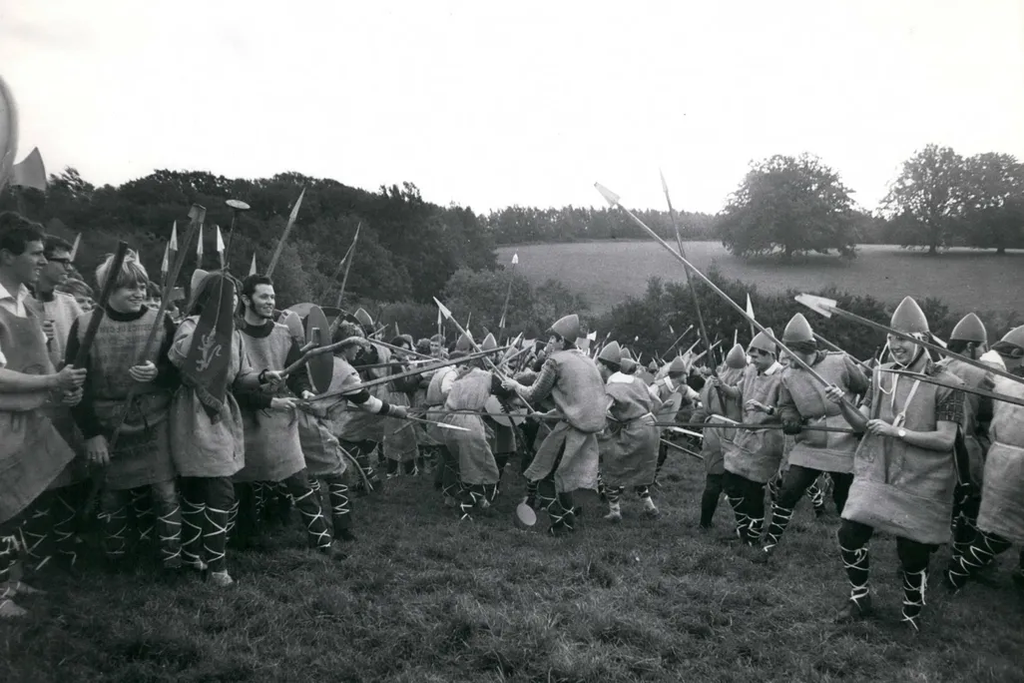
A remarkable piece of British history has returned to the spotlight after rare color footage of a chaotic 1966 re-enactment of the Battle of Hastings was rediscovered and restored. The film captures hundreds of university students dressed in improvised medieval costumes, carrying wooden weapons and charging toward one another to recreate a battle that changed the course of English history nearly 900 years earlier.
Recorded on October 14, 1966, the unusual event brought together students from the universities of Kent and Sussex to commemorate the 900th anniversary of the famous Battle of Hastings. What was intended as a historical celebration quickly became a lively spectacle marked by enthusiastic fighting, homemade armor and some surprisingly casual attitudes toward safety.
For decades, the original footage remained among hundreds of reels of family film. Now, with help from English Heritage, the material has been transformed into a restored short film that offers a fascinating glimpse into British student culture, local celebrations and the early days of a tradition that continues today.
The rediscovered footage is more than a nostalgic curiosity. It preserves an extraordinary moment when history, university rivalry and an ambitious public event came together in a way that few participants could have imagined would still attract attention 60 years later.
A Forgotten Film Reveals the Battle of Hastings Re-enactment of 1966
The original event took place in East Sussex, near the historic landscape associated with the Battle of Hastings. The real battle was fought in 1066 between the English army of King Harold II and the invading Norman forces led by William, Duke of Normandy, later known as William the Conqueror.
Nine centuries after that decisive confrontation, organizers wanted to mark the anniversary with a large public celebration. The result was a re-enactment involving approximately 500 students from the universities of Kent and Sussex.
The participants were not professional historical performers equipped with carefully researched costumes. Instead, many wore improvised outfits made from sacks, burlap and imitation chainmail. Their swords and other weapons were constructed from wood or hardboard and painted to resemble metal.
These homemade props gave the event a distinctive appearance. Although the students were attempting to portray medieval warriors, their costumes reflected the practical limitations and creative enthusiasm of an amateur production in the 1960s.
The rivalry between the two universities added another layer of excitement. The students were playing opposing armies, but their competitive spirit extended beyond the historical roles they had been assigned. Participants later recalled that the confrontation became surprisingly physical, with considerable pushing, shoving and energetic exchanges between the two sides.
The re-enactment reportedly attracted around 30,000 spectators, turning the anniversary into a major local occasion. For many people in attendance, it was an opportunity to celebrate a defining event in English history while enjoying an unusual and entertaining spectacle.
Few could have predicted that the day would eventually become the subject of a rediscovered film, offering future generations a rare view of how the anniversary was celebrated in 1966.
Why Were Hundreds of Students Recreating a Battle From 1066?
The Battle of Hastings occupies a central place in the history of England because it marked the beginning of a major political and cultural transformation.
In October 1066, William of Normandy invaded England and confronted the forces of King Harold II near the town of Hastings. Harold had recently faced another invading army led by Harald Hardrada of Norway, defeating it at the Battle of Stamford Bridge before marching south to confront William.
The Norman and English armies met on October 14, 1066. The fighting continued for much of the day, ending with a Norman victory and the death of Harold. William subsequently consolidated his control over England and was crowned king on Christmas Day that year.
The Norman Conquest brought significant changes to English political institutions, land ownership, architecture, language and aristocratic society. Its consequences continued to influence the country for generations.
By 1966, the 900th anniversary provided a natural opportunity for communities across Britain to revisit the events of 1066. Public commemorations, historical displays and theatrical performances helped bring the story to life for audiences who might otherwise have encountered it only through textbooks.
The student re-enactment near Hastings was one such celebration. Rather than presenting a quiet lecture about medieval warfare, it allowed hundreds of young people to participate directly in a dramatic interpretation of the past.
The result was not a precise reconstruction of eleventh-century military life. It was an energetic public performance shaped by the resources, attitudes and sense of fun of its time.
That distinction is part of what makes the surviving footage valuable today. It shows not only how people imagined the medieval past in 1966, but also how they chose to celebrate an important historical anniversary.
The Local Filmmaker Who Preserved the Extraordinary Event
The rediscovered film owes its existence to Alan Wootton, a local electronics business owner who was asked by Hastings Town Council to document the anniversary celebrations.
Wootton had experience with film and sound technology. His family also had an interest in recording events, and his son Cliff Wootton helped with the production when he was just 12 years old.
The younger Wootton was not simply watching the festivities from the sidelines. He assisted his father and the small production team with sound recording, placing him close to an event that would eventually become an important part of his family’s film archive.
The footage was recorded on color film, preserving details that might have been lost in written descriptions or still photographs. Viewers can see the participants’ improvised costumes, the movement of the opposing groups and the atmosphere surrounding the large public gathering.
Following Alan Wootton’s death, his wife Mary passed the family’s collection of approximately 300 film reels to their son. Cliff gradually reviewed and processed the material over the years.
The collection represented a substantial record of earlier decades, but going through hundreds of reels was a considerable undertaking. Many recordings had been stored for years, and turning them into material suitable for modern audiences required patience and technical work.
A later visit to Battle Abbey helped bring the 1966 footage back into focus. Remembering his father’s recording, Cliff discussed the material with people connected to the historic site.
That conversation led to collaboration with English Heritage, the organization responsible for preserving and presenting many important historic sites in England. The footage was restored and edited into a film lasting approximately 12 minutes, accompanied by a soundtrack created with historical musician Jonny Dyer.
The restoration transformed a family archive into a public historical resource, allowing an event that had largely faded from public memory to be seen again.
What the Rediscovered Footage Shows About Life in 1966
One of the most compelling aspects of the film is its ability to capture details that formal historical accounts might overlook.
The participants march through local streets, gather in improvised formations and prepare for the confrontation. Their costumes and equipment reveal a practical approach to historical performance, with homemade shields and imitation weapons standing in for the equipment of medieval soldiers.
The footage also records a style of public entertainment that feels different from many modern historical events. The students appear enthusiastic and energetic, while the organization of the spectacle reflects a time when expectations surrounding crowd management and participant safety were less formalized.
Some scenes show people on foot getting remarkably close to horses. The combination of moving animals, makeshift armor and wooden weapons has prompted modern observers to reflect on how differently such an event might be organized today.
The footage is not a reliable guide to what eleventh-century soldiers actually wore or how they fought. Its historical value lies elsewhere: it documents a twentieth-century attempt to bring a medieval battle to life.
That makes it useful for studying public history as well as the social atmosphere of the 1960s. It reveals how ordinary people engaged with the past, how local authorities organized commemorative events and how amateur filmmaking preserved experiences for later generations.
Color film is particularly valuable in this context. It retains the visual character of the occasion, from the appearance of the costumes to the landscape and the crowds gathered to watch.
The result feels less like a formal documentary about medieval warfare and more like a window into an event that people once experienced in person.
A Re-enactment That Became Surprisingly Real
Although the students were carrying imitation weapons, participants later recalled that the confrontation sometimes became more intense than expected.
Peter Sampson, who took part as a Norman foot soldier, remembered being recruited with the promise of a day out, a coach trip and beer. The experience proved considerably more physical than a simple costume performance.
In recollections shared with journalists, Sampson described substantial pushing and fighting when the two groups met. One of his friends was struck in the face by the end of an imitation spear, demonstrating that even wooden or makeshift weapons could cause discomfort or injury when used carelessly.
The university rivalry contributed to the atmosphere, but the event also depended on the enthusiasm of the participants. Hundreds of students had come together to portray opposing armies, and the excitement of the confrontation could easily overtake the theatrical nature of the exercise.
The event has since been described in colorful terms by people who remember it. Yet the surviving film also places those memories in context, allowing viewers to observe the scale of the gathering and the energy of the participants.
Its appeal lies partly in the contrast between the seriousness of the historical event being commemorated and the informal, occasionally unruly character of the modern re-enactment.
The real Battle of Hastings involved armies, political ambitions and consequences that reshaped England. The 1966 version was a public celebration, but the students’ determination to throw themselves into their roles gave it an unexpectedly authentic sense of disorder.
From a Student Spectacle to an Annual British Tradition
Perhaps the most important legacy of the 1966 event is that it helped establish a tradition that continues more than half a century later.
The first re-enactment’s success encouraged organizers to repeat the event. Over time, the annual gathering developed into a more structured historical celebration, with participants paying greater attention to period clothing, equipment and the practical details of medieval life.
Today, English Heritage organizes the Battle of Hastings re-enactment at Battle Abbey in East Sussex. Modern events bring together large numbers of performers and historical enthusiasts, offering visitors an opportunity to watch staged combat and explore aspects of life during the Norman Conquest.
These contemporary productions differ significantly from the student spectacle of 1966. Re-enactors can draw on more extensive historical research, specialized equipment and established practices for organizing public performances.
The aim is not simply to create an entertaining fight. It is also to help audiences understand the historical setting, military culture and broader consequences of the Norman invasion.
Nevertheless, the rediscovered film provides a reminder that today’s tradition began with an event that was considerably less polished. The homemade costumes and enthusiastic student combat formed part of the foundation for a celebration that has evolved over decades.
The footage therefore documents two stories at once: the commemoration of a battle fought in 1066 and the beginnings of a modern tradition that continues to connect people with that history.
Why English Heritage Calls the Film a Historical Time Capsule
English Heritage has described the rediscovered footage as an extraordinary time capsule, and the phrase captures its significance.
A time capsule preserves more than the central event it was created to document. It also retains incidental details about clothing, behavior, technology, public attitudes and the surroundings in which people lived.
The 1966 film shows how participants dressed for a historical performance, how spectators gathered and how a local celebration was organized. It also records the filmmaking techniques used by Alan Wootton and his team, preserving an example of amateur color filmmaking from the period.
The footage can also help reconnect surviving participants and their families with a shared experience. English Heritage has encouraged people who took part in the original re-enactment, or who recognize relatives and friends in the film, to come forward.
The organization has said that it does not have a complete record of the original foot soldiers’ names. The rediscovered film could therefore help identify individuals whose participation might otherwise have remained undocumented.
For those who were there, seeing the footage again may bring back memories of student life, friendships and an unusual day spent participating in a national anniversary. For younger viewers, it offers a chance to encounter the social world of the 1960s through images rather than written recollections alone.
Preserving such material also demonstrates why historical archives matter. Footage that appears ordinary or amusing when first recorded can become an important resource as the years pass and direct memories of an event begin to disappear.
How to Watch the Rediscovered Battle of Hastings Film
The restored 12-minute film was prepared for public presentation by English Heritage ahead of the 2026 Battle of Hastings re-enactment at Battle Abbey on October 10 and 11.
The footage provides an accessible introduction to the original 1966 event, combining scenes of the student participants with a visual record of the atmosphere surrounding the anniversary. Its relatively short running time makes it suitable for audiences interested in British history, archival discoveries and the evolution of historical re-enactments.
Those hoping to view the film should check English Heritage’s official announcements for current screening or viewing arrangements. The original announcement described plans to show the restored material during the 2026 event, but further access should not be assumed without confirmation.
The film is worth watching not because it offers a perfectly accurate reconstruction of medieval combat, but because it captures something that a modern production cannot reproduce: the actual people, places and attitudes of 1966.
Its images allow audiences to observe the event directly, compare it with modern re-enactments and consider how public celebrations of history have changed.
A Lost Piece of History Finds a New Audience
The rediscovery of the 1966 Battle of Hastings footage demonstrates how valuable historical material can remain hidden in private collections for decades before finding a wider audience.
What began as a local council’s request for a film record became a lasting document of hundreds of students participating in an ambitious anniversary celebration. Alan Wootton’s decision to record the event, followed by Cliff Wootton’s work to recover and restore the reels, ensured that the day would not disappear entirely from public memory.
The film captures homemade armor, wooden swords, university rivalry and the enthusiasm of a generation marking one of England’s most consequential historical events. It also preserves the beginnings of a re-enactment tradition that continues to bring thousands of visitors closer to the story of 1066.
Nearly 60 years later, the footage offers a vivid reminder that history is not preserved only in official documents, grand monuments or museum collections. Sometimes, it survives because someone brought a camera to an unusual event and carefully kept the resulting film.
For viewers today, the rediscovered footage provides a rare opportunity to look back at a memorable moment in British history—and to see how a spirited student spectacle became part of a much longer story of remembrance, heritage and public engagement.