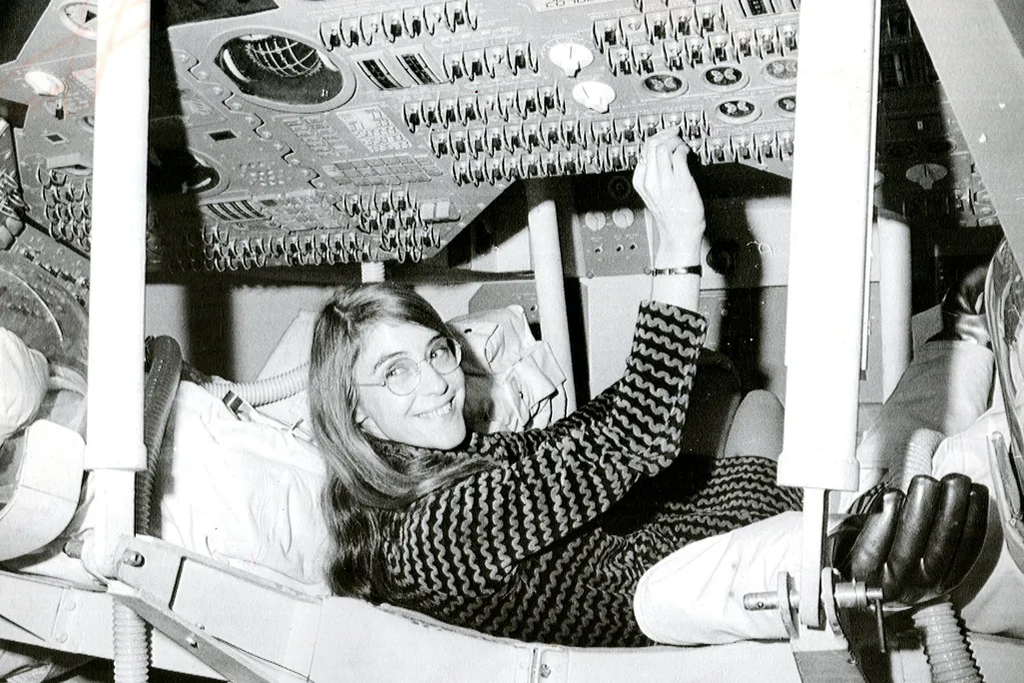
Margaret Hamilton, the pioneering computer scientist whose work helped make humanity’s first Moon landing possible, has died at the age of 90. Her passing marks the loss of one of the most influential figures in the early history of software engineering, a woman whose technical vision helped NASA navigate some of the most demanding challenges of the Apollo space program.
Hamilton died on September 30, 2026, in Cambridge, Massachusetts. She was widely recognized for leading the software engineering team at the Massachusetts Institute of Technology’s Instrumentation Laboratory, where engineers developed the onboard flight software used in NASA’s Apollo missions.
At a time when computers were still relatively new and software engineering had yet to establish itself as a distinct professional discipline, Hamilton understood that reliable code could be just as important as the spacecraft’s engines, navigation equipment, and physical construction. Her work helped ensure that astronauts and computers could respond to unexpected problems during missions where even a small error could have catastrophic consequences.
Her contribution became particularly significant during Apollo 11 in July 1969, when astronauts Neil Armstrong and Buzz Aldrin approached the lunar surface. As the Lunar Module Eagle descended toward the Moon, its guidance computer produced unexpected warning alarms. The software’s ability to prioritize essential tasks helped the spacecraft continue operating, allowing the landing to proceed.
Hamilton’s legacy extends far beyond a single historic moment. She helped establish principles of software reliability that remain important in modern computing, from aerospace engineering to safety-critical systems. She also challenged assumptions about women’s place in technology during an era when computer programming and engineering leadership were overwhelmingly dominated by men.
In 2016, President Barack Obama awarded Hamilton the Presidential Medal of Freedom, the United States’ highest civilian honor, recognizing her pioneering contributions to science and technology.
Her story is ultimately one of technical achievement, determination, and the importance of work that often happens behind the scenes. While the astronauts became the public faces of the first Moon landing, Hamilton and her colleagues helped build the digital systems that made their extraordinary journey possible.
Margaret Hamilton’s Early Life and Education
Margaret Heafield Hamilton was born in Paoli, Indiana, in 1936. She grew up during a period when computing was still in its infancy and long before software development became a familiar career path.
She attended Earlham College in Richmond, Indiana, where she studied mathematics and philosophy. Her education helped develop the analytical thinking and problem-solving skills that would later become central to her work in computer science.
After completing her studies, Hamilton moved into a professional world in which the modern technology industry barely existed. Computers were large, expensive machines used primarily by governments, universities, research institutions, and major organizations. Programming was a specialized activity, often involving direct interaction with hardware and requiring an understanding of how a machine processed instructions.
Hamilton began working at MIT in 1959. One of her early experiences involved working with meteorologist Edward Lorenz on mathematical and computer-based weather research. This work introduced her to the challenges of using computers to model complex systems and helped lay the groundwork for her subsequent career.
She later worked on the Semi-Automatic Ground Environment, or SAGE, an air-defense project designed to process radar information and help identify potential threats. The project demanded dependable software capable of handling large amounts of information in real time.
These early experiences proved valuable preparation for the Apollo program. Hamilton was learning to develop computer systems in which accuracy and reliability were essential, rather than optional qualities.
The skills she acquired would soon be applied to a challenge of unprecedented scale: helping humans travel to another world and return safely.
Joining NASA’s Apollo Program
In the mid-1960s, NASA was working toward President John F. Kennedy’s goal of landing a human on the Moon and returning that person safely to Earth before the decade ended. Achieving that ambition required enormous advances in rocket technology, spacecraft design, communications, navigation, and computing.
MIT’s Instrumentation Laboratory had secured a NASA contract to develop the onboard guidance software for the Apollo missions. Hamilton applied for the opportunity in 1965 and became the first programmer hired for the Apollo project at the laboratory.
The work was unlike most programming tasks of the era. The software had to operate in a spacecraft traveling hundreds of thousands of miles from Earth, where engineers could not simply intervene directly whenever a computer encountered a problem.
The Apollo Guidance Computer had limited processing power and memory by modern standards. Its software needed to perform essential calculations, manage competing tasks, and respond predictably under pressure. The system also had to work within strict limitations imposed by the spacecraft’s hardware.
Hamilton eventually led a team responsible for developing the onboard flight software for crewed Apollo missions. This involved far more than writing individual programs. The team had to consider how different components interacted, how the computer would respond to unexpected conditions, and how to ensure that essential operations could continue when resources became limited.
Hamilton helped champion a more systematic approach to software development, emphasizing careful design, testing, and the ability to anticipate errors before they threatened a mission.
Her work was particularly significant because software was not yet widely regarded as an engineering discipline comparable to mechanical or electrical engineering. Hamilton and her colleagues were helping create the methods and professional standards that would define the field.
The Apollo 11 Computer Alarms That Tested the System
The moment that brought Hamilton’s work into sharp focus occurred on July 20, 1969, during the final descent of Apollo 11’s Lunar Module Eagle.
Armstrong and Aldrin were preparing to land on the Moon when the onboard guidance computer began displaying program alarms. The warnings, known as 1201 and 1202, indicated that the computer was experiencing an overload of work and could not complete every task it had been asked to perform.
For the astronauts and the engineers supporting the mission from Earth, the alarms created an urgent situation. A computer malfunction during the final moments of descent could have forced an abort, jeopardizing the planned landing.
Yet the alarms did not mean that the computer had simply stopped functioning. The software had been designed to prioritize critical tasks and discard lower-priority work when necessary. This allowed the computer to preserve the operations needed to guide the spacecraft.
Mission Control assessed the situation, and flight controllers determined that the mission could continue. Armstrong and Aldrin completed the descent, and Eagle landed safely in the Sea of Tranquility.
Armstrong’s first steps onto the lunar surface soon became one of the most recognizable moments in human history.
The success depended on the combined efforts of astronauts, flight controllers, scientists, engineers, technicians, and many other professionals. Hamilton’s contribution was a crucial part of that larger achievement: the software was designed to respond to unexpected demands without abandoning the tasks essential to the mission.
The incident demonstrated why reliable software could be a matter of life and death. It also illustrated the value of anticipating failures and building systems that could recover gracefully rather than collapse when something unexpected occurred.
Why Hamilton’s Approach to Software Engineering Mattered
Hamilton became an important advocate for treating software development as a rigorous engineering discipline. At the time, the field was still evolving, and many people underestimated the complexity of creating dependable programs.
The term “software engineering” became closely associated with her efforts to communicate the seriousness and sophistication of the work. She wanted people to recognize that software required structured methods, careful planning, and systematic verification.
Her approach emphasized the need to think beyond whether a program worked under ideal conditions. Engineers also had to consider what might happen when equipment behaved unexpectedly, when information arrived at the wrong time, or when a computer was asked to handle more tasks than it could process simultaneously.
This philosophy became especially important in aerospace applications, where software could influence navigation, timing, equipment operation, and crew safety.
Hamilton’s work helped demonstrate that dependable software could not be treated as an afterthought added to a finished machine. It had to be considered an integral part of the system from the beginning.
These ideas remain relevant in contemporary technology. Modern aircraft, spacecraft, medical devices, industrial controls, and other safety-critical systems depend on software that must behave predictably under demanding conditions.
Although today’s computers are vastly more powerful than the Apollo Guidance Computer, increased computing power does not eliminate the need for sound engineering. Complex systems can still fail when their designers overlook unusual conditions or misunderstand how different components interact.
Hamilton’s emphasis on reliability, disciplined design, and anticipating errors helped establish principles that continue to influence software engineering.
A Working Mother in a Male-Dominated Field
Hamilton’s career also unfolded during a period when women faced substantial barriers in science, technology, engineering, and mathematics.
Computer programming in the 1960s involved many women, but leadership positions and public recognition were often disproportionately awarded to men. The achievements of female programmers could be overlooked even when their work was central to a project’s success.
Hamilton navigated this environment while raising her daughter, Lauren. Her experience reflected the challenges faced by working parents in demanding technical careers, particularly when the profession was still developing its expectations and structures.
The Apollo program required intense collaboration and sustained effort. Developing software for missions with strict deadlines meant that engineers had to coordinate complex tasks while responding to changing technical requirements.
Hamilton earned recognition through the quality and importance of her work, eventually becoming a leader within the project. Her career helped challenge the assumption that women were less suited to technical leadership or the development of complex computer systems.
Her story has since become an important part of the history of women in technology. Images of Hamilton standing beside stacks of printed Apollo software have become widely recognized, symbolizing the scale of the work involved and the expertise required to carry it out.
Her achievements also helped make the contributions of software engineers more visible. The Apollo missions are often remembered through images of rockets, astronauts, and the lunar surface, but Hamilton’s career highlights the many forms of expertise required to make space exploration possible.
Life After Apollo and the Presidential Medal of Freedom
Hamilton continued working in computing after the Apollo era. In the 1970s, she helped develop new approaches to software reliability and systems design, extending ideas she had explored during her NASA work.
She later founded software companies, including Higher Order Software and Hamilton Technologies. Through these ventures, she continued developing and promoting methods for designing reliable systems.
Her work demonstrated that the lessons learned from Apollo had applications beyond space exploration. As computers became more widespread, the need for dependable software grew across industries and institutions.
Hamilton received increasing recognition as the historical significance of her contributions became more widely understood.
In November 2016, President Barack Obama presented her with the Presidential Medal of Freedom. The award recognized her role in helping develop the software that guided the Apollo missions and her influence on the evolution of modern computing.
The honor reflected a broader reassessment of the people whose contributions had been essential to the Moon landings. The Apollo program was a collective achievement, and Hamilton’s recognition helped bring attention to the engineers and programmers whose work often remained less visible than that of astronauts.
Her influence also reached new generations through educational programs, historical exhibitions, and popular representations of women who helped shape modern science and technology.
Margaret Hamilton’s Lasting Legacy
Hamilton’s death at 90 closes a remarkable chapter in the history of computing, but her influence remains embedded in the way engineers think about software.
The Apollo program showed that computer systems could support extraordinarily complex tasks in environments where mistakes carried enormous consequences. Hamilton helped establish the principles that made those systems more resilient, demonstrating the importance of designing software to anticipate unexpected conditions rather than assuming everything would go according to plan.
Her career also reminds us that historic achievements rarely belong to a single individual. The first Moon landing depended on the combined work of thousands of people, many of whom never appeared in the most famous photographs of the mission.
Hamilton’s contribution was distinctive because she helped solve a problem that was still poorly understood: how to create software dependable enough to support human spaceflight. The alarms during Apollo 11 revealed the importance of that work at precisely the moment when the mission’s success was at stake.
Today, software operates behind countless everyday activities, from communications and transportation to healthcare and scientific research. Much of it works so quietly that users rarely think about the people who designed it or the risks its developers had to consider.
Hamilton helped change that understanding. She insisted, through her work and her advocacy, that software deserved the same seriousness and discipline as other forms of engineering.
Her legacy is therefore both technical and cultural. She helped make the Moon landing possible, contributed to the development of a profession, and became a symbol of the women whose achievements helped shape the modern technological world.
Margaret Hamilton may be remembered most vividly for the code that supported Apollo, but her broader lesson reaches far beyond space exploration: innovation requires imagination, careful planning, and the determination to prepare for problems before they arise.
As humanity continues exploring space and building increasingly complex computer systems, the principles she championed remain essential. Her work helped carry astronauts to the Moon, and its influence continues to shape the technology that connects the world today.