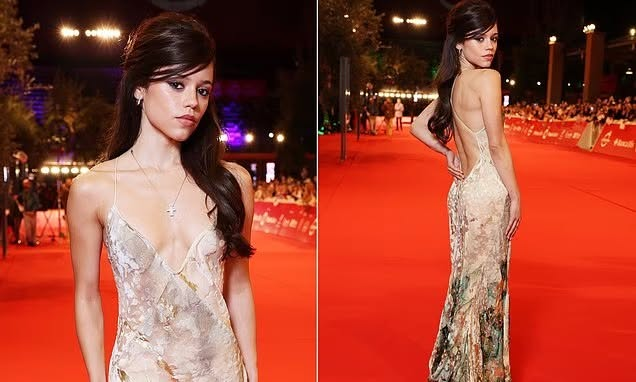
A stunning red carpet appearance doesn’t always guarantee an equally warm reception for a movie, and Jenna Ortega’s latest appearance has highlighted that familiar Hollywood contrast. The actress attracted attention with a plunging nude dress at the Rome premiere of Klara and the Sun, bringing her distinctive fashion sensibility to an event that combined cinematic anticipation with considerable style interest.
Yet while Ortega’s outfit became a talking point, reports of harsh criticism and one-star reviews for the film introduced a very different conversation. The contrast between the glamour of the premiere and the reported early response to the movie raised an important question: can a memorable red carpet moment help a film stand out when its reception proves less enthusiastic?
For Ortega, whose career has made her one of the most recognizable young actresses in Hollywood, the appearance represents another example of her ability to attract attention through fashion as well as acting. For Klara and the Sun, however, the discussion illustrates how a film must ultimately be judged on more than the excitement surrounding its stars.
The result is a story that brings together celebrity fashion, movie criticism, and the unpredictable nature of audience expectations.
Jenna Ortega’s Rome Premiere Look Steals the Spotlight
Jenna Ortega has developed a recognizable presence on the red carpet, frequently choosing outfits that combine contemporary glamour with unconventional details. Rather than relying exclusively on traditional Hollywood silhouettes, she has often embraced fashion choices that feel dramatic, artistic, and carefully considered.
Her reported appearance in a plunging nude dress at the Rome premiere of Klara and the Sun fits comfortably within that broader fashion identity.
A nude-toned gown can make a striking impression because its effect depends heavily on cut, texture, and silhouette. When paired with a plunging neckline, the result can feel both elegant and daring, particularly under the bright lights and camera flashes of a major film premiere.
The appeal of such a look lies in its balance. The neutral color creates a relatively understated foundation, while the neckline and overall shape introduce the dramatic element that makes the outfit memorable.
For a star attending an international premiere, these details matter. Red carpet appearances are highly visual events, and an outfit can quickly become one of the most widely circulated elements of the evening.
Ortega’s fashion choices have helped establish her as a celebrity whose appearances regularly invite discussion. Whether she is attending a film premiere, a major awards ceremony, or a fashion event, her style often reflects a willingness to experiment rather than simply follow established trends.
However, fashion attention and cinematic success remain two separate things. An outfit may generate excitement even when the film associated with it receives a more complicated response.
Why Jenna Ortega Continues to Make Headlines for Her Fashion
Ortega’s appeal extends beyond the characters she plays on screen.
Since gaining widespread recognition through projects including Wednesday, she has become a prominent figure in entertainment and fashion conversations. Her public image combines a distinctive screen presence with a style that often challenges conventional expectations of young Hollywood glamour.
One reason her fashion choices attract attention is that they tend to feel connected to her broader artistic identity. Darker styling, unconventional silhouettes, and carefully chosen statement pieces have all contributed to the public perception of Ortega as a performer who is comfortable embracing individuality.
That does not mean every outfit needs to be controversial to attract attention. Sometimes, the combination of a familiar celebrity, an important premiere, and a well-executed look is enough to create a memorable moment.
The Rome appearance offers an example of how celebrity fashion can become a parallel story alongside a film’s release.
Photographs from premieres are shared across entertainment websites and social media, often reaching audiences who may not yet know much about the movie itself. A striking dress can therefore introduce the film to a broader audience, even if the initial conversation focuses more on the star than on the production.
For Ortega, that visibility can reinforce her position as both an actress and a fashion figure. For the film, it creates attention, although attention alone cannot determine whether audiences will ultimately embrace the story.
What Is Klara and the Sun About?
Klara and the Sun is based on the acclaimed novel by Kazuo Ishiguro, the Nobel Prize-winning author known for exploring memory, human relationships, identity, and the emotional consequences of technological change.
The story centers on Klara, an Artificial Friend designed to provide companionship to young people. Observing the world from her distinctive perspective, Klara attempts to understand human behavior, emotional attachment, and the hopes people place in technology.
The novel uses this unusual viewpoint to explore questions that are increasingly relevant in contemporary society. What makes someone human? Can artificial intelligence understand love or sacrifice? And how do people respond when technology becomes part of their most intimate relationships?
These questions give the story a foundation that extends beyond conventional science fiction.
Rather than relying solely on technological spectacle, Ishiguro’s work is known for its quieter emotional approach. The story’s central appeal lies in the tension between Klara’s observations and the complex realities of the people around her.
Adapting such material for the screen presents a particular challenge. A novel can communicate a character’s inner thoughts through narration, while a film must find visual and dramatic ways to convey similar ideas.
The success of the adaptation therefore depends not only on the source material but also on how effectively the filmmakers translate its emotional subtleties into a cinematic experience.
That challenge may help explain why reactions to literary adaptations can vary considerably among viewers and critics.
Why Reported One-Star Reviews Have Sparked Discussion
According to the premise of the reports surrounding the Rome premiere, Klara and the Sun faced harsh criticism, including some one-star reviews.
Such reactions can quickly become a talking point, particularly when a film arrives with a recognizable star and an established literary work behind it. However, an individual rating does not necessarily represent the overall critical consensus, and the exact review scores and their sources should be verified before drawing firm conclusions about the film’s reception.
A one-star review generally signals a highly negative response from an individual critic or viewer. The reasons can differ considerably, ranging from dissatisfaction with the screenplay to concerns about pacing, performances, direction, or the way a source novel has been adapted.
For a story like Klara and the Sun, expectations may be particularly high because the novel has an established readership and explores themes that invite thoughtful interpretation.
Some viewers may prefer an adaptation that remains close to the book’s philosophical depth. Others may expect a more emotionally direct or visually engaging experience.
When those expectations differ from the film’s creative choices, disappointment can follow.
Nevertheless, early criticism should be understood as one part of a movie’s broader reception. Reviews published around a premiere may not capture how audiences respond over time, and initial reactions can differ from the opinions that emerge after wider release.
The important distinction is between a film attracting negative reviews and the assumption that every viewer will share the same judgment.
The Challenge of Adapting a Beloved Novel
Adapting a respected novel for cinema can be a difficult balancing act.
Filmmakers must decide which elements to preserve, which details can be simplified, and how to translate a story’s atmosphere into a visual medium. These decisions inevitably affect how readers and newcomers experience the finished production.
With Klara and the Sun, the central challenge is especially interesting because the story depends on perception. Klara’s understanding of the world is limited, yet her observations invite audiences to consider human behavior from a different perspective.
A successful adaptation must preserve that distinctive viewpoint while providing enough dramatic momentum to hold viewers’ attention.
If the film explains too much, it may lose some of the ambiguity that makes the novel compelling. If it leaves too much unexplained, audiences unfamiliar with the book may struggle to understand the emotional significance of certain events.
Pacing can also become a concern when a reflective literary story moves to the screen. Internal questions that work beautifully on the page may require careful visual storytelling to remain engaging in a film.
These are not easy problems to solve, and different creative approaches can produce very different responses.
Ultimately, the film must establish its own identity rather than relying entirely on the reputation of the novel.
Can Red Carpet Glamour Influence a Movie’s Success?
Celebrity premieres serve several purposes at once. They celebrate the work of the filmmakers and cast, create publicity, and provide a visually engaging moment that entertainment outlets can share with their audiences.
Fashion plays an important role in that process.
A memorable gown can generate headlines, social media conversations, and photographs that travel far beyond the event itself. For a film seeking visibility, such coverage can help ensure that its title remains part of the entertainment conversation.
However, the relationship between publicity and audience satisfaction is complicated.
A star’s appearance may encourage someone to learn more about a movie, but it cannot guarantee that the person will enjoy it. Similarly, negative reviews may discourage some viewers while encouraging others to watch and form their own opinions.
In Ortega’s case, the reported contrast between her striking appearance and the film’s critical response makes the premiere particularly interesting from a media perspective.
The fashion moment provides an immediately accessible story, while the movie’s reception invites a more detailed discussion about storytelling and artistic expectations.
Both can exist at the same time without canceling each other out.
A successful red carpet appearance is a success in its own right, even if the film attached to the event faces criticism.
Jenna Ortega’s Career Continues Beyond One Premiere
Ortega’s career has developed through a combination of television, film, and projects that have strengthened her reputation as a performer with a distinctive screen presence.
Her success in Wednesday introduced her to a much wider international audience, while her work in horror and other dramatic productions has demonstrated her ability to operate across different genres.
As her profile has grown, the attention surrounding her projects has expanded accordingly. Audiences are increasingly interested not only in the characters she portrays but also in her fashion choices, professional decisions, and approach to selecting roles.
That attention can create opportunities, but it also brings heightened expectations.
When an actor becomes strongly associated with a successful project, audiences may approach subsequent films with assumptions about the kind of performance or material they want to see.
A literary adaptation like Klara and the Sun presents an opportunity to explore a different kind of story, particularly one built around emotional questions rather than conventional action.
Regardless of the initial reviews, Ortega’s long-term career will depend on the range of work she chooses and the performances she delivers across multiple projects, not on the reception of a single premiere.
Final Thoughts: A Fashion Triumph and a Film Under Scrutiny
Jenna Ortega’s reported appearance in a plunging nude dress at the Rome premiere of Klara and the Sun illustrates the unusual relationship between celebrity fashion and movie publicity.
Her look attracted attention through its bold silhouette and understated color, reinforcing her reputation as a young star with a distinctive approach to red carpet dressing.
Meanwhile, reports of harsh reviews and one-star ratings have raised questions about how the film translates Kazuo Ishiguro’s thoughtful, emotionally complex novel to the screen. The precise scale of that criticism should be established through verified reviews rather than assumed from isolated ratings.
What remains clear is that a premiere can produce more than one story.
The fashion may captivate photographers, the film may divide critics, and audiences may ultimately reach their own conclusions after watching it.
For Ortega, the Rome appearance provides another memorable moment in a career that continues to attract attention across entertainment and fashion. For Klara and the Sun, the real test will be whether its storytelling resonates with viewers beyond the initial wave of headlines.
After all, a dazzling dress can make a premiere unforgettable, but a movie’s lasting reputation depends on what happens once the lights dim and the story begins.