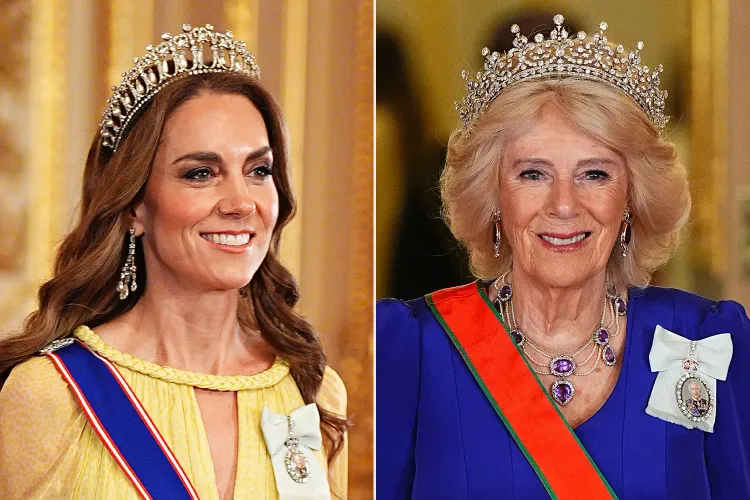
Kate Middleton and Queen Camilla have long captivated royal watchers with their elegant fashion choices, but their jewelry often tells a story that goes far beyond style. At a state banquet connected with Oman, the two royal women’s tiara choices offered a fascinating opportunity to explore the history, symbolism, and unexpected connections behind some of the British royal family’s most treasured jewels.
State banquets are among the most glamorous events in the royal calendar. They bring together heads of state, senior members of the royal family, diplomats, and distinguished guests for an evening that celebrates international relationships. Every detail matters, from the carefully chosen gowns to the decorations, ceremonial uniforms, and historic jewelry worn by the royal hosts.
For Kate, Princess of Wales, and Queen Camilla, a tiara is never simply an accessory. These extraordinary pieces can represent family history, royal tradition, personal taste, and continuity across generations. Their appearance at an important diplomatic occasion can therefore prompt questions about why a particular jewel was selected and what its history reveals.
The precise connection between the tiaras reportedly worn by Kate and Camilla at the Oman state banquet should be confirmed against official photographs and reliable descriptions of the event before any specific relationship between the pieces is treated as fact. Nevertheless, the subject highlights one of the most intriguing aspects of royal fashion: two seemingly different jewels can share a story through the people, traditions, and history that connect them.
Why Tiaras Matter at a Royal State Banquet
A state banquet is one of the most formal occasions hosted by the British monarch. These dinners are designed to honor visiting heads of state and strengthen diplomatic relationships, making them significant events both politically and ceremonially.
The dress code is traditionally elaborate, with evening gowns, formal decorations, and, on appropriate occasions, tiaras. The jewelry worn by senior royal women often attracts particular attention because many of these pieces have been preserved for decades or even generations.
Unlike contemporary fashion accessories, royal tiaras frequently carry substantial historical significance. Some were commissioned to celebrate marriages, others were inherited through family lines, and many have been worn by several generations of royal women.
Their appearances also reflect the continuing role of tradition within the monarchy. While clothing styles change with each generation, historic jewels provide a visible link between the present royal family and its predecessors.
For Kate Middleton, wearing a tiara represents a particularly formal aspect of her role as Princess of Wales. Although she is often photographed in modern coats, elegant dresses, and understated jewelry, a state banquet offers an opportunity to participate in a ceremonial tradition associated with the highest levels of royal diplomacy.
Queen Camilla, meanwhile, has developed her own recognizable approach to royal evening wear, often pairing formal gowns with historic pieces from the royal collection or jewels associated with her family.
Their choices are therefore interesting not only as fashion statements but also as expressions of the monarchy’s wider history.
Kate Middleton’s Evolving Relationship With Royal Jewelry
Since becoming a member of the royal family, Kate has developed a style that balances contemporary elegance with respect for royal tradition. Her public wardrobe frequently features clean silhouettes, carefully coordinated colors, and accessories selected to suit the occasion.
Her approach to tiaras follows a similar principle. Rather than wearing them regularly, she has reserved these elaborate pieces for especially formal events, including state banquets and significant royal celebrations.
This relative rarity contributes to the excitement surrounding each appearance. When Kate wears a tiara, royal watchers often examine its design, historical background, and previous owners.
The jewelry can also carry connections to important figures in royal history. A tiara may have been worn by a former queen, passed down through the family, or become associated with a particular royal woman through repeated appearances at major occasions.
Kate’s position within the monarchy gives these choices additional meaning. As the wife of Prince William and a future queen consort, she represents both the current generation of the royal family and its long-term continuity.
However, not every tiara worn by a senior royal necessarily belongs to the same personal collection or follows the same inheritance path. Some jewels are privately owned, while others are part of the royal collection and may be made available for particular occasions.
Understanding these distinctions is essential when examining a possible connection between two tiaras. Similar appearances do not automatically establish that the pieces share an owner, a maker, or a direct family history.
Queen Camilla’s Love of Historic Jewels
Queen Camilla’s public appearances often feature jewelry that reflects the formal traditions of the British monarchy. Her evening looks frequently combine richly colored gowns with historic necklaces, earrings, brooches, or tiaras.
Royal jewelry can be especially meaningful for a queen consort because it helps communicate the continuity of the institution. A historic tiara can connect the present monarch’s household with previous generations, while also becoming part of the visual identity of the current reign.
Camilla’s choices may differ from Kate’s in style and presentation, but both women operate within the same broader tradition of ceremonial dressing.
A tiara’s significance can arise from several sources. Its craftsmanship may reveal the period in which it was made. Its gemstones may have been reused from an older piece. Its ownership history may connect it to a royal marriage, a family inheritance, or a particular monarch.
Some jewels have also been altered over time, with their original designs modified to suit changing fashions or the preferences of successive owners.
These details make royal tiaras fascinating historical objects rather than merely expensive decorations.
For Camilla, wearing an established royal jewel at a diplomatic event can also provide a visual connection to the monarchy’s past. For observers, discovering that another royal woman has worn a related piece can make the occasion even more interesting.
The key is establishing the actual connection through the documented history of each jewel rather than assuming that two tiaras are related simply because they appeared at the same event.
The Unexpected Connections Hidden in Royal Tiaras
The phrase “unexpected connection” is particularly appealing when discussing royal jewelry because a tiara’s history is rarely limited to its original design.
Two pieces may be connected through a shared royal ancestor, the same jeweler, gemstones that once belonged to a larger set, or a tradition of wearing particular jewels at diplomatic events.
In other cases, the relationship may be more symbolic than direct. Two tiaras can represent different generations of the same family while serving similar ceremonial purposes.
The British royal family’s jewelry history contains numerous examples of jewels passing between generations, being adapted to new styles, or becoming associated with particular members of the monarchy. These changes mean that the story of a piece can be more complicated than its present-day appearance suggests.
For example, a tiara may originally have been created for one royal woman but later become closely associated with another. A jewel can also acquire new significance when it is worn at a major national celebration or an important international occasion.
Such histories help explain why royal jewelry generates sustained public interest. A photograph captures only one moment, while the jewel itself may carry decades of personal and institutional history.
To establish the specific connection between Kate’s and Camilla’s tiaras at the Oman state banquet, however, it would be necessary to identify both pieces accurately and compare their documented histories. Without that confirmation, naming a shared designer, ancestor, or set of gemstones would risk creating a connection that may not exist.
Royal Fashion as a Form of Diplomacy
The state banquet setting adds another dimension to the discussion. Royal fashion is often treated as entertainment, but formal clothing can also serve a diplomatic purpose.
When the British monarch welcomes a foreign head of state, the event is designed to demonstrate respect, hospitality, and the importance of the relationship between the two countries. Clothing, decorations, and ceremonial details all contribute to that message.
The choice of a tiara can be part of this broader visual language. A historic jewel may communicate continuity and tradition, while a carefully selected gown can reflect the formality of the occasion.
Royal women do not necessarily choose jewelry with a single diplomatic message in mind. Personal taste, availability, historical associations, and practical considerations may all influence the final decision.
Nevertheless, their appearances become part of the public presentation of the monarchy.
At an event associated with Oman, the British royal family’s formal dress would be viewed alongside the broader traditions of diplomatic hospitality and international ceremony. The banquet’s significance therefore extends beyond the clothes worn by individual guests.
The tiaras may attract immediate attention, but the occasion itself is intended to celebrate relationships between nations.
Why Kate and Camilla’s Style Choices Attract So Much Attention
Kate and Camilla occupy different positions within the royal family, yet their public appearances are frequently examined together. Their clothing choices provide an accessible way for audiences to engage with royal life, particularly when the event involves historic jewels or formal dress.
Kate’s style is often associated with modern tailoring and a restrained approach to accessories. Camilla’s evening wardrobe, meanwhile, frequently embraces the established conventions of royal ceremonial fashion.
These descriptions are broad observations rather than fixed rules. Both women have worn a range of styles, and their choices naturally vary according to the occasion.
What makes their tiaras especially interesting is that the jewels can communicate a sense of continuity even when the women wearing them have distinct personal styles.
A tiara that has survived multiple generations can become a shared reference point between different periods of royal history. Its appearance on a contemporary royal woman allows audiences to see how traditions are preserved while the people who participate in them change.
That combination of personal style and inherited history is one reason royal jewelry remains a popular subject long after a banquet has ended.
A Royal Jewelry Story That Goes Beyond Appearance
The interest in Kate Middleton and Queen Camilla’s tiaras at the Oman state banquet illustrates why royal fashion often becomes a subject of historical investigation.
A photograph can prompt questions about gemstones, craftsmanship, ownership, and the people who wore a jewel before it reached its current wearer. Those questions can reveal connections that are not immediately obvious to the casual observer.
However, accuracy remains important. The specific identity of each tiara and the nature of their reported connection must be established before the story can be told in detail.
What can be said more broadly is that tiaras occupy a distinctive place within the British monarchy. They combine craftsmanship with family history, ceremonial tradition, and the public symbolism of royal life.
For Kate, these jewels offer a way to participate in the monarchy’s historic customs while developing her own public identity. For Camilla, they provide a connection to the traditions associated with the role of queen consort.
At a state banquet, their appearance is part of a larger event that brings diplomacy, ceremony, and royal heritage together.
Ultimately, the fascination lies in the possibility that two beautiful objects may tell a much larger story. Behind every historic tiara is a record of changing fashions, personal histories, and generations of royal women who helped preserve its place in the monarchy’s enduring traditions.