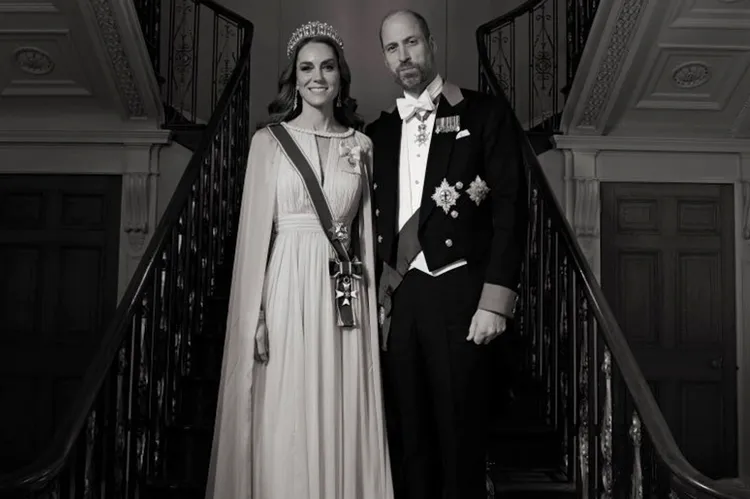
The Prince and Princess of Wales continue to capture public attention whenever they appear at a major royal occasion. From their elegant evening wear to the traditions surrounding state banquets, Prince William and Kate Middleton often provide memorable moments that reflect both the history and the modern image of the British monarchy. A glamorous state banquet portrait featuring the royal couple naturally invites interest, particularly when an unexpected detail gives the image a different story to tell.
State banquets are among the most formal events in the royal calendar. They bring together members of the Royal Family, visiting heads of state, diplomats and other distinguished guests. Beyond the glittering surroundings and carefully chosen outfits, these occasions carry diplomatic significance, representing the United Kingdom’s relationships with other nations.
A striking portrait of William and Kate can therefore be more than a photograph of a beautifully dressed couple. It can also offer a glimpse into royal protocol, the responsibilities they share and the balance between tradition and change that continues to shape the monarchy.
Kate Middleton and Prince William in the Spotlight
The Prince and Princess of Wales have become two of the most recognizable figures in the British Royal Family. As the heir to the throne and his wife, they occupy a central position in the monarchy’s public life, attending official engagements, supporting charitable causes and representing the Crown at important national and international events.
Their appearances at state occasions are often closely followed by royal watchers. Kate’s fashion choices regularly attract attention, while William’s role as a future king adds significance to the couple’s presence. Together, they present an image of partnership that combines ceremonial formality with a more contemporary approach to royal duties.
A state banquet portrait brings these elements together. The formal setting, traditional dress and carefully considered composition can communicate respect for the occasion while allowing the couple’s personalities to remain visible.
However, it is important to distinguish between what a photograph actually shows and what observers may interpret from it. Royal portraits can inspire discussion about symbolism, fashion and protocol, but not every visual detail signals a major change within the Royal Family.
Why State Banquet Portraits Matter
State banquets are designed to honor visiting leaders and reinforce diplomatic relationships. These occasions usually involve elaborate arrangements, formal dress codes and established ceremonial customs. Every element, from the seating plan to the order of events, can reflect the importance of the visiting delegation and the relationship being celebrated.
For the Prince and Princess of Wales, appearances at these events also provide an opportunity to demonstrate their understanding of royal tradition. As William prepares for his future responsibilities as king, participation in significant ceremonial occasions forms part of his public role.
Kate’s presence is equally important. As Princess of Wales, she supports William in his official duties and represents the monarchy at events where presentation, diplomacy and respect for tradition are essential.
An official portrait can preserve a moment from such an occasion and allow it to reach audiences far beyond the banquet room. Images shared publicly often become part of the visual record of a royal visit, helping people understand how the monarchy presents itself on the international stage.
Kate Middleton’s Evening Style Draws Attention
Kate’s formal wardrobe has become a familiar subject of public interest. At major royal occasions, she often balances contemporary elegance with established royal dress traditions. Her choices may include evening gowns, carefully selected jewelry and accessories that reflect the formality of the event.
State banquets offer a particularly distinctive setting for this style. The dress code is usually more elaborate than that of an ordinary official engagement, and royal women may wear formal jewelry or ceremonial pieces associated with the monarchy’s history.
Such details can carry personal, historical or symbolic significance. A piece of jewelry may have been worn by another member of the Royal Family, while a particular design may reflect a long-standing preference or a connection to an earlier royal era.
Nevertheless, fashion details should be interpreted carefully. Without confirmed information about the outfit and accessories in a particular portrait, it would be misleading to assign a specific meaning to them. The most reliable approach is to appreciate the craftsmanship and tradition while separating documented facts from speculation.
For many observers, this combination of modern fashion and royal heritage is part of what makes Kate’s state-banquet appearances so compelling.
Prince William’s Role in the Royal Family’s Future
While Kate’s clothing often generates headlines, William’s position gives state occasions a wider constitutional and diplomatic context. As the Prince of Wales, he is the first in line to the British throne and is expected to undertake an increasingly significant range of responsibilities over time.
His public appearances help him build experience in diplomacy, ceremonial duties and representing the United Kingdom. State banquets are particularly important because they place the Royal Family at the center of formal international hospitality.
William’s partnership with Kate also shapes how the couple is perceived. Their joint appearances demonstrate how royal duties are frequently carried out through cooperation, with both individuals contributing to the public work of the monarchy.
That does not mean every portrait should be treated as a statement about the succession or a major institutional development. Sometimes, an official image simply records an important occasion. Its significance comes from the event itself, the people involved and the traditions it represents.
The Twist Behind the Glamorous Portrait
The phrase “there’s a twist” naturally raises curiosity about what makes a royal portrait different from an ordinary state-banquet image. The unexpected element could relate to the photograph’s timing, the setting, a detail in the couple’s appearance or the circumstances in which the image was shared.
However, the specific twist cannot be established from the headline alone. Without a confirmed description of the portrait or an official explanation of the detail attracting attention, it would be unfair to present a particular interpretation as fact.
This distinction matters when discussing the Royal Family. Photographs are frequently analyzed for small visual clues, and online commentary can quickly turn an ordinary detail into a much larger narrative. A pose, an accessory or a change in presentation may prompt questions, but it does not automatically prove that a message is being sent or that a significant development has taken place.
The most useful way to approach the portrait is to consider the verified context first. When and where was it taken? What event does it commemorate? Was the image released by an official royal source? And what, precisely, makes it different from previous portraits?
Answering those questions would help clarify the story without relying on assumptions. Until the detail is confirmed, the “twist” should be treated as a point of curiosity rather than evidence of a hidden royal message.
Royal Photography in the Modern Media Era
The way audiences encounter royal photographs has changed significantly. Official images that once appeared mainly in newspapers and magazines can now circulate rapidly through social media, where they are viewed, shared and discussed by people around the world.
This wider reach allows royal events to connect with audiences who may never follow the monarchy’s daily schedule. A single portrait can generate conversations about clothing, history, diplomacy and the changing role of the Royal Family.
At the same time, rapid online discussion can encourage speculation. A photograph may be cropped, reposted without context or accompanied by a dramatic headline that emphasizes mystery over explanation. Readers may then draw conclusions before the original circumstances are clear.
For this reason, credible reporting should distinguish confirmed information from interpretation. An image can be visually striking without containing a secret message, and a surprising detail does not necessarily indicate controversy.
For William and Kate, whose public appearances receive considerable attention, this distinction is particularly relevant. Their portraits are both personal representations and part of the monarchy’s broader public image.
Balancing Royal Tradition With a Modern Image
The Prince and Princess of Wales represent a generation of the Royal Family expected to preserve long-standing traditions while engaging with a changing public. State banquets reflect the historical side of that responsibility, with their formal customs and diplomatic purpose.
Yet the public’s response to royal images is increasingly shaped by modern media habits. Audiences want to know not only what the couple wore but also why the occasion matters and whether there is a broader story behind the photograph.
The challenge is to provide that context without exaggerating what the image can tell us. Royal tradition often includes symbolism, but meaningful interpretations should be supported by evidence rather than assumptions about facial expressions, clothing or body language.
A glamorous portrait can still be interesting without a dramatic explanation. It may celebrate an important diplomatic occasion, document a formal appearance or show how William and Kate approach their shared public responsibilities.
In that sense, the image’s value lies not only in its visual appeal but also in the royal history and public duties surrounding it.
Why the Portrait Continues to Attract Interest
Interest in Kate Middleton and Prince William reflects their prominent place in the British monarchy and the public’s curiosity about its future. Their appearances combine fashion, tradition, family history and official responsibility, making even a single photograph a subject of discussion.
A state-banquet portrait is especially distinctive because it captures the Royal Family in a setting where ceremony and diplomacy meet. The clothing and surroundings may draw the eye, but the occasion itself gives the image its deeper context.
If a particular detail makes the new portrait unusual, confirming that detail is essential to understanding the story accurately. Until then, the most responsible conclusion is that the photograph has attracted attention, while the exact nature of the reported twist remains unclear.
Conclusion
Kate Middleton and Prince William’s glamorous state-banquet portraits offer a window into the traditions, responsibilities and evolving public image of the British Royal Family. Their formal appearances carry diplomatic significance, while their personal style helps make royal occasions accessible to a worldwide audience.
The suggestion of an unexpected twist adds intrigue, but the detail should not be treated as confirmed without reliable information about the image and its context. Separating fact from speculation allows readers to appreciate the portrait without turning an unexplained detail into an unsupported royal narrative.
Ultimately, the enduring interest in the Prince and Princess of Wales comes from the combination of history and change they represent. Whether a portrait is remembered for its elegance, its ceremonial importance or a genuinely unusual detail, its meaning is best understood through the facts behind the photograph.