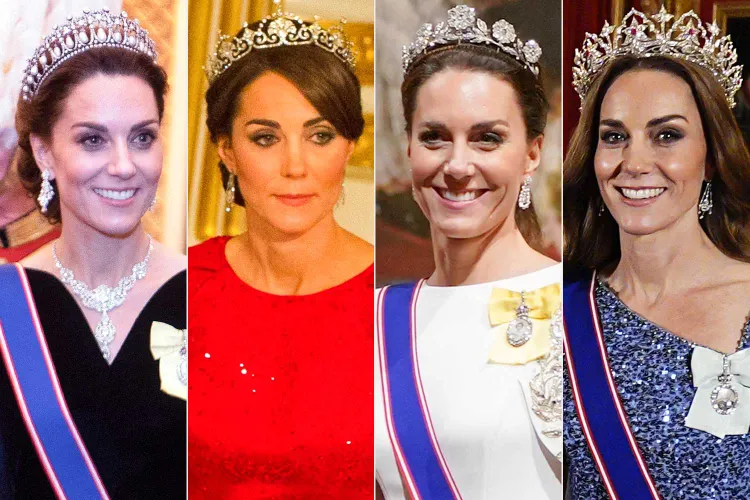
Since her wedding to Prince William in April 2011, Catherine, Princess of Wales, has become one of the most closely watched figures in royal fashion. From elegant evening gowns to carefully chosen accessories, her public appearances often attract international attention. Yet few elements of her wardrobe inspire as much fascination as the royal tiara.
These historic jewels are more than beautiful accessories. They represent generations of royal tradition, family history, and the formal customs surrounding state occasions and diplomatic receptions. For Catherine, each tiara appearance has offered a glimpse into the traditions she has gradually embraced as a senior member of the British royal family.
Unlike everyday jewelry, tiaras are generally reserved for particularly formal events, including state banquets and selected diplomatic occasions. The choice of jewel can reflect the event’s dress code, the royal collection’s history, and the symbolism associated with a particular piece.
Since becoming the Duchess of Cambridge in 2011 and later the Princess of Wales in 2022, Catherine has worn several notable tiaras. Some have strong connections to Queen Elizabeth II, while others have been associated with generations of royal women before her.
Here is a closer look at Catherine’s most memorable tiara appearances since her royal wedding, the stories behind the jewels, and why each occasion has become part of her evolving royal style.
1. The Cartier Halo Tiara at Her Royal Wedding in 2011
<text> </text>
Catherine’s first and most famous tiara appearance took place on April 29, 2011, when she married Prince William at Westminster Abbey in London.
For the historic occasion, she wore the Cartier Halo Tiara, a delicate diamond piece loaned to her by Queen Elizabeth II. The tiara featured graduated diamond scrolls arranged in an elegant halo design, complementing the lace details of her wedding dress by Sarah Burton for Alexander McQueen.
The jewel had a long royal history before Catherine wore it. Cartier created it in 1936 for the future King George VI, who purchased it for his wife, Elizabeth, later known as the Queen Mother. It subsequently passed to Queen Elizabeth II, who received it as a gift from her mother on her 18th birthday.
Catherine’s choice was widely admired for its understated elegance. Rather than overpowering her wedding dress, the tiara framed her face and helped create a timeless bridal look.
The appearance also marked the beginning of her public relationship with the royal jewelry collection. Although the wedding was a personal milestone, it was also a major ceremonial occasion, bringing royal tradition and contemporary fashion together before a global audience.
2. The Lotus Flower Tiara at a Diplomatic Reception in 2013
Catherine wore the Lotus Flower Tiara for a diplomatic reception at Buckingham Palace in December 2013, making it one of her earliest tiara appearances after her wedding.
The jewel is also known as the Papyrus Tiara because of its distinctive fan-shaped motifs, which resemble lotus flowers or papyrus leaves. Its design gives it a lighter, more architectural appearance than some of the larger diamond tiaras in the royal collection.
The piece was originally created by Garrard in the 1920s for Queen Elizabeth, the Queen Mother, when she was the Duchess of York. It was later worn by Princess Margaret, whose association with the tiara helped make it recognizable to royal jewelry enthusiasts.
Catherine’s decision to wear the Lotus Flower Tiara brought renewed attention to a piece with a strong connection to earlier generations of royal women. Its graceful shape also suited her preference for jewelry that makes a statement without overwhelming an outfit.
Diplomatic receptions are among the occasions when tiaras remain part of formal royal dress. Such events bring together members of the royal family, visiting dignitaries, and representatives of government and international organizations.
For Catherine, the appearance demonstrated how historic jewelry can be incorporated into a modern royal wardrobe while retaining its ceremonial significance.
3. The Lotus Flower Tiara Returns in 2015
Catherine wore the Lotus Flower Tiara again in October 2015 during a state banquet at Buckingham Palace held in honor of Chinese President Xi Jinping and his wife, Peng Liyuan.
The banquet formed part of a state visit, an occasion characterized by formal protocol, diplomatic hospitality, and elaborate evening dress. Catherine’s tiara was paired with an elegant evening gown, creating a polished look appropriate for the event.
Wearing the same tiara again demonstrated that royal jewelry does not need to be new to remain memorable. Repeating a historic piece can reinforce its connection to the royal collection while allowing it to complement a different outfit.
The Lotus Flower Tiara’s association with Princess Margaret gave it additional historical interest. By wearing it, Catherine helped introduce the jewel to a newer generation of royal watchers who may not have followed the royal family’s jewelry traditions in earlier decades.
The appearance also illustrated the importance of context in royal fashion. A tiara worn at a state banquet carries a different significance from one worn at a wedding or private celebration, even when the jewel itself remains unchanged.
4. The Cambridge Lover’s Knot Tiara in 2015
One of Catherine’s most recognizable tiara choices is the Cambridge Lover’s Knot Tiara, which she wore in December 2015 at the annual Diplomatic Reception at Buckingham Palace.
The tiara is distinguished by its pearl drops suspended beneath diamond arches and its repeated lover’s-knot motifs. The combination of diamonds and pearls gives it a dramatic yet traditional appearance.
The original design was created in 1914 by Garrard for Queen Mary. It was inspired by an earlier tiara owned by Mary’s grandmother, Princess Augusta of Hesse, and reflected Mary’s interest in preserving and recreating historic royal jewelry designs.
The piece later became closely associated with Diana, Princess of Wales, who wore it on numerous formal occasions. Because of that association, Catherine’s use of the tiara has attracted particular interest from royal fashion observers.
Its appearance on Catherine also demonstrates how royal jewels can carry several layers of meaning. The tiara is an object of craftsmanship and history, but it is also linked in the public imagination to different generations of women who have occupied prominent positions within the royal family.
Catherine’s styling has generally allowed the tiara’s elaborate design to remain the focal point of her jewelry, complementing rather than competing with the rest of her formal ensemble.