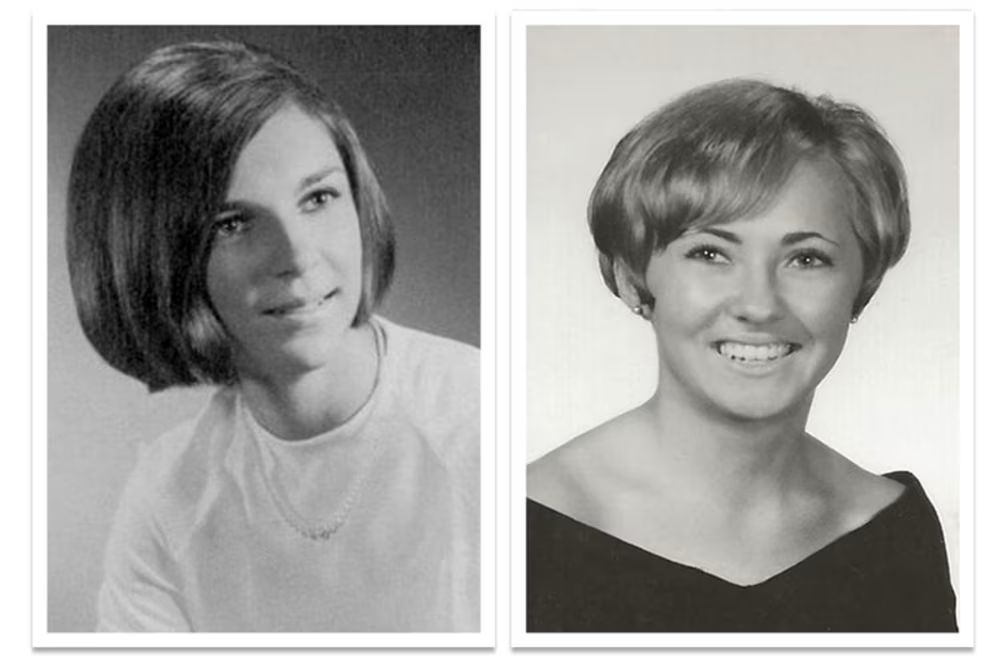
On a cold January night in 1970, two young women attending West Virginia University went into downtown Morgantown to watch a movie. Eighteen-year-old freshmen Mared Malarik and Karen Ferrell had no reason to believe that an ordinary evening with a friend would become one of West Virginia’s most haunting criminal cases.
After the screening, the women tried to find a ride back to their dormitory. They were last seen getting into a light-colored sedan. Then they disappeared.
For 88 days, their families, friends, and the university community waited for answers. The search ended on April 16, 1970, when investigators discovered their bodies in a wooded area south of Morgantown. Both women had been decapitated, and their heads were never recovered.
More than five decades later, the murders of Mared Malarik and Karen Ferrell continue to provoke questions about the investigation, the evidence, and the man who was eventually convicted of their deaths. Although Eugene Paul Clawson was found guilty at two separate trials, researchers and others who have examined the case have questioned whether the evidence truly established his guilt.
The case remains a disturbing chapter in West Virginia history, marked by an unresolved debate over responsibility, missing evidence, and whether the full truth about what happened to the two students will ever emerge.
Who Were Mared Malarik and Karen Ferrell?
Mared Malarik and Karen Ferrell were both 18-year-old freshmen at West Virginia University in Morgantown. Although they came from different backgrounds, the young women had become friends during their first year at college.
Mared came from Kinnelon, New Jersey, while Karen was from Quinwood, West Virginia. Like many students beginning university life, they were building new friendships, attending classes, and adjusting to greater independence away from home.
Their futures appeared full of possibilities. They were at an age when college offered opportunities to discover new interests, develop lasting relationships, and decide what direction their lives might take.
On January 18, 1970, the pair went downtown to see Oliver!, the musical film based on Charles Dickens’s Oliver Twist. They attended an evening screening at the Metropolitan Theatre in Morgantown.
After the movie, they needed to return to their residence hall. Public transportation between parts of the campus was limited during the evening, and hitchhiking was a common practice among students at the time.
The decision to accept a ride did not necessarily seem extraordinary in the context of the period. Yet the car they entered would become the central mystery of the investigation.
Mared and Karen were never seen alive again by anyone whose account has definitively established their subsequent movements.
Their disappearance left two families searching for answers and transformed an ordinary college town into the setting of a deeply unsettling criminal investigation.
The Night the Two Freshmen Disappeared
On the evening of January 18, Mared and Karen left the Metropolitan Theatre and began making their way back toward campus.
After walking a short distance, they attempted to hitch a ride. Witnesses reported seeing the women enter a light-colored or cream-colored sedan.
That vehicle became one of the most important unanswered questions in the case. Investigators needed to identify the driver, establish where the car traveled, and determine what happened after the women entered it.
But the available information did not immediately provide a clear answer.
When Mared and Karen failed to return to their dormitory, concern grew. Their absence was reported, and authorities began looking for them.
In the days that followed, investigators faced the challenge of reconstructing the movements of two missing people without knowing where they had gone or who might have been responsible.
The case initially received criticism from people who believed the search was not progressing quickly enough. As the weeks passed without a confirmed sighting, anxiety spread through the university community.
Students began reconsidering the risks of hitchhiking, particularly for women traveling after dark. The disappearance also raised broader concerns about transportation between the campus and downtown Morgantown.
For the families, however, the immediate concern was far more personal. They needed to know whether Mared and Karen were alive and where they could be found.
The Discovery 88 Days Later
The search took a devastating turn on April 16, 1970, when authorities discovered the remains of two young women in a wooded area south of Morgantown.
The bodies had been concealed in a makeshift grave, covered with stones, logs, branches, and other debris. The condition of the remains made the discovery particularly difficult for investigators.
The women had been decapitated, and their heads were missing. Despite subsequent efforts to locate them, the heads were never recovered.
Authorities identified the remains as those of Mared Malarik and Karen Ferrell, bringing an end to the uncertainty surrounding their disappearance but opening a new and more disturbing phase of the investigation.
The location of the grave suggested that whoever had concealed the bodies had made an effort to hide them from discovery.
Investigators examined the surrounding area for physical evidence and searched for belongings that might help reconstruct the women’s final movements. Personal items associated with the victims had been found during the preceding weeks, providing potential clues about where they had traveled.
The discovery shocked Morgantown and drew renewed attention to the case. The question was no longer simply where the two students had gone. It was who had taken them, why they had been killed, and whether the evidence could lead investigators to the person responsible.
Despite extensive efforts, the investigation did not immediately produce an answer that could resolve every question.
The Strange Letters and the Search for Clues
One unusual aspect of the case involved anonymous letters sent during the search. The letters reportedly contained information about where the bodies might be found and directed investigators toward a wooded area.
The messages added another layer of uncertainty. Investigators had to consider whether the writer was someone with genuine knowledge of the crime, someone attempting to mislead authorities, or a person who had obtained information through another means.
The search also uncovered personal belongings associated with the missing women in areas south of Morgantown. These discoveries raised questions about how the items had come to be separated from their owners and whether they had been discarded along a route traveled by the victims.
Such evidence can be important in a missing-person investigation, but its meaning depends on context. Finding an object in a particular location does not automatically establish who placed it there or why.
The case attracted numerous theories and possible suspects. Some theories focused on people who had been seen around the university or had histories of violence. Others relied on rumors that circulated through the community.
The abundance of speculation made the investigation especially difficult to interpret years later. Distinguishing verifiable evidence from stories repeated without confirmation became essential to understanding what authorities actually knew.
Although the letters and recovered belongings helped shape the search, they did not immediately settle the central question of who had killed Mared and Karen.
Eugene Paul Clawson and the Controversial Convictions
In 1976, Eugene Paul Clawson, a man with a criminal history, confessed to the murders and was convicted. His confession appeared to offer a breakthrough in a case that had remained unresolved for years.
However, Clawson later recanted his confession, claiming that he had fabricated details after reading accounts of the murders in detective magazines. His statements became a major point of contention during the legal proceedings.
Clawson’s first conviction was overturned by the West Virginia Supreme Court of Appeals in 1980 because of errors involving evidence presented at trial, including the admission of gruesome photographs of the victims. The court ordered a new trial.
In 1981, Clawson was tried again and convicted of the murders. He received a life sentence and continued to maintain his innocence.
Clawson died in prison in 2014, taking his own account of the events beyond the reach of further questioning.
His convictions are an important part of the case’s legal history. Nevertheless, they have not ended the debate among researchers who have examined the confession, the physical evidence, and the investigation’s broader circumstances.
Some researchers have argued that elements of Clawson’s statements were inconsistent with established facts or reflected information already available in published accounts. Others have questioned whether the evidence independently connected him to the killings strongly enough to resolve lingering doubts.
These concerns do not, by themselves, establish that Clawson was innocent or identify another killer. They do, however, explain why the case continues to attract attention despite the convictions.
The distinction matters: Clawson was legally convicted, but questions about the reliability of the evidence have continued to shape discussions of the murders.
Why the Malarik and Ferrell Case Still Raises Questions
Several aspects of the case remain especially troubling.
First, the heads of both victims were never found. Investigators searched for additional evidence, but the missing remains have left an important part of the physical record incomplete.
Second, the identity and movements of the driver who picked up the women remain central to reconstructing the crime. The reported light-colored sedan became an enduring clue, but the broader circumstances surrounding the ride have never been clarified to everyone’s satisfaction.
Third, the case illustrates the difficulties of relying on confessions in criminal investigations. A confession can be powerful evidence, but its reliability must be evaluated alongside physical evidence, witness accounts, and the circumstances under which it was made.
The controversy surrounding Clawson’s statements has encouraged later researchers to revisit the original investigation rather than treating the convictions as the end of every historical question.
In 2022, investigators returned to the wooded location where the bodies had been discovered more than half a century earlier. They carefully examined the site in hopes of finding evidence that might have been overlooked or remained buried.
The renewed search demonstrated that the passage of time had not eliminated interest in the case. Even decades later, investigators and researchers continued to look for information that might clarify what happened.
Yet old crime scenes present substantial challenges. Weather, vegetation, human activity, and the passage of time can alter the landscape and reduce the likelihood that evidence will survive intact.
The absence of the victims’ heads also limits what can be established from the surviving remains. Any new discovery would need to be evaluated carefully to determine whether it could meaningfully advance the investigation.
The Lasting Impact on West Virginia University
The murders had a profound effect on West Virginia University and the surrounding community.
Before the disappearance, hitchhiking was a familiar way for some students to travel between campus and downtown Morgantown. Afterward, the case intensified concerns about student safety and the risks of accepting rides from strangers.
The tragedy also exposed the vulnerability students could experience when transportation options were limited, particularly at night. Discussions about campus security, transportation services, and the protection of young women became part of the wider response.
For Mared and Karen’s families, the loss was immeasurable. The two young women had gone to a movie and expected to return to their dormitory. Instead, their lives ended in circumstances that continue to provoke difficult questions.
Their names have remained part of the university’s history, remembered not simply because of the violence they suffered but because they were young people whose futures were cut short.
The case has also been revisited through books, podcasts, and historical research, introducing new generations to the victims and the unresolved questions surrounding the investigation.
These accounts can help preserve important details, but they also carry a responsibility to distinguish established facts from speculation. The victims deserve to be remembered as people, not reduced to the most disturbing details of their deaths.
Conclusion: A Case That Continues to Demand Answers
The murders of West Virginia University freshmen Mared Malarik and Karen Ferrell remain among the most haunting criminal cases in Morgantown’s history.
On January 18, 1970, the two friends disappeared after attending a movie downtown and attempting to hitch a ride back to campus. Eighty-eight days later, their bodies were discovered in a concealed grave in the woods south of the city. Their heads were never recovered.
Eugene Paul Clawson was convicted of the murders in 1976 and again in 1981 after his first conviction was overturned. He died in prison in 2014, maintaining his innocence. Questions raised about his confession and the evidence have continued to fuel debate over whether the full circumstances of the crime are understood.
Although the legal history includes convictions, the case’s unanswered questions remain significant. The identity of anyone else who may have been involved, the fate of the victims’ missing heads, and the complete sequence of events have not been conclusively established in the public record.
More than 55 years later, the story of Mared Malarik and Karen Ferrell is a reminder of the lasting consequences of violent crime and the importance of carefully examining evidence, even after a courtroom has delivered its verdict.
For their families, their university, and those who continue to study the case, the hope remains that new information may one day bring greater clarity to what happened on that cold January night in Morgantown.