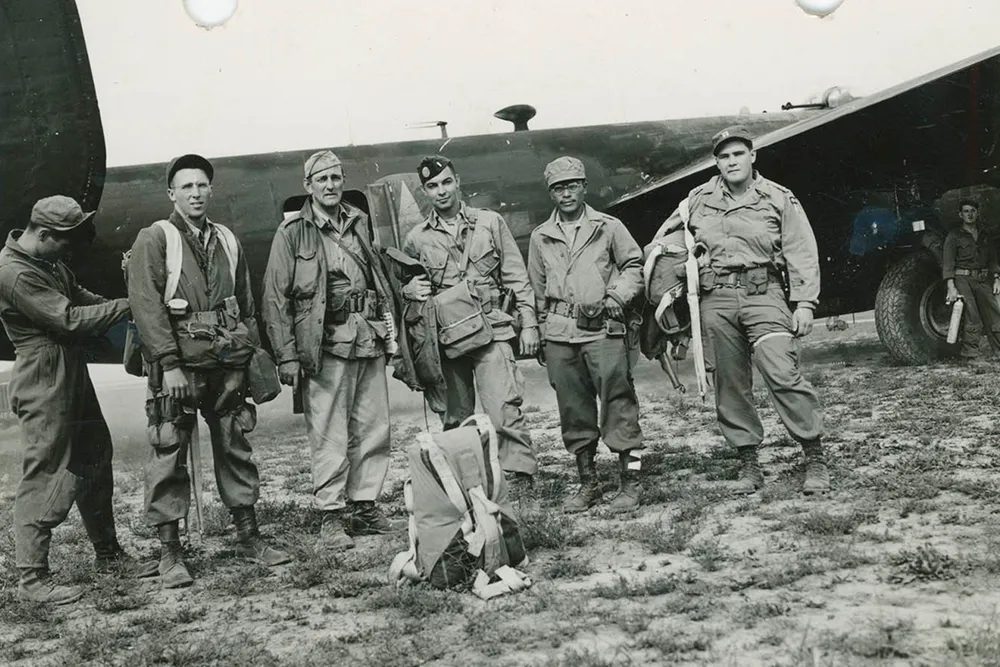
- A direct descendant of Thomas Jefferson, Francis Lowell Coolidge was an agent with the Office of Strategic Services, a predecessor to the CIA. His wartime experiences reveal the extraordinary risks faced by the Americans who operated behind enemy lines.*
During World War II, thousands of American servicemen served in dangerous missions across Europe and the Pacific. Among them were intelligence agents and special operations personnel who worked far beyond the front lines, gathering information, organizing resistance movements, and helping Allied forces undermine enemy control. One of these men was Francis Lowell Coolidge, an American commando whose wartime service connected two vastly different theaters of the conflict.
Coolidge served with the Office of Strategic Services, better known as the OSS, the wartime intelligence organization that helped lay the groundwork for the modern Central Intelligence Agency. His missions placed him in environments where secrecy, local knowledge, and personal courage could mean the difference between success and capture.
What makes his story particularly remarkable is the claim that he parachuted behind enemy lines in both the European and Pacific theaters. Such operations demanded extensive preparation and required personnel to work under conditions in which conventional military support might be unavailable. For agents like Coolidge, survival often depended on adapting quickly to unfamiliar surroundings and maintaining contact with local allies.
His family background adds another dimension to his story. Coolidge was a direct descendant of Thomas Jefferson, the third president of the United States and one of the principal figures associated with the American founding. Yet his wartime significance rested not on his ancestry but on the dangerous responsibilities he accepted during a global conflict.
An especially personal element of his story is a farewell letter he wrote to his wife before a mission. The letter offers a glimpse into the emotional reality of secret wartime service, when an agent could leave home knowing that the next assignment might prevent him from returning.
Who Was Francis Lowell Coolidge?
Francis Lowell Coolidge belonged to a generation of Americans whose lives were transformed by World War II. The conflict required people from a wide range of backgrounds to assume responsibilities that had seemed unlikely in peacetime.
For men selected for intelligence and special operations work, military service could involve much more than conventional combat. They might be expected to travel secretly, communicate with resistance groups, evaluate political conditions, and operate independently in territory controlled by enemy forces.
The OSS recruited people with varied professional and personal backgrounds. Its personnel included military officers, academics, linguists, businesspeople, journalists, and individuals with specialized technical skills. The organization valued adaptability because its missions often required agents to solve problems without the support available to conventional military units.
Coolidge’s service placed him within this demanding world. His reported parachute operations behind enemy lines in Europe and the Pacific suggest a career shaped by the extraordinary geographic and operational reach of the Allied war effort.
The two theaters presented very different challenges. In Europe, OSS personnel could work with underground resistance movements opposing German occupation. In the Pacific, operations might involve navigating remote islands, dense vegetation, unfamiliar languages, and Japanese-controlled territory.
Although the precise details of individual missions should be established through reliable historical records, Coolidge’s reported service illustrates the breadth of the responsibilities assigned to American special operations personnel during the war.
The Office of Strategic Services: America’s Wartime Intelligence Organization
The Office of Strategic Services was established in June 1942 under the leadership of William J. Donovan. Its creation reflected the growing recognition that modern warfare required coordinated intelligence gathering, covert operations, and support for resistance movements.
Before the OSS existed, American intelligence responsibilities were divided among several organizations. The expansion of the war demonstrated the need for a more centralized body capable of collecting information and conducting operations in enemy-controlled territory.
The OSS developed capabilities that included espionage, sabotage, psychological warfare, intelligence analysis, and assistance to resistance groups. Its personnel worked alongside Allied military organizations and local partners to weaken enemy operations and improve the strategic position of Allied forces.
The organization was not a conventional commando force in the narrow sense. Some OSS branches concentrated on gathering intelligence, while others supported guerrilla warfare or conducted direct-action missions. Personnel could be trained in parachuting, communications, demolition, weapons, and clandestine tradecraft depending on their assignments.
Working for the OSS required considerable discretion. Agents could not always rely on uniforms, clearly defined front lines, or the protections that conventional soldiers might expect. Capture could expose not only the individual but also local collaborators and wider intelligence networks.
The OSS was dissolved after the war in 1945, but its legacy continued. In 1947, the National Security Act established the CIA, which inherited important aspects of the American foreign intelligence mission. The OSS also influenced later special operations organizations and intelligence practices.
For Coolidge and his colleagues, the OSS provided a framework for missions that combined military objectives with clandestine activity.
Parachuting Behind Enemy Lines in Europe
Europe presented the Allies with a complex intelligence environment. German forces occupied large areas of the continent, while resistance movements operated in France, Italy, the Balkans, and other regions.
These resistance networks could provide valuable information about enemy troop movements, supply routes, military installations, and local political conditions. They could also carry out sabotage and disrupt German communications.
OSS agents and other Allied operatives sometimes entered occupied territory by parachute. Such insertions were dangerous because aircraft had to approach drop zones without attracting excessive attention, and agents needed to locate their equipment after landing.
A parachute insertion was only the beginning of the mission. Once on the ground, an operative had to avoid patrols, establish contact with trusted individuals, and follow strict security procedures. Even a small mistake could expose an entire network.
The risks extended beyond direct confrontation with German forces. Agents had to consider informants, checkpoints, shortages of food and equipment, and the possibility that communications would fail.
For personnel working with local resistance groups, cultural awareness and language skills could be as important as weapons training. Successful cooperation depended on trust, and trust was difficult to establish in an environment where a single compromised contact could lead to arrests or executions.
Coolidge’s reported service in the European theater places him within this dangerous tradition of covert Allied operations. His experiences would have unfolded in a world where information was a weapon and where a small team working quietly could sometimes achieve results disproportionate to its size.
A Different Battlefield in the Pacific
The Pacific theater presented another set of challenges for American intelligence and special operations personnel.
Unlike occupied Europe, where many agents could work with established resistance movements, the Pacific involved enormous distances, scattered islands, tropical climates, and widely differing local conditions. Japanese forces controlled extensive territories, and Allied commanders needed reliable information about enemy positions, coastal defenses, airfields, and supply networks.
Some OSS operations supported Allied campaigns through intelligence collection and cooperation with local groups. Other missions involved helping organize resistance, training local personnel, or gathering information in remote areas.
Parachuting into such environments required careful planning. Agents might land in unfamiliar terrain far from established Allied positions, with limited supplies and uncertain communications. Tropical weather, difficult landscapes, and the risk of detection could complicate every stage of an operation.
The Pacific also demanded flexibility. A mission designed for one island or region could require significant changes when weather, enemy activity, or local conditions shifted unexpectedly.
The reported fact that Coolidge served behind enemy lines in both Europe and the Pacific makes his story especially compelling. The two theaters differed in geography, culture, and military circumstances, yet both relied on personnel who could operate beyond the reach of conventional forces.
His experience reflects the global scale of Allied intelligence operations and the willingness of some servicemen to undertake assignments far removed from ordinary military duties.
The Human Cost of Secret Missions
Behind the technical details of parachuting, intelligence gathering, and covert operations lay a deeply personal reality. Agents who entered enemy territory understood that their missions could expose them to capture, interrogation, injury, or death.
Unlike conventional soldiers, intelligence operatives sometimes had to protect their identities even when dealing with friendly forces. They could not always explain their work to family members, and secrecy often continued long after a mission ended.
For spouses and relatives, this uncertainty could be difficult to bear. A letter might arrive with little explanation of where the writer was going or how long the separation would last. Communication could be limited by operational security, leaving loved ones with few ways to understand the risks.
Coolidge’s farewell letter to his wife is therefore an especially meaningful part of his story. It offers a personal counterpoint to the military history of the OSS, reminding readers that clandestine operations involved people with families, relationships, and hopes for a future beyond the war.
The letter’s emotional significance lies in that contrast. Military records tend to emphasize dates, assignments, locations, and outcomes. A personal message can reveal the uncertainty behind those details and the private courage required to leave loved ones while facing an unknown future.
Because the full text of the letter is not reproduced here, its exact wording and circumstances should not be inferred. Nevertheless, its reported existence highlights the value of personal documents in reconstructing the human experiences of wartime intelligence personnel.
A Jefferson Descendant in the Service of His Country
Coolidge’s reported descent from Thomas Jefferson adds a historical connection to his biography. Jefferson, who served as president from 1801 to 1809, was a central figure in the American Revolution and the early development of the United States.
Family ancestry can provide an interesting link between different periods of American history, but it does not explain an individual’s choices or achievements by itself. Coolidge’s wartime service should be understood through the work he undertook and the risks associated with it, rather than through his relationship to a famous ancestor.
The contrast between Jefferson’s era and Coolidge’s is nevertheless striking. Jefferson lived during a period when intelligence gathering, military correspondence, and covert activity played roles in struggles for political independence. More than a century later, World War II demanded a far more specialized intelligence apparatus capable of operating across continents.
The OSS represented part of that transformation. It brought together people and capabilities to support a modern global conflict, using communications, clandestine networks, specialized training, and cooperation with military forces.
Coolidge’s reported missions connect him to that larger history of Americans serving their country in unconventional ways.
Why Francis Lowell Coolidge’s Story Matters Today
The history of the OSS continues to attract attention because its work helped shape modern intelligence and special operations. Its personnel operated in circumstances where information could be difficult to obtain and where conventional military strength was not always sufficient.
Stories of individual agents help make this history more understandable. Rather than viewing intelligence work only through institutional records, biographies and personal letters reveal the people who accepted its risks.
Coolidge’s reported service in both the European and Pacific theaters highlights the range of missions undertaken during World War II. His farewell letter also points to the emotional consequences of those assignments, particularly for families who had to endure long separations without knowing whether their loved ones would return.
Historical accuracy remains essential when recounting such stories. Details about specific missions, dates, locations, and the contents of private correspondence should be grounded in documentary evidence. The secrecy surrounding wartime intelligence can leave gaps in the historical record, making careful interpretation especially important.
Even so, the broader significance of Coolidge’s story is clear: the Allied victory depended on more than armies advancing across battlefields. It also relied on intelligence, local cooperation, unconventional operations, and individuals willing to work under extraordinary conditions.
Conclusion: Remembering an American Wartime Operative
Francis Lowell Coolidge’s reported service as an OSS agent who parachuted behind enemy lines in both Europe and the Pacific offers a compelling perspective on America’s wartime intelligence effort.
The Office of Strategic Services operated in a world where secrecy, preparation, and cooperation were essential. Its personnel gathered information, supported resistance movements, and undertook missions that could place them far from friendly forces.
Coolidge’s reported descent from Thomas Jefferson adds a connection to America’s founding history, while his farewell letter to his wife brings attention to the personal sacrifices behind covert service.
His story also reminds us that World War II was fought on many fronts, some of them hidden from public view. Alongside the soldiers who fought in recognizable battles were operatives whose work depended on discretion and whose experiences could remain largely unknown for years.
Remembering people like Coolidge helps broaden our understanding of the conflict. Their contributions demonstrate that military history is not only a record of battles and commanders but also a collection of individual lives shaped by duty, uncertainty, courage, and sacrifice.