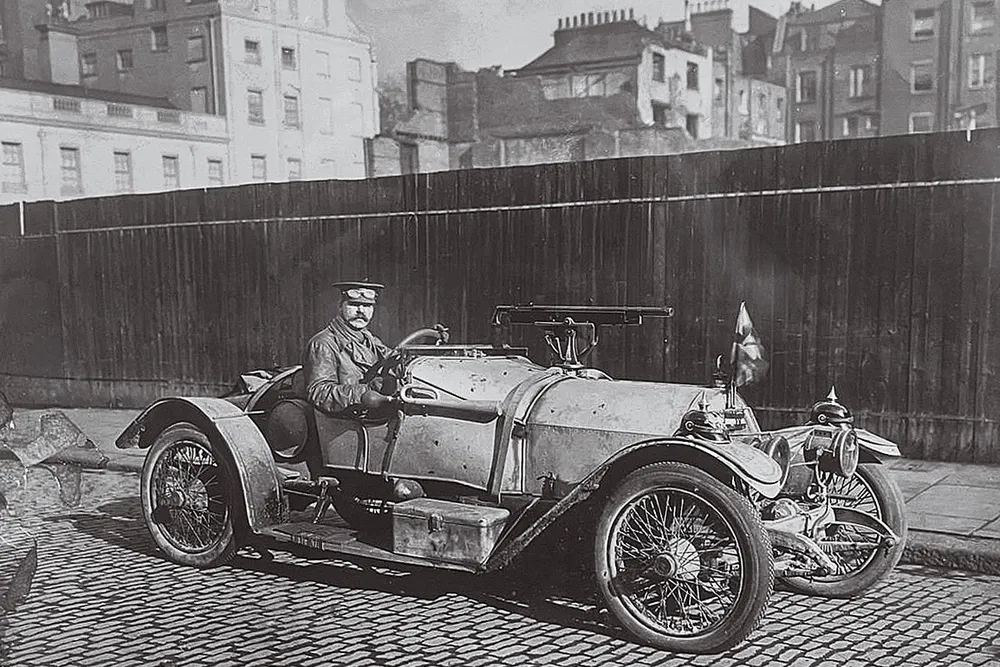
When the gentlemen drivers of Britain’s Royal Automobile Club Volunteer Force shipped their roadsters and racers to face the Germans, they became chauffeurs, couriers and inadvertent combatants.
When the First World War erupted in the summer of 1914, the automobile was still a relatively new technology. Cars were expensive, mechanically temperamental, and far from common on ordinary roads. Yet a small group of British motorists had already embraced the possibilities of motorized transportation, organizing clubs, participating in races, and experimenting with vehicles that offered speed and independence unlike anything available from traditional horse-drawn transport.
Among these early enthusiasts were members of the Royal Automobile Club Volunteer Force, a group of motorists who offered their driving skills and vehicles to support Britain and its allies. When war arrived, some of these drivers took their automobiles to the European continent, where they became chauffeurs, couriers, transport specialists, and sometimes participants in dangerous situations near the front lines.
Their experience illustrates a significant change in military history. The First World War is often remembered for trenches, artillery, machine guns, and enormous infantry offensives. But it was also a conflict in which motor vehicles began changing how armies moved people, delivered messages, transported supplies, and approached the battlefield.
The volunteers did not single-handedly mechanize warfare, but their early efforts helped demonstrate that automobiles could serve purposes far beyond private recreation. Their story reveals how a technology associated with wealthy hobbyists became an increasingly important instrument of modern warfare.
Britain’s Early Automobile Enthusiasts
At the beginning of the twentieth century, automobiles represented innovation, social status, and adventure. Reliable mass-market cars had not yet become a normal part of everyday life, and owning a motor vehicle often required considerable financial resources and mechanical knowledge.
Britain’s Royal Automobile Club, founded in 1897, brought together motorists interested in the development and promotion of motoring. Its members included wealthy enthusiasts who enjoyed touring, racing, and exploring the possibilities of the new technology.
For these drivers, motoring was more than simply traveling from one place to another. It involved understanding engines, maintaining vehicles, navigating unfamiliar roads, and dealing with mechanical problems that could leave an automobile stranded far from assistance.
Those skills would become unexpectedly valuable when the First World War began.
The Royal Automobile Club Volunteer Force emerged from the wider movement to make civilian motoring expertise available for national service. Its members offered their vehicles and driving abilities to assist military authorities at a time when the British Army was still heavily dependent on horses and conventional transport methods.
The volunteers were not necessarily trained soldiers. Many were civilians whose experience came from driving, vehicle maintenance, and participation in motoring organizations. Their practical knowledge nevertheless offered a useful resource for an army preparing to operate across unfamiliar territory under rapidly changing conditions.
Taking Cars to the Western Front
When Britain entered the First World War in August 1914, the scale and speed of the conflict quickly placed enormous pressure on transportation systems.
Military commanders needed ways to move officers, carry dispatches, transport supplies, and maintain communication between units. Railways remained essential for moving large quantities of men and equipment, while horses continued to perform much of the work close to the front.
Motor vehicles offered another possibility.
Cars could travel relatively quickly along suitable roads, carrying small groups of officers or delivering urgent messages between headquarters. Compared with horse-drawn transport, they could provide greater speed over certain distances and were less dependent on the availability of fresh animals.
However, early automobiles were not designed for the conditions that wartime service demanded. Roads could be damaged, muddy, congested, or blocked by military traffic. Engines needed maintenance, spare parts were not always available, and fuel supplies had to be organized.
A civilian driver who had previously enjoyed a fast journey through the countryside could suddenly find himself navigating unfamiliar roads while military operations unfolded nearby.
The transition was challenging, but the volunteers’ willingness to place their cars and skills at the army’s disposal helped demonstrate the practical value of motor transport.
Their contribution was particularly relevant during the opening campaigns of the war, when armies were moving rapidly and commanders urgently needed information about enemy positions, friendly units, and changing conditions.
From Gentlemen Drivers to Military Chauffeurs
One of the most important roles performed by early motor volunteers was transporting officers and other military personnel.
Commanders often needed to travel between headquarters, field positions, and communication centers. A motorcar could make such journeys faster than a horse-drawn carriage when roads and mechanical conditions permitted.
The drivers therefore became chauffeurs operating in an environment very different from civilian motoring.
They had to manage fuel consumption, monitor engine performance, and keep vehicles running despite long hours of use. A breakdown that would once have been an inconvenience during a private journey could now delay a military meeting or disrupt an important movement.
Some drivers also carried official dispatches. Before reliable electronic communication became widely available, written messages remained essential to military command. Telephones and telegraph systems were useful, but they could be vulnerable to disruption, and communication lines did not always reach the places where commanders needed information.
A driver carrying a dispatch might have to travel through traffic, avoid damaged roads, and locate the correct headquarters under difficult circumstances.
The work required more than enthusiasm for automobiles. It demanded judgment, patience, mechanical awareness, and the ability to remain focused under pressure.
These volunteers helped establish an important principle of mechanized warfare: transportation was not simply a background service. The speed and reliability with which information and personnel moved could influence military decisions.
How Automobiles Changed the Experience of War
The First World War accelerated the development of military motor transport because armies were operating on a scale that placed unprecedented demands on logistics.
Automobiles offered several advantages. They could carry officers over distances that would otherwise require horses, transport small quantities of urgent supplies, and support communication between military installations.
Their flexibility was particularly valuable when a railway station was too far from a destination or when a message needed to be delivered directly to a specific location.
Yet automobiles also had limitations. Early vehicles could struggle on rough ground, and their performance depended heavily on road conditions. They were vulnerable to mechanical failure and required a steady supply of fuel, lubricants, tires, and replacement parts.
These limitations meant that motorcars could not simply replace horses across every military task. Instead, armies gradually developed systems in which different forms of transport served different purposes.
Horses remained indispensable for pulling artillery, carrying equipment, and moving through terrain inaccessible to ordinary vehicles. Railways handled large-scale transportation, while automobiles and trucks became increasingly useful for flexible road transport.
This combination of old and new technologies was characteristic of the First World War. Mechanization did not arrive all at once. It developed through experimentation, adaptation, and the practical lessons learned under wartime pressure.
The experiences of civilian motoring volunteers formed a small but revealing part of that larger transformation.
From Roadsters to Armored Vehicles
The use of automobiles in the First World War extended beyond transporting officers and carrying messages. Military authorities also began exploring how motor vehicles could be adapted for combat.
Armored cars were among the most visible examples. These vehicles combined automobile or truck chassis with protective armor and mounted weapons, offering a mobile platform for reconnaissance, patrols, and other operations.
Their effectiveness depended on circumstances. Armored cars could perform useful work on suitable roads and relatively firm terrain, but they were much less practical in the mud and shell-damaged ground that characterized many sectors of the Western Front.
Nevertheless, their development reflected a growing recognition that motor vehicles could do more than support existing military structures. They could become part of the fighting force itself.
The war also encouraged experimentation with heavier vehicles. The development of tanks, which first appeared in combat in 1916, represented a much more ambitious attempt to overcome the defensive power of machine guns, trenches, and barbed wire.
Tanks were not simply automobiles with armor attached. They required different engineering solutions, tracked running gear, and the ability to cross obstacles that ordinary cars could not manage.
Still, the broader movement toward mechanized warfare shared a common motivation: military planners were searching for ways to move people and weapons across difficult terrain while reducing vulnerability to enemy fire.
The early automobile volunteers were not directly responsible for every later innovation, but their service belonged to the same historical shift toward motorized military operations.
The Risks of Serving Near the Battlefield
For civilian motorists who volunteered during the war, the transition from recreational driving to military service could be dangerous.
A vehicle traveling near an active front might encounter shellfire, enemy aircraft, damaged infrastructure, or sudden changes in military movements. Even away from direct combat, drivers faced the hazards of poor roads, mechanical breakdowns, fatigue, and congestion.
A car was also a conspicuous object. Unlike a person traveling on foot, a vehicle could be seen and heard from a distance, making its movements easier to notice.
The drivers were not necessarily trained for combat, yet their work could place them in situations where the distinction between transportation duty and exposure to danger became blurred.
This is one reason the description of the volunteers as “inadvertent combatants” captures an important aspect of their experience. Their original purpose was often practical support rather than direct fighting, but wartime conditions could bring them close to military action.
Their story also demonstrates how civilian expertise can become important during emergencies. Skills developed for leisure or commercial activity may acquire new significance when a country mobilizes its resources for war.
The Lasting Legacy of the Motor Volunteers
The First World War transformed military transportation. By the end of the conflict, motor vehicles had become more firmly established in military planning, and the development of trucks, ambulances, staff cars, armored vehicles, and other specialized machines had advanced considerably.
The process continued after 1918. Improvements in engine reliability, vehicle production, road networks, and fuel logistics made motor transport increasingly practical for armed forces around the world.
Later conflicts would demonstrate the enormous importance of mobility. Military operations depended not only on weapons but also on the ability to move troops, equipment, ammunition, food, and medical supplies over long distances.
The mechanization of war was not the achievement of one organization or a small group of enthusiasts. It resulted from industrial development, military innovation, engineering, and the experiences of millions of people working in different roles.
Nevertheless, the Royal Automobile Club Volunteer Force offers a useful example of how an emerging civilian technology entered military service. The volunteers helped show that automobiles could perform valuable work under wartime conditions, even when the vehicles themselves were still relatively primitive.
Their contribution was part of a broader transition in which the automobile moved from the margins of everyday life toward a central position in modern transportation and warfare.
Conclusion: When Motoring Enthusiasm Met Modern Warfare
The British motorists who offered their vehicles and driving skills during the First World War occupied an unusual place in military history. They began as enthusiasts of a technology associated with speed, adventure, and personal freedom, but wartime demands turned their cars into tools of military transportation.
As chauffeurs and couriers, they helped move officers and messages when speed and reliable communication mattered. Their experiences also exposed the strengths and weaknesses of early automobiles operating under difficult conditions.
The wider conflict accelerated the development of military vehicles, from staff cars and trucks to armored cars and tanks. These innovations emerged through many different efforts, but together they helped reshape the relationship between transportation and combat.
The Royal Automobile Club volunteers did not create mechanized warfare on their own. Their story is significant because it shows how a relatively small group of civilian pioneers became part of a much larger technological transformation.
When their roadsters and racing cars arrived in wartime Europe, the automobile was still a young invention. By the end of the war, motor transport had demonstrated that it could play an important role in military operations—and that the future of warfare would increasingly depend on machines as well as manpower.