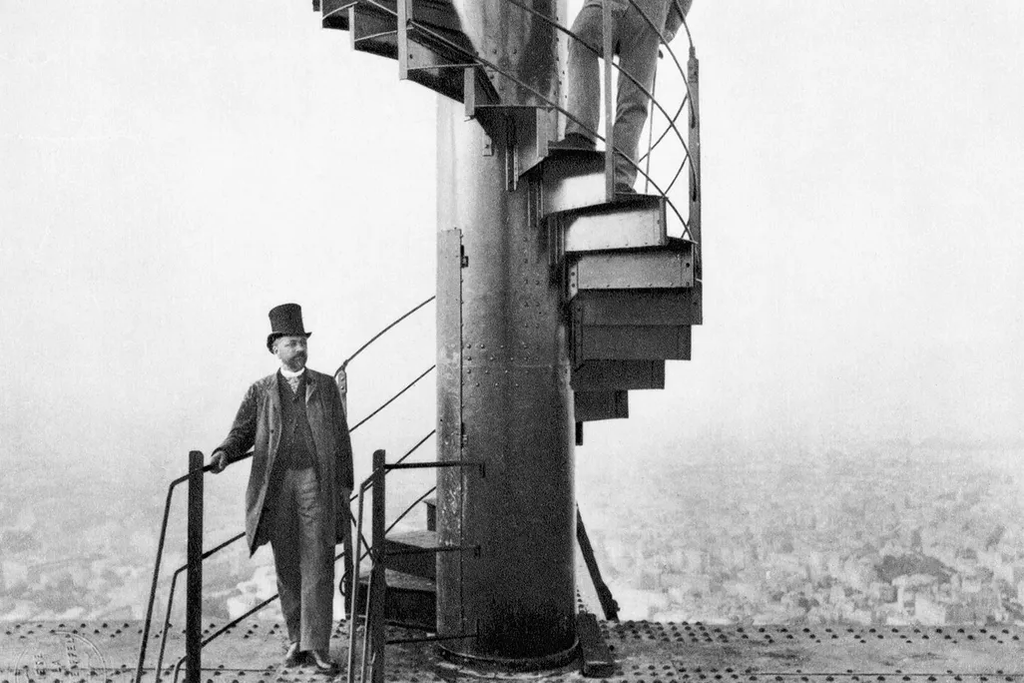
The Eiffel Tower is one of the most recognizable landmarks in the world, attracting millions of visitors to Paris every year. Today, its elevators and carefully maintained stairways make it possible for people to explore the famous iron structure and enjoy sweeping views of the French capital. But the tower once offered a very different experience for visitors climbing toward its highest level: a dizzying spiral staircase with a single guardrail that wound through the iron framework.
Installed in 1889, the original staircase connecting the Eiffel Tower’s second and third levels consisted of 1,062 steps. It was an extraordinary feat of engineering, designed to help visitors reach the summit of a structure that was then one of the most ambitious architectural projects in the world.
Much of that original staircase was eventually dismantled as the tower evolved to accommodate changing visitor needs and modern safety standards. Today, however, pieces of the historic structure survive in museums and private collections. In a remarkable opportunity for collectors and history enthusiasts, 14 original steps from the Eiffel Tower’s famous staircase have been offered for sale.
The possibility of owning a fragment of the monument connects modern collectors with a defining moment in engineering history. Each step represents a small part of the structure that helped introduce the world to a new age of iron construction, industrial ambition, and architectural innovation.
The Eiffel Tower’s Original Spiral Staircase
When the Eiffel Tower opened in 1889, its design represented a dramatic departure from the traditional stone monuments and buildings that dominated European architecture.
Created by engineer Gustave Eiffel’s company for the 1889 Exposition Universelle in Paris, the tower was intended to demonstrate the possibilities of modern iron construction. At approximately 300 meters tall when completed, it became the tallest human-made structure in the world at the time.
The original staircase was an important part of that achievement. Its 1,062 steps connected the second level to the summit, giving visitors a way to climb through the tower’s open iron framework.
Unlike a conventional staircase inside a building, the structure followed the tower’s geometry. Its spiral form created a winding route upward, with the surrounding iron beams offering changing views of Paris as climbers ascended.
The staircase was also a remarkable example of practical engineering. Every section had to fit within the tower’s structure while accommodating the movement of visitors. The design combined functionality with the visual drama of a climb through one of the world’s most ambitious iron constructions.
For those who made the journey, reaching the top required considerable physical effort. The climb was not simply a way to reach a viewing platform; it was part of the experience of encountering the Eiffel Tower itself.
Why the Original Staircase Was So Extraordinary
The Eiffel Tower’s staircase reflected the engineering priorities of the late 19th century. Builders were exploring how iron could be used to create structures that were taller, lighter, and more open than many traditional masonry buildings.
The tower’s framework distributed structural loads through an interconnected system of iron members. Its staircase had to work within that framework, following the tower’s shape while remaining secure enough for public use.
A spiral staircase can be an efficient way to move people vertically in a limited space, but it also presents challenges. The winding route can make it difficult to see far ahead, and the visual openness of the Eiffel Tower meant that climbers could see through portions of the structure to the city below.
The presence of a single guardrail, as described in accounts of the original staircase, would have made the climb feel especially exposed compared with modern visitor facilities.
For some visitors, the experience must have been thrilling. For others, the combination of height, narrow steps, and open views could have been intimidating.
Yet the staircase offered something that elevators could not fully replicate: a gradual physical journey through the tower’s iron skeleton. Climbers could experience the scale of the structure step by step, seeing how its components fitted together and how the view changed with every turn.
That experience helped make the tower more than an engineering demonstration. It became an attraction in which the structure itself formed part of the adventure.
The Eiffel Tower and the 1889 World’s Fair
The staircase was installed as part of the Eiffel Tower project for the 1889 Exposition Universelle, a major international exhibition held in Paris to mark the centenary of the French Revolution.
World’s fairs were important showcases for technological progress, industrial production, architecture, and national achievement. Countries and companies used these events to present innovations that demonstrated their economic and engineering capabilities.
The Eiffel Tower became one of the exhibition’s defining attractions. Its immense height and exposed iron framework offered a striking contrast to the buildings and monuments that visitors were accustomed to seeing.
The tower also generated debate. Some artists and writers objected to its appearance, arguing that the iron structure clashed with Paris’s traditional architectural character. Others celebrated it as a symbol of modernity and technical achievement.
The staircase helped visitors engage directly with that achievement. Rather than viewing the tower only from the ground, people could climb into its framework and experience its scale from within.
The tower’s success ultimately helped establish it as a permanent feature of the Paris skyline. Although it was initially conceived in connection with the exhibition and its future was once uncertain, it later became an internationally recognized symbol of France.
The original staircase is part of that history, linking the monument’s earliest years with the generations of visitors who came to experience it.
Why Was the Original Staircase Dismantled?
The Eiffel Tower has changed considerably since its opening. Although its fundamental iron structure remains, visitor facilities and access arrangements have evolved to meet modern requirements.
The original staircase connecting the second and third levels was dismantled in 1983. By that time, the tower had been welcoming visitors for nearly a century, and its operations had developed around the need to accommodate large numbers of people safely and efficiently.
Elevators offer a faster and more accessible way to reach the upper levels than a long spiral staircase. Modern tourism also requires facilities that can manage crowds, maintain safe movement, and support the needs of visitors with different physical abilities.
Removing the original staircase made room for changes to the tower’s access system and visitor experience. The dismantling also created an unusual situation: a major historic structure was separated into sections, some of which could be preserved rather than discarded.
The staircase was divided into multiple pieces. Fragments subsequently entered museums and private collections, allowing portions of the original structure to survive outside the tower itself.
Although visitors can no longer climb the complete original staircase between the second and third levels, surviving sections preserve physical evidence of the engineering methods used in the tower’s early years.
Fourteen Original Steps Offer a Piece of History
The offer of 14 original steps from the Eiffel Tower’s staircase presents an unusual opportunity for collectors interested in architecture and historic engineering.
Unlike a souvenir manufactured to resemble the tower, an original staircase fragment is a physical part of the monument itself. Its historical significance comes from its connection to the structure built for the 1889 World’s Fair and used by visitors during the tower’s early decades.
For collectors, such an object can combine several forms of appeal. It has a direct association with a famous landmark, represents a recognizable moment in engineering history, and offers a tangible connection to a structure that millions of people have visited.
The value of a historic architectural fragment depends on several factors, including its documented origin, condition, rarity, and the circumstances of its sale. An auction estimate is not the same as a final sale price, and prices can vary depending on buyer interest.
Provenance is especially important for objects of this kind. Documentation establishing that a fragment genuinely came from the Eiffel Tower helps distinguish an authentic historical artifact from a reproduction or an object with an uncertain history.
The staircase’s dismantling in 1983 provides the broader historical context for the survival of such pieces. Once removed from the tower, sections could be preserved, displayed, or sold as individual objects.
For a buyer, owning one of the original steps would mean possessing a fragment of a structure whose influence extends far beyond Paris.
Where Can You See Fragments of the Original Staircase?
Not every surviving section of the Eiffel Tower’s original staircase remains in private hands. Pieces have been preserved in museums and other collections, allowing the public to encounter parts of the structure without climbing the original route.
These fragments are important because they help translate a large engineering project into something visitors can examine at close range. The tower itself can be difficult to understand fully from the ground, where its immense height dominates the view. A preserved staircase section reveals more about the individual components and the practical details of its construction.
Museum displays can also place the fragments within the wider history of the Eiffel Tower, explaining the 1889 exhibition, the development of iron engineering, and the changes that occurred as the monument became a major tourist destination.
The preservation of original pieces demonstrates that historic infrastructure can have value beyond its original function. A staircase that once helped visitors climb the tower can later become an artifact documenting the history of architecture and engineering.
For visitors interested in the tower’s story, these fragments provide another way to understand how the monument evolved and why its early design remains significant.
What the Staircase Reveals About Engineering History
The Eiffel Tower’s original staircase is a reminder that engineering is not only about creating a structure that stands. It is also about designing systems that allow people to interact with that structure.
In 1889, the tower demonstrated how iron could be used to achieve an extraordinary height. Its staircase translated that achievement into a route that visitors could physically experience.
The climb also exposed the practical challenges of public access. A staircase suitable for a pioneering monument in the late 19th century may not meet the expectations of a modern tourist attraction serving millions of people.
Changes to the tower reflect broader developments in public safety, accessibility, transportation, and visitor management. Elevators and updated facilities make it possible for more people to experience the monument, while the preservation of staircase fragments ensures that earlier engineering solutions are not entirely lost.
The story therefore illustrates a balance between preservation and adaptation. Historic structures must evolve to remain useful, but the physical evidence of their earlier forms can still be protected and studied.
The surviving steps are valuable not because they can replace the complete staircase, but because they help preserve the story of how the Eiffel Tower was built and experienced.
Conclusion: A Historic Piece of the Eiffel Tower Could Become a Collector’s Treasure
The original spiral staircase of the Eiffel Tower was an extraordinary feature of the monument when it opened in 1889. Its 1,062 steps connected the second and third levels, offering visitors a challenging climb through the iron framework toward the summit.
Dismantled in 1983, the staircase no longer serves as a complete route through the tower. Yet fragments have survived in museums and private collections, preserving a tangible connection to the monument’s earliest history.
The offer of 14 original steps provides a rare opportunity to own part of that story. For collectors and engineering enthusiasts, the pieces represent more than unusual decorative objects. They are remnants of a structure that changed perceptions of what modern engineering could accomplish.
The Eiffel Tower continues to evolve, welcoming visitors through modern access systems while retaining the iron framework that made it famous. Its original staircase belongs to an earlier chapter, when climbing the monument was a more physical and exposed experience.
Nearly 137 years after the staircase was installed, its surviving fragments continue to connect the present with the ambition of 19th-century engineers. Each preserved step offers a small but tangible reminder of the extraordinary effort required to build one of the world’s most recognizable landmarks.