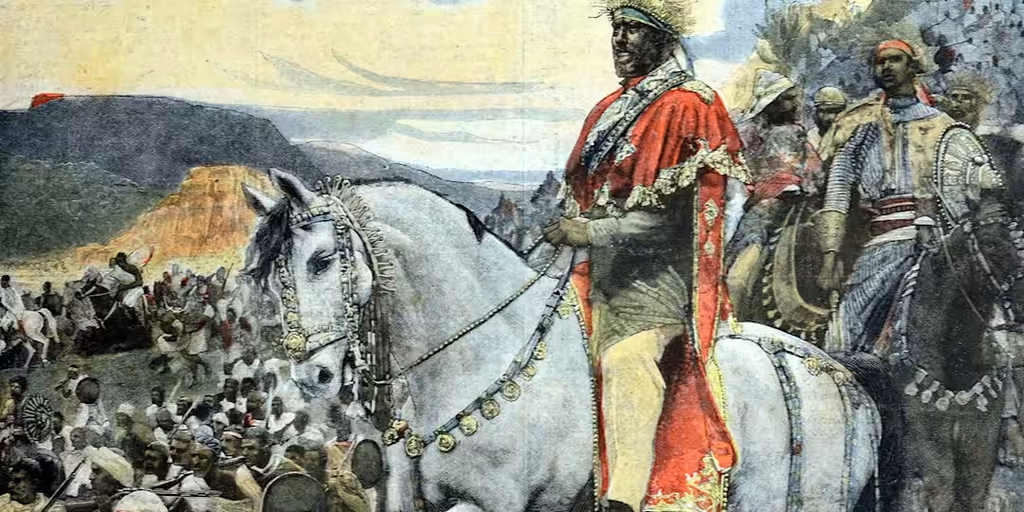
In March 1896, an African army achieved a victory that would challenge European assumptions about colonial conquest and change the course of Ethiopian history. At the Battle of Adwa, Ethiopian forces defeated an invading Italian army, preventing Italy from establishing colonial control over the independent African kingdom. The victory preserved Ethiopia’s sovereignty and became one of the most celebrated examples of African resistance to European imperialism.
The battle took place during the Scramble for Africa, a period when European powers rapidly claimed territories across the continent. Italy, seeking to expand its colonial possessions and strengthen its international standing, had attempted to bring Ethiopia under its influence. But Emperor Menelik II and Empress Taytu Betul helped unite political leaders, mobilize a large army, and prepare their country to resist the invasion.
On March 1, 1896, Ethiopian forces confronted Italian troops near Adwa, in the mountainous highlands of northern Ethiopia. The Italians suffered a decisive defeat, losing thousands of soldiers and abandoning their immediate ambition to conquer the country.
The victory at Adwa was more than a military triumph. It demonstrated that African states could organize effective resistance, exploit an invading army’s weaknesses, and defend their independence during an era of aggressive European expansion. Its legacy continues to influence Ethiopian national identity and broader discussions about colonialism, sovereignty, and African history.
The Scramble for Africa and Italy’s Ambitions
During the late 19th century, European powers competed to control African territory, seeking access to resources, trade routes, strategic locations, and political influence. This expansion, commonly known as the Scramble for Africa, accelerated after the Berlin Conference of 1884–1885, which established rules among European powers for asserting colonial claims.
By the 1890s, much of Africa had been divided into European-controlled territories or spheres of influence. Ethiopia, however, remained an independent state with its own political institutions, military traditions, and established ruling dynasty.
Italy had entered the colonial competition relatively late. It had established a foothold along the Red Sea coast, including territory that became the colony of Eritrea. Italian leaders hoped to expand inland and extend their influence over Ethiopia.
Their ambitions were supported by a treaty signed at Wuchale in 1889 between Italy and Menelik, then king of Shewa, who later became emperor. The treaty contained different wording in its Italian and Amharic versions concerning Ethiopia’s relationship with Italy.
The Italian version was interpreted as making Ethiopia an Italian protectorate, while the Amharic version did not impose the same obligation. Menelik rejected Italy’s attempt to treat the treaty as establishing a protectorate over his country.
The disagreement developed into a major diplomatic crisis. In 1893, Menelik repudiated the treaty, and relations between the two governments deteriorated.
For Italy, Ethiopia represented an opportunity to expand its colonial empire. For Menelik and his supporters, the dispute threatened the country’s independence and political future.
The stage was set for a confrontation that would test Italy’s imperial ambitions against Ethiopia’s determination to remain sovereign.
Emperor Menelik II and Empress Taytu Betul Prepare for War
Emperor Menelik II became one of the central figures in Ethiopia’s resistance to Italian expansion. He understood that defending the country required more than bravery on the battlefield. Ethiopia needed political unity, weapons, supplies, and an effective strategy for confronting a modern European army.
Menelik worked to strengthen his authority while building relationships with regional rulers. Ethiopia was not a centralized nation-state in the same way as many modern countries, and its different regions were governed by powerful leaders with their own interests. Bringing these forces together was essential to mounting a large-scale military response.
Empress Taytu Betul also played an important political role. She was a prominent adviser who supported resistance to Italian demands and opposed concessions that threatened Ethiopian sovereignty. Her influence helped shape the political atmosphere surrounding the conflict.
Menelik’s government acquired modern firearms through international trade, although weapons and ammunition were not distributed evenly among Ethiopian forces. These purchases strengthened the army’s ability to confront Italian troops, who possessed rifles, artillery, and other equipment associated with contemporary European warfare.
Ethiopia’s military advantage did not come from weapons alone. Menelik could call upon a substantial force of regional armies, including cavalry and infantry familiar with the difficult terrain of the highlands.
Mobilizing these forces required considerable logistical effort. Soldiers needed food, ammunition, transportation, and coordination over long distances. Local leaders had to maintain their own contingents while cooperating with the emperor’s wider campaign.
The preparation helped create an army large enough to challenge the invading Italians. It also reflected a broader political achievement: Ethiopia’s leaders recognized that the threat of colonization required cooperation across regional and personal rivalries.
The Road to the Battle of Adwa
Italian forces advanced into northern Ethiopia as the conflict escalated. Their military campaign relied on the expectation that European weapons, training, and organization would provide a decisive advantage over Ethiopian forces.
However, the Italian position was more complicated than it appeared. The army operated far from its principal bases, depended on supply lines running through difficult terrain, and faced challenges in securing reliable intelligence about Ethiopian movements.
The Italian expedition also included Eritrean troops serving under Italian command. These soldiers were part of the colonial military system that Italy had developed in the region.
Meanwhile, Menelik’s army assembled in the northern highlands. Ethiopian commanders could draw on knowledge of the local landscape, while the terrain itself complicated Italian efforts to coordinate their movements.
The confrontation came near Adwa, a town surrounded by rugged hills and mountain ridges. The area offered defensive opportunities but also demanded careful coordination from any army attempting to maneuver through it.
By the end of February 1896, the two sides were approaching a decisive encounter. The Italians were operating under difficult logistical conditions, while the Ethiopians had gathered a formidable force.
The battle that followed would reveal how mistakes in planning and communication could undermine the advantages of a modern army.
March 1, 1896: Ethiopia Wins the Battle of Adwa
The Battle of Adwa began in the early hours of March 1, 1896, when Italian forces advanced toward Ethiopian positions. Italian commanders had divided their troops into separate formations, intending to move through the mountainous terrain and engage the opposing army.
The plan depended on accurate navigation, coordination, and reliable information about Ethiopian positions. In the darkness and unfamiliar landscape, however, the Italian formations struggled to maintain the intended arrangement.
Ethiopian forces were prepared to confront the advance. Their numbers were substantial, and their commanders could concentrate troops against Italian units that became separated or exposed.
As the fighting intensified, Italian formations found themselves facing powerful attacks from Ethiopian infantry and cavalry. The mountainous terrain made communication difficult, while the fragmented deployment weakened the Italians’ ability to support one another effectively.
Ethiopian troops pressed their advantage, using their numerical strength and knowledge of the terrain to overwhelm Italian positions. The engagement developed into a major defeat for the invading army.
The exact number of soldiers involved and the casualties reported in historical accounts vary, but the scale of the Italian loss was unmistakable. Thousands of Italian and Eritrean troops serving with Italy were killed, wounded, or captured. Ethiopian casualties were also severe, reflecting the intensity of the fighting.
The defeat shocked Italian political and military leaders. Rather than securing control over Ethiopia, the expedition had suffered a disaster that made immediate conquest far more difficult.
For Menelik, Taytu, and the Ethiopian commanders, the victory confirmed that the country could resist a major European invasion.
Why the Italian Army Lost
The outcome at Adwa cannot be explained by a single factor. Instead, several military and political circumstances combined to produce Italy’s defeat.
Ethiopian mobilization and numerical strength
Menelik succeeded in assembling a large army drawn from different regions. Although estimates vary, Ethiopian forces substantially outnumbered the Italian expedition.
This allowed Ethiopian commanders to bring pressure against multiple Italian formations and exploit weaknesses in the invaders’ deployment.
Italian planning and coordination problems
The Italian advance depended on separate formations moving through unfamiliar, rugged terrain. Difficult navigation and communication problems contributed to the breakdown of the plan.
When units became separated, Italian commanders struggled to concentrate their forces effectively against the Ethiopian army.
Logistics and supply difficulties
Operating far from established bases created serious challenges for the Italian expedition. Supplies had to travel over difficult routes, and maintaining a large force in the region required extensive planning.
The Ethiopians also faced logistical difficulties, but their ability to mobilize local resources and operate within familiar territory helped support the campaign.
Ethiopian leadership and preparation
Menelik’s political work helped bring regional forces together, while Ethiopian commanders took advantage of the opportunities created by the Italian advance.
The victory reflected organization, preparation, and tactical decisions rather than simply a numerical advantage.
Together, these factors transformed what Italy expected to be a colonial victory into one of the most significant defeats suffered by a European army during the Scramble for Africa.
The Treaty of Addis Ababa and Ethiopia’s Independence
The defeat at Adwa forced Italy to reconsider its policy toward Ethiopia. In October 1896, the two countries signed the Treaty of Addis Ababa, which formally ended the war.
The treaty annulled the Treaty of Wuchale and recognized Ethiopia’s independence. Italy abandoned its immediate attempt to establish a protectorate over the country, while its colonial possession of Eritrea remained under Italian control.
The agreement was a major diplomatic achievement for Menelik’s government. Ethiopia had not merely survived the invasion; it had compelled a European power to negotiate on terms that recognized its sovereignty.
The victory strengthened Menelik’s position within Ethiopia and increased his standing internationally. It also demonstrated that the colonial expansion of European states was not inevitable and that African rulers could successfully defend their political independence.
However, Ethiopia’s victory did not end European colonialism elsewhere on the continent. Most African territories remained subject to foreign domination, and Italy continued to maintain its colony in neighboring Eritrea.
The Battle of Adwa nevertheless became an enduring symbol of resistance to imperial rule.
Why the Battle of Adwa Still Matters Today
Adwa occupies a central place in Ethiopian national memory. The victory is commemorated annually on March 2, the day after the battle, as a national holiday known as Adwa Victory Day.
The commemoration honors the soldiers and leaders who defended the country’s independence. It also celebrates the political cooperation that enabled Ethiopian forces to confront an invading army during a period of intense European expansion.
Beyond Ethiopia, Adwa became an important reference point for people challenging colonial domination and racial hierarchies. Its significance extended across Africa and into the wider African diaspora, where the victory demonstrated that a European imperial army could be defeated by an African state.
The battle also complicates simplistic accounts of 19th-century warfare. Ethiopia’s victory was not the result of a European power intervening on its behalf. It emerged from Ethiopian political leadership, military mobilization, strategic preparation, and the determination of its forces.
At the same time, the historical significance of Adwa should not obscure the complexity of Ethiopia’s own history. The Ethiopian state was itself expanding and consolidating authority over different regions during this period. Its victory against Italy occurred within a broader political landscape shaped by competing interests, regional rivalries, and state-building.
Understanding these complexities makes the achievement at Adwa more meaningful, not less. It places the battle within the realities of African political history rather than reducing it to a simple contest between two uniform sides.
Conclusion: The Victory That Preserved Ethiopia’s Sovereignty
The Battle of Adwa was a turning point in the history of Ethiopia and one of the most consequential military victories achieved by an African state during the Scramble for Africa.
By uniting regional forces, acquiring modern weapons, preparing for invasion, and exploiting the difficulties faced by Italian troops, Emperor Menelik II, Empress Taytu Betul, and Ethiopian commanders helped defeat a powerful colonial expedition on March 1, 1896.
The victory forced Italy to negotiate the Treaty of Addis Ababa later that year, formally recognizing Ethiopia’s independence and ending its immediate effort to establish colonial control over the country.
Adwa did not bring an end to European imperialism across Africa, but it challenged the belief that colonial conquest was unavoidable. It showed that African states could defend their sovereignty through effective leadership, military organization, and political cooperation.
More than a century later, the battle remains a source of pride in Ethiopia and an enduring symbol of resistance to colonial domination. Its legacy lies not only in the defeat of an invading army, but also in the preservation of an independent African state during one of the most aggressive periods of European expansion.