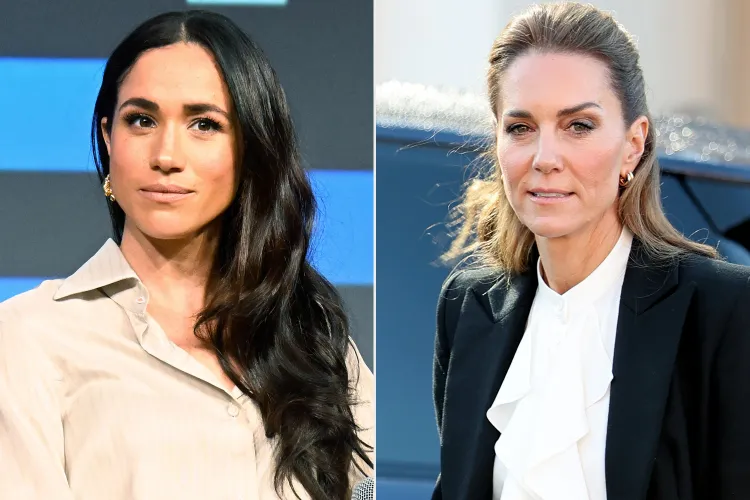
Meghan Markle reportedly told a designer friend, “You’ve embarrassed me,” after an incident involving Kate Middleton’s stylist, according to claims described in a book about the British royal family. The alleged exchange has attracted attention because it offers another glimpse into the complicated relationships, professional connections, and competing public narratives surrounding the Princess of Wales and the Duchess of Sussex.
Meghan and Kate have frequently found themselves at the center of public discussion, particularly since Prince Harry and Meghan stepped back from their senior royal roles in 2020. Although both women have pursued their own public projects, their clothing choices, working relationships, and appearances have continued to attract scrutiny from royal commentators and fashion observers.
The reported disagreement also highlights how closely fashion and royal life can intersect. Stylists, designers, and fashion houses often work behind the scenes to prepare public figures for high-profile appearances. A misunderstanding involving one person’s professional relationships can therefore become a much larger story when the people involved are members of the British royal family.
However, the alleged remark should be understood in its proper context. The account comes from a book’s reported claims, rather than a publicly established finding about what happened. Without independently verified details about the exchange, it is important to distinguish the reported account from confirmed facts.
What the Book Claims About Meghan Markle’s Reaction
According to the account described in the book, Meghan Markle was upset with a designer friend following a mistake connected to Kate Middleton’s stylist. The phrase attributed to Meghan—“You’ve embarrassed me”—suggests that she believed the situation had placed her in an uncomfortable position.
The precise circumstances surrounding the alleged exchange are essential to understanding the story. In fashion, professional relationships can involve introductions, wardrobe arrangements, private communications, and expectations about who will work with a particular designer. A misunderstanding in any of these areas can create tension, especially when several high-profile clients are involved.
Yet the reported quotation alone does not establish exactly what the designer did, what Meghan expected, or how Kate’s stylist became involved. Those details should not be filled in through speculation.
The distinction matters because stories about the royal family can quickly become simplified into competing narratives about personal rivalries. An isolated disagreement, even if accurately reported, does not necessarily demonstrate a broader feud or reveal the full nature of the relationships between the people involved.
For readers, the most useful approach is to examine the claim as one account of a reported interaction, rather than treating it as definitive evidence of Meghan’s personality or her relationship with Kate.
Why Kate Middleton’s Stylist Matters
Kate Middleton, now known as Catherine, Princess of Wales, has developed a recognizable public style that combines traditional tailoring, British fashion labels, established designers, and carefully selected accessories.
Her wardrobe is often examined for its color choices, silhouettes, and connections to British fashion. Public appearances can generate considerable interest in the designers she wears, while individual pieces may receive renewed attention after photographs are published.
A stylist can play an important role in shaping such a public image. The work may involve selecting clothing for an event, coordinating accessories, communicating with fashion houses, arranging fittings, and ensuring that an outfit suits the occasion.
For a member of the royal family, these decisions can carry additional significance. Clothing may be interpreted as a reflection of personal taste, professional presentation, cultural identity, or support for a particular designer.
Kate’s long-standing public image has consequently made the people who help coordinate her wardrobe subjects of interest in their own right. Their professional connections can attract attention, particularly when those connections overlap with the wider royal circle.
However, a stylist’s involvement in a reported fashion-related disagreement does not automatically indicate a conflict between the people they dress. Fashion professionals often work within broad networks, and their clients may have different relationships with the same designers or brands.
Without further verified information, the reported incident should not be taken as proof that Kate or her stylist intended to embarrass Meghan.
Meghan Markle’s Relationship With the Fashion Industry
Meghan Markle has maintained a strong connection with fashion throughout her public life. Before marrying Prince Harry, she worked as an actress and developed a personal style that often combined contemporary labels with accessible wardrobe staples.
Her marriage into the royal family brought a different level of attention to her clothing. Outfits worn during official engagements were frequently discussed in newspapers, fashion magazines, and online publications.
Some of her choices attracted particular interest because of their designers, colors, or connection to the places she visited. The so-called “Meghan effect”—the increased attention certain products receive after being worn by the duchess—became part of broader conversations about celebrity influence and fashion consumption.
Royal dressing, however, comes with expectations that differ from those faced by many other public figures. Members of the royal family are often expected to consider the formality of an event, the setting, and the wider message conveyed by their appearance.
Meghan’s transition from actress to duchess placed her under intense scrutiny, with individual clothing choices sometimes becoming subjects of extensive commentary.
Her later life outside the working royal structure has given her more freedom to shape her public image, but interest in her wardrobe and professional relationships has continued.
Against this background, a reported disagreement involving a designer friend could attract attention even if the original incident was relatively limited. The public’s familiarity with Meghan’s fashion profile helps explain the interest, but it does not establish the accuracy or significance of the specific claim.
Meghan Markle and Kate Middleton: A Relationship Under Public Scrutiny
The relationship between Meghan and Kate has been the subject of widespread media attention for years. Both women married into the British royal family, but their roles, public responsibilities, and personal circumstances have differed.
Kate became a senior working royal after marrying Prince William in 2011. Over time, she developed a public role centered on charitable initiatives, early childhood development, mental health, and other causes.
Meghan joined the royal family after marrying Prince Harry in 2018. Her public work included charitable engagements and advocacy, but she and Harry later decided to step back from their positions as senior working royals.
Their departure from royal duties in 2020 marked a major change in the family’s public structure. Since then, the relationship between the Sussexes and the wider royal family has been discussed through interviews, documentaries, books, and media commentary.
Reports about tension between Meghan and Kate have often drawn on anonymous accounts or recollections from people said to be familiar with events behind the scenes. Some stories have been disputed, while others have remained difficult for the public to verify independently.
This environment can make even a seemingly small anecdote appear significant. A reported comment about a designer may be interpreted as part of a larger story about the two women, although the incident itself may not support such a broad conclusion.
It is therefore important to avoid treating every account of disagreement as confirmation of a lasting personal feud. The full context of any interaction matters, and private relationships are rarely captured completely by a single quotation.
Why Royal Fashion Stories Attract So Much Attention
Fashion stories involving the British royal family occupy a distinctive place in popular culture. Royal clothing is highly visible, photographed extensively, and often connected to questions about tradition, public image, and national identity.
Designers may benefit from the attention generated when a royal figure wears one of their creations. A single appearance can introduce a label to new audiences, while particular garments can become closely associated with a significant event.
Stylists and designers therefore operate in a professional environment where reputation and discretion can be especially important. They may need to balance clients’ preferences, availability, event requirements, and expectations about privacy.
When a reported disagreement involves two prominent royal women, these professional considerations become part of a much larger public narrative.
Readers may be interested not only in the clothing itself but also in the relationships behind it: who introduced whom, which designer worked with which client, and how fashion choices influence public perception.
Nevertheless, fashion coverage can sometimes encourage assumptions that go beyond the available evidence. A designer’s professional connection to one royal figure does not necessarily mean that another figure has been excluded, criticized, or deliberately undermined.
Similarly, an alleged private disagreement does not establish that the people involved are engaged in an ongoing rivalry.
Responsible reporting should separate verifiable information from interpretation, particularly when the claims concern personal relationships rather than public statements or documented professional decisions.
The Importance of Distinguishing Claims From Confirmed Facts
The wording “book claims” is an important part of this story. It signals that the reported exchange is being presented through a particular account, rather than as an independently established event.
Books about royalty can draw on interviews, recollections, documents, and information from people connected to the family. Their accounts can offer useful perspectives, but individual claims may vary in how directly they can be verified.
A quotation attributed to a public figure should therefore be considered alongside its source, context, and any available response from the people involved.
In this case, the reported phrase suggests frustration, but it does not independently reveal the entire conversation or explain the motivations of everyone involved.
It would also be misleading to infer that Kate Middleton personally participated in the alleged disagreement simply because her stylist was reportedly connected to it. The claim, as described, concerns Meghan and a designer friend, with Kate’s stylist forming part of the reported circumstances.
That distinction prevents the story from being expanded into an accusation against someone who may not have been directly involved.
The same principle applies to wider claims about the royal family. A single anecdote may generate discussion, but it should not be used as conclusive evidence of an individual’s character or the state of a private relationship.
What the Reported Exchange Reveals About Life in the Royal Spotlight
Whether viewed as a fashion-industry disagreement or a royal news story, the reported exchange illustrates the pressures surrounding public figures whose professional relationships receive constant attention.
For people operating in the royal orbit, even routine decisions can attract scrutiny. A designer collaboration, a wardrobe selection, or a conversation between acquaintances may be interpreted through the lens of public expectations and existing narratives.
Meghan and Kate have both experienced intense interest in their appearance and public conduct. Their clothing choices are regularly analyzed, while stories about their relationships can attract attention far beyond the original circumstances.
That scrutiny can make it difficult to separate ordinary professional disagreements from claims of personal hostility. People in any industry may feel disappointed or embarrassed when expectations are not met, but the meaning of an exchange depends on what actually occurred.
The reported quotation attributed to Meghan may suggest that she felt let down by a friend. Without fuller, verified context, however, it cannot establish why she reacted that way or whether the incident had lasting consequences.
Ultimately, the story is a reminder that public narratives about the royal family often develop from fragments of information. Careful readers should remain open to new details while resisting the temptation to treat an incomplete account as the final word.
Conclusion: A Reported Fashion Disagreement Adds Another Chapter to Royal Speculation
The claim that Meghan Markle told a designer friend, “You’ve embarrassed me,” following a mistake involving Kate Middleton’s stylist has attracted interest because it brings together three familiar subjects: royal relationships, celebrity fashion, and the professional networks behind public appearances.
The reported exchange suggests that Meghan may have been unhappy with how a situation unfolded. However, the precise circumstances and broader significance of the incident should not be assumed without reliable supporting details.
Kate Middleton’s stylist has a role in helping shape the Princess of Wales’s public wardrobe, while Meghan has developed her own fashion identity through her work as an actress and her years in the royal spotlight. Their connections to designers illustrate how overlapping professional networks can become a focus of public interest.
At the same time, the story should not automatically be treated as evidence of a direct confrontation between Meghan and Kate or proof of a continuing feud. The available account concerns an alleged exchange involving Meghan and a designer friend, and its full context remains essential.
As public interest in the British royal family continues, stories like this demonstrate the importance of distinguishing reported claims from confirmed facts. Behind the headlines are real people, professional relationships, and private interactions that may be more complicated than a brief quotation can convey.