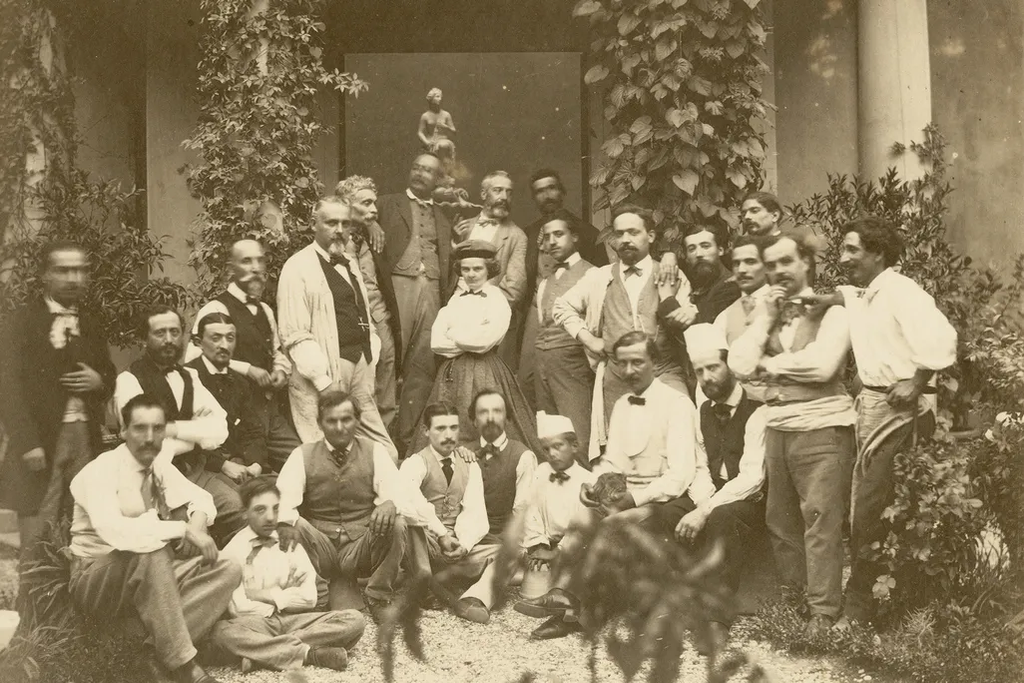
For decades, a remarkable piece of American art history remained hidden in plain sight in an English garden. The marble sculpture, created by one of the earliest American women to establish herself as a professional sculptor, went largely unrecognized while its artistic and historical significance remained overlooked. Its story offers a fascinating glimpse into the lives of pioneering women artists, the movement of valuable artworks across the Atlantic, and the unexpected places where important cultural treasures can survive for generations.
The discovery also highlights how history can become obscured by changing ownership, forgotten records, and shifting perceptions of artistic importance. A sculpture that once represented the achievements of a talented artist could eventually become little more than a decorative object in a private garden. Yet the work’s survival provides an opportunity to reconsider the contributions of women who challenged the limitations of their time and helped shape the development of American sculpture.
Although the exact circumstances surrounding the sculpture’s rediscovery depend on the historical records associated with the individual artwork, its central story reflects a broader truth: significant works of art do not always remain in museums or prominent collections. Sometimes, they endure quietly in ordinary settings until someone recognizes what they truly represent.
A Pioneering Woman in the History of American Sculpture
The history of American sculpture includes many celebrated male artists, but women also played an important role in developing the country’s artistic traditions. Their achievements were often made despite considerable social and professional barriers.
In the eighteenth and nineteenth centuries, women who wished to pursue serious artistic careers faced restrictions on education, professional training, and access to influential patrons. Sculpture presented particular challenges because it required specialized materials, substantial equipment, and considerable physical labor. Marble carving also demanded technical expertise that was difficult to acquire without access to professional workshops or experienced instructors.
Despite these obstacles, several women established themselves as accomplished sculptors. Among the most important was Patience Wright, an American-born artist active in the eighteenth century who became known for her work in wax. However, the title of America’s first professional female sculptor is more commonly associated with figures working in the nineteenth century, and the precise attribution depends on how professional sculpture is defined.
One prominent candidate is Edmonia Lewis, a pioneering African American and Native American sculptor whose career developed internationally during the nineteenth century. Born in 1844, Lewis overcame racial and gender discrimination to establish herself as a professional artist. She studied in Boston before moving to Rome, where she became known for sculptures that combined classical forms with subjects drawn from African American history, Indigenous heritage, religion, and literature.
Another important figure was Harriet Hosmer, who became one of the best-known American women sculptors of her generation. Born in Massachusetts in 1830, Hosmer pursued artistic training at a time when women were frequently excluded from formal instruction in anatomy and sculpture. She eventually established a successful studio in Rome and attracted commissions from prominent patrons.
These artists helped challenge the assumption that sculpture was a profession reserved for men. Their careers demonstrated that women could master demanding techniques, produce ambitious works in marble, and participate in the international art market.
Identifying the artist behind a rediscovered sculpture is therefore more than an exercise in attribution. It can help restore a forgotten work to the broader history of women’s achievements in the arts.
How a Marble Sculpture Could Disappear From Public Attention
A sculpture does not need to be destroyed to disappear from history. Sometimes, it simply moves away from the institutions and audiences that once gave it meaning.
Marble sculptures have long been prized for their durability, elegance, and association with classical art. Wealthy collectors in Britain and the United States frequently purchased sculptures for country houses, gardens, and private collections. These works could remain within a family for generations, even as their original owners and the stories behind their acquisitions were forgotten.
When a property changed hands, its contents might be inherited, sold, redistributed, or left behind. A sculpture could be moved outdoors because it was considered decorative rather than historically important. Over time, the distinction between a valuable work of art and an attractive garden ornament could become blurred.
This process was particularly likely when ownership records were incomplete or when the artist’s name was no longer widely recognized. Women artists faced an additional disadvantage because their contributions were often less consistently documented or celebrated than those of their male contemporaries.
A marble sculpture placed in a garden might attract occasional admiration without prompting questions about its creator. Visitors could appreciate its appearance while remaining unaware of its connection to a significant chapter of American art history.
Outdoor conditions also create challenges for preserving marble. Rain, frost, air pollution, biological growth, and changes in temperature can gradually affect the stone’s surface. Even a sculpture that survives structurally may lose fine details or accumulate deposits that make its original appearance difficult to assess.
Nevertheless, marble is durable enough that a work can survive for many decades outdoors. If the sculpture remains protected from serious physical damage, important details may still be recoverable through careful examination.
Why the Sculpture’s Rediscovery Matters
The rediscovery of an overlooked artwork can transform how historians understand its significance. A sculpture previously treated as a decorative object may prove to be an important example of an artist’s development, a record of historical taste, or evidence of a forgotten connection between American and British collectors.
Art historians typically begin by examining the object itself. They study its composition, proportions, carving techniques, surface condition, and stylistic characteristics. These details can be compared with documented works by the suspected artist.
The sculpture’s signature, if present, may provide valuable evidence. However, many historical works are unsigned, and even a signature does not always settle questions of authorship. Researchers may need to consider workshop practices, later alterations, and the possibility that an artist’s design was executed partly by assistants.
Provenance, or the documented history of an artwork’s ownership, is another crucial factor. Old inventories, correspondence, estate records, auction catalogues, and photographs may help establish where a sculpture was located at different points in its history.
For a work found in England but associated with an American artist, this research can be particularly revealing. It may help explain how the sculpture crossed the Atlantic, who purchased it, and why it eventually became part of a garden collection.
The investigation can also establish whether the work is a rare surviving example of a particular subject or period. If an artist produced relatively few marble sculptures, an authenticated example may be especially important to scholars and collectors.
However, rediscovery does not automatically guarantee that every historical question can be answered. Some records may have been lost, and certain conclusions may remain tentative. Responsible scholarship requires researchers to distinguish between established evidence and plausible interpretation.
The Special Challenges of Identifying Historic Marble Art
Determining the identity of a marble sculpture requires more than recognizing a familiar face or an appealing artistic style.
Marble has been used by sculptors for thousands of years, and many artists have drawn on similar classical traditions. Drapery, facial expressions, poses, and proportions may reflect widespread artistic conventions rather than the distinctive approach of one individual.
Specialists therefore compare multiple characteristics rather than relying on a single visual resemblance. They may examine the treatment of hair, the handling of fabric, the structure of the face, and the relationship between different parts of the composition.
The tools available to modern researchers can also support the investigation. High-resolution photography allows specialists to document fine details, while three-dimensional scanning can record the sculpture’s shape with considerable precision. Scientific analysis may help identify the type of stone or reveal evidence of repairs and later modifications.
These techniques do not independently establish an artist’s identity, but they can provide useful information when combined with documentary research and expert assessment.
Conservation specialists also play an important role. Before a historic sculpture is cleaned or restored, its surface must be examined carefully. Removing deposits too aggressively can damage original carving, erase traces of earlier treatments, or alter evidence that may help explain the object’s history.
For a sculpture that has spent decades outdoors, preservation and identification are closely connected. Protecting the object allows future researchers to continue investigating its origins.
Women Artists and the Changing Art Historical Narrative
The story of a forgotten sculpture also connects with a larger effort to reassess women’s contributions to art history.
For generations, museum collections, academic writing, and popular histories often gave greater attention to male artists. Women’s achievements were sometimes minimized, their work attributed to male contemporaries, or their professional careers treated as exceptions rather than evidence of broader artistic participation.
This imbalance was not simply the result of artistic ability. Women frequently had fewer opportunities to obtain commissions, join professional networks, study from live models, or establish workshops. Their access to patrons and public exhibitions could also be restricted.
Even successful women artists sometimes struggled to maintain their reputations after their deaths. As collections changed ownership and artistic fashions evolved, works associated with women could lose visibility.
Today, museums, researchers, and collectors are increasingly interested in identifying and reassessing works by historically overlooked artists. Reattribution can change museum displays, encourage new research, and bring attention to careers that deserve a more prominent place in the historical record.
A sculpture rediscovered in an English garden may therefore have significance beyond its individual beauty. It can serve as a tangible reminder that the history of art is not fixed. New evidence can challenge familiar assumptions and reveal connections that were previously overlooked.
From a Private Garden to a Wider Historical Story
When an artwork is rediscovered, questions about its future often follow. Should it remain where it was found, enter a museum collection, undergo conservation, or be made available for public viewing?
There is no single answer. The appropriate decision depends on the sculpture’s condition, ownership, historical importance, and the practical circumstances surrounding its preservation.
Keeping a sculpture in its original setting may preserve an important part of its history. A garden, country house, or private estate can provide context that would be difficult to recreate elsewhere. On the other hand, a museum may offer more reliable environmental protection, specialist conservation, and opportunities for public education.
Documentation is essential regardless of the decision. Detailed photographs, condition reports, historical research, and a clear ownership record help ensure that the sculpture’s significance is not lost again.
Public interpretation matters as well. When visitors learn who created an artwork and why it is important, they can appreciate more than its appearance. They gain insight into the artist’s life, the historical period, and the circumstances that shaped the object’s journey.
The sculpture’s story also illustrates the importance of looking carefully at familiar surroundings. A garden ornament, an inherited portrait, or an object stored in an attic may have a history far more remarkable than its current setting suggests.
Why Forgotten Artworks Continue to Fascinate Us
Stories of rediscovered art capture the imagination because they combine mystery, history, and the possibility of new knowledge. An object that appeared ordinary for decades suddenly becomes the subject of serious investigation, changing how people understand its past.
Yet the greatest value of such discoveries is not necessarily a dramatic increase in market price. Financial value may be relevant to collectors, but historical and cultural significance can be much broader.
A rediscovered sculpture can reveal the ambitions of an artist who worked against the expectations of her era. It can demonstrate how artworks circulated between countries and how private collections influenced artistic taste. It can also expose gaps in historical records and encourage researchers to investigate other overlooked objects.
In the case of women sculptors, these discoveries may be especially meaningful. They help establish that women were not merely peripheral participants in the development of sculpture. Many pursued ambitious careers, mastered demanding techniques, and created works that deserve careful study.
The marble sculpture that remained in an English garden for decades represents the possibility that important stories can survive even when their context has been forgotten. Its rediscovery invites a fresh look at the relationship between artistic achievement, historical memory, and the places where cultural objects endure.
Conclusion: A Hidden Sculpture With a Story Worth Rediscovering
A rare marble sculpture by an early American woman sculptor, overlooked for decades in an English garden, offers a compelling reminder that art history is full of unfinished stories. Objects can survive long after the people who created or collected them have passed away, waiting for renewed attention to reveal their significance.
The sculpture’s journey reflects several important themes: the challenges women faced in establishing professional artistic careers, the movement of artworks across the Atlantic, and the difficulties of preserving historical knowledge as collections change hands.
Its story also demonstrates why careful attribution and provenance research matter. Establishing an artwork’s creator and ownership history requires evidence, specialist knowledge, and a willingness to revisit assumptions that may have gone unquestioned for generations.
Ultimately, the significance of a rediscovered sculpture lies in more than the marble from which it was carved. It lies in the human achievement preserved within the stone and the historical connections that can be recovered through research.
Sometimes, an extraordinary piece of history does not emerge from a dramatic archaeological excavation or a forgotten museum storeroom. It is already there, quietly standing in a garden, waiting for someone to look more closely.