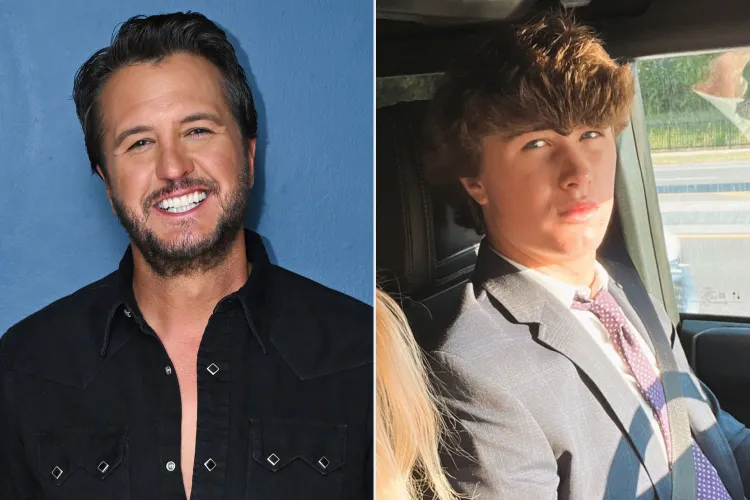
Country music star Luke Bryan and his family are facing a difficult moment after his 18-year-old son, Thomas “Bo” Boyer Bryan, suffered a broken collarbone during a high school football game in Tennessee. The injury occurred on Friday, October 16, 2026, when Bo was playing quarterback for Battle Ground Academy against Pope John Paul II High School.
The young athlete initially thought he had experienced a relatively minor injury after being brought down during the game. However, as he got back to his feet and made his way to the sidelines, he realized that something was not right. His description of the moment, particularly his admission that he knew something was wrong once he reached the sideline, has drawn attention from fans following his football journey.
Bo later confirmed that he had broken his collarbone, sharing an update on social media and thanking people for their concern and support. Although the injury is an unfortunate setback during his senior year, his determination to return to the field has offered encouragement to those who have followed his progress.
For Luke Bryan, who has publicly expressed pride in his son’s dedication to football, the situation highlights the uncertainty that comes with competitive high school sports. Behind the statistics, victories, and excitement of Friday-night football are young athletes who work hard toward their goals while facing the physical risks of the game.
What Happened to Luke Bryan’s Son During the Football Game?
Bo Bryan sustained the injury during Battle Ground Academy’s game against Pope John Paul II High School on October 16. Playing as the team’s quarterback, the 18-year-old was sacked during a play and landed on his right shoulder.
According to accounts of the incident, two players landed on him during the tackle. At first, Bo believed he had suffered a temporary injury rather than a broken bone.
Speaking about the experience after the game, he explained that he initially thought it was simply a “stinger” when he hit the ground. Once he got up, however, he began to suspect that the injury was more serious.
The situation became clearer when he reached the sidelines. Medical personnel and team trainers assessed him, placed his arm in a sling, and kept his shoulder wrapped while he remained off the field for the rest of the game.
The decision to keep him out of the remaining action was an important precaution. In contact sports such as football, a player who experiences significant pain or has difficulty moving an arm or shoulder should be evaluated rather than encouraged to continue playing.
Bo subsequently confirmed the broken collarbone through an Instagram Stories update the following day. He thanked everyone who had sent thoughts and prayers and expressed confidence that he would return.
Although the injury ended his participation in that particular game, the update provided fans with a clearer understanding of what had happened. It also shifted attention from the immediate shock of the incident toward his recovery and the question of when he might be able to play again.
“I Really Knew Something Was Wrong”: Bo Bryan Describes the Moment
Bo’s description of the injury has resonated with readers because it captures the uncertainty athletes can experience immediately after a hard tackle.
During a football game, players regularly absorb physical contact. A collision can leave someone sore or temporarily uncomfortable, making it difficult to determine the seriousness of an injury in the first few seconds.
Bo initially thought the impact might have caused a stinger, a term commonly used to describe a sudden sensation of pain, tingling, or burning associated with irritation of nerves around the neck and shoulder area.
However, his symptoms and experience after getting up made him realize that something more serious might have happened.
“When I got to the sideline, I really knew something was wrong,” he explained while describing the incident.
That realization marked a turning point in the evening. Instead of returning to the field, Bo remained on the sidelines while medical personnel assessed his condition.
His account is a reminder that athletes do not always immediately understand the nature of an injury. Adrenaline and the intensity of competition can make it difficult to assess pain accurately in the moments after a collision.
It also highlights the importance of listening to the body. When a player experiences unusual pain or suspects a serious injury, seeking an assessment is far more important than trying to push through the discomfort.
For Bo, the experience brought an unexpected interruption to a season in which he had already demonstrated considerable progress as a quarterback.
Bo Bryan’s Broken Collarbone and the Road to Recovery
A broken collarbone, also known as a clavicle fracture, is an injury that can occur when a person falls directly onto the shoulder or lands on an outstretched arm. Because the collarbone connects the upper arm and shoulder region to the central skeleton, a fracture can make ordinary movements uncomfortable.
Treatment depends on the location and severity of the break, whether the bone has shifted out of alignment, and the patient’s overall condition. Many collarbone fractures can be managed without surgery, using a sling and appropriate medical follow-up. More complicated injuries may require additional treatment.
Recovery also takes time. The bone needs to heal before an athlete can safely resume contact sports, and returning to football involves more than simply waiting until the pain improves.
Medical professionals may assess healing, shoulder movement, strength, and the athlete’s ability to perform sport-specific activities before approving a return to play. The timeline varies from person to person, so it would be premature to predict exactly when Bo will be ready to compete again.
For a quarterback, shoulder function is particularly important. Throwing requires coordinated movement involving the shoulder, arm, torso, and upper back. A player must be able to make throws comfortably and safely before returning to full competition.
The recovery process may therefore involve patience, medical guidance, and a gradual progression back to athletic activity.
Bo’s public message expressing confidence that he would return reflects a positive attitude, but his long-term recovery will depend on the injury itself and the advice of his healthcare team.
A Breakout Season for Luke Bryan’s Son
Before the injury, Bo had been enjoying an impressive senior football season at Battle Ground Academy in Tennessee.
Reports placed his statistics at approximately 2,006 passing yards, 30 touchdown passes, and three interceptions. Those numbers reflect a productive season for a high school quarterback and help explain why his absence could present a significant challenge for the team.
A quarterback plays a central role in offensive coordination. Beyond throwing the ball, the position requires decision-making, communication, awareness of defensive formations, and the ability to respond quickly when a play develops differently than expected.
Bo’s performance had helped establish him as one of the notable high school quarterbacks in his region. His season also represented the result of continued practice, preparation, and experience in competitive situations.
For a senior athlete, the timing of an injury can be especially frustrating. The final year of high school sports often carries additional meaning because players are working toward personal goals, team achievements, and possible future opportunities.
An injury does not erase the work already completed, but it can force an athlete to reconsider expectations for the remainder of a season.
Bo’s situation illustrates how quickly circumstances can change in football. One tackle can interrupt months of preparation, leaving a player and his teammates to adjust to a new reality.
Coach Bobby Bentley Addresses the Challenge for Battle Ground Academy
Bo’s injury also created questions for Battle Ground Academy’s coaching staff.
Head coach Bobby Bentley acknowledged that the team would need to work out how to respond to the quarterback’s absence. The challenge involved more than identifying another player to take snaps. Coaches would need to consider how to adjust the offensive approach, organize practice, and help the rest of the team adapt.
A quarterback’s absence can affect the rhythm of an offense because players become accustomed to working with a particular leader. Timing between the quarterback and receivers, communication at the line of scrimmage, and confidence in key plays all develop through repetition.
When that familiar structure changes, the team must find ways to maintain consistency while adjusting its strategy.
Bentley indicated that the coaching staff would work through the situation together. His response reflected the practical demands of managing a team after an unexpected injury.
For Bo’s teammates, the situation may also provide an opportunity to demonstrate resilience. High school football depends on collective effort, and players often need to take on different responsibilities when circumstances change.
Still, replacing an injured starting quarterback is never a simple task. The team must balance its competitive goals with the need to support a player who has contributed significantly to the season.
Luke Bryan Has Spoken Proudly About His Son’s Football Journey
Luke Bryan is widely known for his successful country music career, but he has also spoken publicly about his pride in his son’s development as a football player.
The singer has described watching Bo learn through the pressures and challenges of his senior season. In a September 2026 interview, Bryan praised his son’s work ethic and commitment, noting that the season had introduced him to important experiences involving pressure, setbacks, and changing circumstances.
Bryan’s comments emphasized the effort behind the results rather than focusing exclusively on statistics. For parents watching their children compete, the hours spent practicing, improving, and working with teammates can be just as meaningful as the final score.
His support also reflects the balance many families must maintain when a child pursues competitive sports. Parents may celebrate successful performances while helping young athletes manage disappointment, uncertainty, and the physical demands of competition.
Although Bryan is accustomed to performing in front of large audiences, his role as a father is separate from his public career. His pride in Bo’s achievements reflects a familiar family experience: wanting to see a child work toward a goal and hoping that the effort brings a rewarding outcome.
Bo’s injury is therefore more than a sports update for the Bryan family. It is an unexpected challenge during an important stage of his life, when he has been working to make the most of his final high school season.
The Bryan Family’s Life Beyond the Football Field
Luke Bryan and his wife, Caroline, have two sons: Bo and his younger brother, Tatum, known as Tate. The family has also taken on an important caregiving role for Bryan’s nieces and nephew following the deaths of his sister, Kelly, and her husband, Ben Cheshire.
The family has spoken openly over the years about the importance of supporting one another through both joyful and difficult experiences. That background has become part of the public’s understanding of Bryan beyond his music career.
Even so, it is important to respect the family’s privacy during a medical setback. Bo’s injury has been shared publicly through accounts of the game and his own social media update, but that does not mean every aspect of his recovery needs to be disclosed.
For now, the central concern is that he receives appropriate care and has the time needed to recover.
Fans who wish him well can offer encouragement without pressuring him to return before he is ready. For a young athlete, that kind of support can be meaningful while he works through the practical and emotional challenges of an injury.
Why High School Football Injuries Require Careful Attention
Bo’s experience also highlights a broader issue in high school athletics: the importance of taking injuries seriously, even when they initially appear manageable.
Football involves repeated physical contact, and players may experience bruises, sprains, strains, and fractures during a season. Coaches, athletic trainers, and medical professionals play important roles in identifying injuries and deciding whether a player should continue participating.
A player who experiences significant pain after a collision should not be expected to diagnose the problem independently. Medical evaluation helps determine whether further examination or treatment is needed.
Returning too early can create additional risks, particularly when an injury affects a joint or bone that must withstand repeated force. Athletes benefit from following professional guidance and progressing through recovery at an appropriate pace.
There is also an emotional dimension. Players may feel disappointed about missing games, especially when they are nearing the end of their high school careers. Teammates and coaches can help by reinforcing that recovery is part of athletic development, not a failure of commitment.
Bo’s injury serves as a reminder that protecting an athlete’s long-term health is more important than any single game or statistic.
Conclusion: Fans Rally Around Bo Bryan After His Football Injury
Luke Bryan’s 18-year-old son, Bo, suffered a broken collarbone during Battle Ground Academy’s high school football game against Pope John Paul II High School on October 16, 2026. After initially believing the impact might have caused a minor injury, he recognized that something was wrong and remained on the sidelines while medical personnel assessed him.
Bo later confirmed the fracture and thanked supporters for their thoughts and prayers, expressing confidence that he would return to the field. The injury comes during an impressive senior season in which he had recorded approximately 2,006 passing yards and 30 touchdowns.
For Battle Ground Academy, his absence presents a challenge as the coaching staff adjusts its plans. For Bo and his family, the immediate priority is allowing him to recover safely and determining when a return to football will be appropriate.
Luke Bryan has previously spoken proudly about his son’s work ethic and commitment to the game. Those qualities remain meaningful even as Bo faces an unexpected interruption to his season.
Although the injury is disappointing, it does not diminish the progress Bo has made or the effort he has invested in football. His next chapter will depend on recovery, patience, and the support of his family, coaches, teammates, and medical professionals.
For now, the most important goal is straightforward: giving Bo the time and care he needs to heal before he returns to the sport he loves.