The Statue of Liberty is one of the most recognizable landmarks in the world, standing proudly on Liberty Island in New York Harbor. For generations, it has symbolized freedom, hope, and the promise of a new beginning. Yet the enormous monument that millions of visitors admire today almost never became a reality. Although France agreed to provide the statue as a gift to the United States, the Americans were responsible for financing its pedestal—and raising the necessary money proved far more difficult than expected.
The project faced financial uncertainty, political disagreements, construction challenges, and public skepticism. At one point, the statue’s completed components were waiting in France while the American side struggled to secure enough funding to build a suitable foundation. Without a successful fundraising campaign and the determination of several influential supporters, the monument might never have been assembled in New York Harbor.
The story of the Statue of Liberty is therefore about more than an impressive work of art. It is also a story of international friendship, public generosity, and how a national symbol emerged from a project that nearly collapsed before it was finished.
Why France Decided to Give America the Statue of Liberty
The idea for the Statue of Liberty is commonly associated with French political thinker and abolitionist Édouard René de Laboulaye. He supported the ideals of liberty and democracy and admired the United States, particularly its founding principles and the abolition of slavery following the American Civil War.
In the 1860s, Laboulaye proposed creating a monument to celebrate American independence and the relationship between France and the United States. The gift would commemorate the centennial of American independence in 1876 while expressing support for the principles of freedom and representative government.
The project also reflected France’s own political debates. Supporters of republican government saw the United States as an example of a nation built around democratic ideals. A monument celebrating liberty could therefore communicate a message to both sides of the Atlantic.
French sculptor Frédéric Auguste Bartholdi was selected to develop the design. He envisioned a monumental female figure holding a torch high above her head, representing enlightenment and the spread of liberty. Her other hand would hold a tablet bearing the date of American independence, July 4, 1776.
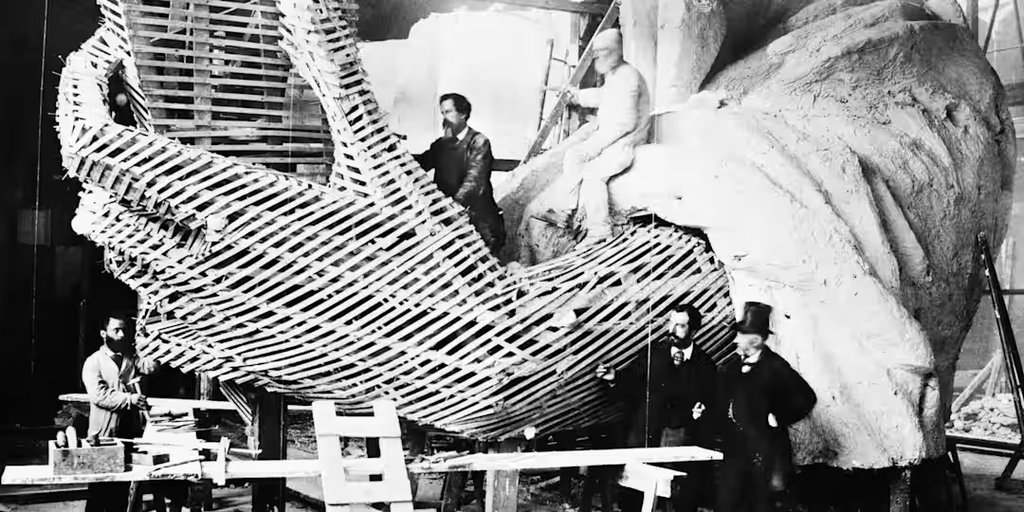
The statue was an ambitious undertaking. Its enormous scale required advanced engineering, substantial funding, and a carefully coordinated construction process. It was not simply a sculpture that could be carved from stone and placed on a platform. Its designers needed to create a structure capable of supporting a towering copper exterior while withstanding wind and other environmental forces.
Despite these challenges, the French project gained momentum. The central agreement was straightforward: France would finance and construct the statue, while the United States would provide the pedestal and prepare the site where the monument would stand.
That division of responsibility would become the source of one of the project’s greatest difficulties.
The Statue Was France’s Responsibility, but America Had to Pay for the Pedestal
One of the most surprising aspects of the Statue of Liberty’s history is that the United States did not simply receive a finished monument ready to be installed.
The statue and its pedestal were separate projects, with different funding arrangements. French supporters organized fundraising efforts to pay for the sculpture, while American organizers were expected to raise money for the foundation and base.
The pedestal was essential to the monument’s design. It needed to provide a stable platform for the statue and elevate the figure above the harbor. Building it required construction materials, skilled workers, engineering expertise, and a substantial amount of money.
However, the American fundraising effort encountered serious problems. Some people questioned why private citizens should contribute to a monument when the government could potentially finance it. Others considered the project expensive and unnecessary at a time when the country faced other financial and social priorities.
The statue was also being developed during a period of economic uncertainty. Raising large sums for a monumental public project was difficult, particularly when donors could not immediately see a completed result.
As a consequence, the American side fell behind schedule. France continued working on the statue, but the United States had not secured all the money needed to complete the pedestal.
The situation created an awkward problem. A gift intended to celebrate the friendship between two nations was moving toward completion on one side of the Atlantic, while the other side struggled to fulfill its part of the agreement.
Without a suitable pedestal, the statue could not be installed as planned. The project needed more than public enthusiasm; it needed enough money to turn the design into a functioning monument.
Why the American Fundraising Campaign Struggled
The American committee responsible for raising money for the pedestal faced a difficult task. The required sum was substantial, and the project did not have an obvious commercial benefit that could easily persuade investors to contribute.
Fundraising also depended on public confidence. Potential donors needed to believe that the project would eventually be completed and that their contributions would make a meaningful difference.
As the financial difficulties continued, the monument became a source of frustration for supporters. The statue itself was progressing in France, but the American construction effort remained uncertain.
There was also a broader question about who should pay for public monuments. Some Americans believed the federal government should cover the cost, while others argued that the project should be supported through private donations. The disagreement delayed progress and exposed the difficulty of coordinating a major national project without a clear funding solution.
Eventually, the American effort faced a critical shortfall. The pedestal could not be completed without additional money, and the original schedule became increasingly unrealistic.
The situation threatened to undermine the entire project. If the United States failed to provide the foundation, France’s expensive gift would have nowhere to stand.
The problem was not that Americans universally opposed the statue. Many supported the idea, but enthusiasm did not automatically translate into sufficient financial contributions. The campaign needed a way to reach a much larger audience and convince ordinary people that they could help rescue the project.
That opportunity came through an unexpected source: the newspaper publisher Joseph Pulitzer.
Joseph Pulitzer’s Campaign Helped Save the Statue of Liberty
Joseph Pulitzer, the influential publisher of the New York World, played a major role in the final fundraising campaign for the pedestal.
In 1885, Pulitzer used his newspaper to appeal directly to the American public. Rather than relying only on wealthy donors, he encouraged ordinary citizens to contribute whatever amount they could afford.
His approach helped transform the fundraising effort into a public campaign. Contributions did not have to be large to matter. Even small donations could become meaningful when thousands of people participated.
Pulitzer also criticized wealthy Americans who supported grand public gestures but had not contributed enough to complete the pedestal. His newspaper gave the project a prominent platform and presented the fundraising shortfall as a challenge that the public could solve together.
The response was significant. Readers sent donations, including small amounts that demonstrated how ordinary citizens could support a major national undertaking.
According to historical accounts, more than 120,000 people contributed to the campaign organized through the newspaper. Many donations were modest, but their combined value helped close the funding gap.
Pulitzer’s campaign was effective partly because it changed the way people viewed the project. The Statue of Liberty was no longer simply an expensive monument being negotiated between committees and governments. It became something that ordinary Americans could help bring into existence.
The campaign also reinforced the idea that the statue belonged to the public. People who contributed to the pedestal could feel that they had played a part in creating a lasting national landmark.
Without this effort, the project might have faced further delays or required a different funding arrangement. Pulitzer’s newspaper did not design the monument or construct its foundation, but it helped provide the money needed to move the project forward.
Building the Pedestal Was a Major Engineering Challenge
Raising the necessary funds was only one part of the challenge. The pedestal itself required substantial engineering and construction work.
The statue’s immense weight meant that its foundation had to be carefully designed. The base was constructed on Bedloe’s Island, now known as Liberty Island, in New York Harbor. The site offered a prominent location near the entrance to the harbor, where arriving ships could see the monument.
The pedestal was designed by American architect Richard Morris Hunt. Its construction involved a large masonry structure capable of supporting the statue while providing a monumental visual base.
The statue’s internal engineering was equally important. Bartholdi collaborated with engineer Gustave Eiffel, who later became famous for the Eiffel Tower. Eiffel helped develop the statue’s internal supporting framework, allowing the copper exterior to be attached to a structure that could accommodate movement caused by wind and temperature changes.
The statue’s outer skin was made from copper sheets shaped and assembled into the monumental figure. Its internal framework provided the strength needed to keep the structure standing.
These engineering decisions were essential because a monument of this scale could not depend on appearance alone. It needed to be stable, durable, and suitable for its exposed harbor location.
The pedestal and statue also had to be coordinated so that the completed figure could be assembled safely. Once the fundraising crisis eased, work on the base could progress toward completion, allowing the French gift to be installed.
The engineering achievement was a reminder that monumental art requires cooperation between artists, architects, engineers, builders, and financial supporters.
The Statue Arrived in Pieces Before It Could Be Assembled
By 1884, the Statue of Liberty had been completed in France and formally presented to the United States. However, the pedestal in New York was not yet ready, creating a delay in the monument’s installation.
The statue was dismantled into hundreds of pieces for transportation across the Atlantic. Its components were packed into crates and shipped to the United States aboard the French vessel Isère, arriving in New York Harbor in June 1885.
The arrival was a major event, but it did not mean the monument could immediately be opened to the public. The pieces had to be stored while construction of the pedestal continued.
The delay highlighted how close the project had come to an embarrassing outcome. France had fulfilled its commitment, but the American side still needed to complete the base that would support the gift.
Once the pedestal was ready, workers began reassembling the statue. The process required lifting and securing the copper sections and attaching them to the internal framework. Each component had to fit into the larger structure according to the design.
The work was completed in 1886. The statue was officially dedicated on October 28 of that year, in a ceremony attended by President Grover Cleveland and other dignitaries.
What had once seemed like an uncertain and potentially stalled project had finally become a permanent feature of New York Harbor.
What the Statue of Liberty Came to Symbolize
The Statue of Liberty was originally intended to celebrate American independence and the shared ideals of liberty and democracy. Over time, its meaning expanded.
For many immigrants arriving in the United States, the statue became a powerful image of hope and possibility. Its location near the entrance to New York Harbor placed it along a major route used by people arriving from overseas.
The association became especially strong during the late nineteenth and early twentieth centuries, when millions of immigrants entered the country through nearby facilities, including Ellis Island, which opened in 1892.
The poem “The New Colossus,” written by Emma Lazarus in 1883, later became closely associated with the monument. Its famous message welcoming people seeking refuge and opportunity helped shape the statue’s identity as a symbol of immigration and welcome.
The poem was written to support fundraising for the pedestal, although its connection to the monument became more prominent later. In 1903, a bronze plaque bearing the poem was installed inside the pedestal.
Today, the statue represents different ideas to different people. For some, it symbolizes the founding principles of the United States. For others, it reflects the hopes of immigrants and the continuing struggle to make liberty meaningful in everyday life.
Its history also reminds visitors that national symbols are not created by a single person or government. They emerge through cooperation, public debate, and the decisions of people who choose to support an idea.
Why the Statue of Liberty Almost Didn’t Get Built
The Statue of Liberty nearly failed because the project depended on two separate financial commitments. France could pay for the sculpture, but the United States still had to provide the pedestal. When American fundraising fell short, the entire monument was placed at risk.
The eventual success required more than the generosity of wealthy patrons. It depended on a public campaign that encouraged thousands of ordinary people to contribute, as well as the work of architects, engineers, builders, and political supporters.
Joseph Pulitzer’s fundraising effort was particularly important because it helped turn the pedestal from a stalled construction project into a shared public responsibility. His campaign showed that small donations could collectively make a difference on a national scale.
The monument’s completion in 1886 transformed New York Harbor and created a landmark that would become known around the world. Yet its history also reveals how easily a major public project can falter when responsibilities are divided and funding is uncertain.
The Statue of Liberty stands today as a symbol of freedom, but its story is also one of persistence and cooperation. France provided the statue, Americans raised the money for its pedestal, and many people contributed their skills and resources to bring the two parts together.
Without that cooperation, the statue might have remained in pieces or become a symbol of an ambitious project that never reached completion. Instead, it became one of the most enduring monuments in the world—and a reminder that even the most powerful symbols sometimes begin with a very practical question: Who will pay to build the foundation?