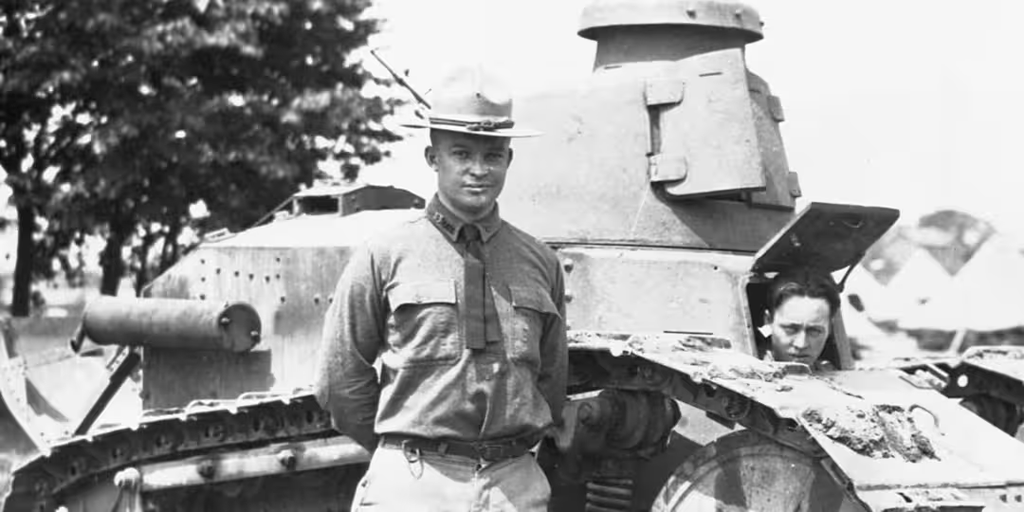
In the summer of 1919, a young American military officer named Dwight D. Eisenhower joined an extraordinary expedition that would help shape the future of transportation in the United States. The journey was supposed to demonstrate the nation’s ability to move military personnel and equipment across the country by road. Instead, it exposed just how difficult cross-country travel could be in an era when paved highways were scarce, bridges were unreliable, and many roads deteriorated into mud, dust, and uneven tracks.
The convoy’s journey lasted 62 days, covering thousands of miles from Washington, D.C., to San Francisco. Eisenhower was not yet a famous general or president. He was a lieutenant colonel participating in a military experiment that tested the limits of America’s road network.
Decades later, after becoming president, Eisenhower championed the creation of the Interstate Highway System, one of the largest infrastructure projects in American history. His experience during the 1919 expedition helped shape his understanding of the importance of reliable roads, national mobility, and the connection between transportation and national security.
Although the journey was not the sole reason the interstate network was created, it became an important part of the story behind the highways that transformed American life.
The United States in 1919: A Nation Without a Modern Highway Network
At the end of World War I, the United States was experiencing rapid technological and economic change. Automobiles were becoming increasingly common, but the country’s road infrastructure had not kept pace with the growing number of vehicles.
In many rural areas, roads were unpaved or poorly maintained. Rain could turn dirt tracks into deep mud, while dry weather produced clouds of dust. Steep grades, narrow bridges, and roads that ended without clear connections made long-distance driving difficult.
Traveling between major cities could require far more time than modern drivers might expect. Routes were not always direct, road signs were inconsistent, and drivers often depended on local knowledge to navigate unfamiliar territory.
These problems were especially important to the United States military. During World War I, moving supplies and personnel efficiently had become a central concern. Railways could transport heavy loads over long distances, but military planners also needed to understand how trucks and other motor vehicles could operate across the country’s existing roads.
A dependable national road network could improve military logistics, support commerce, and connect communities. Yet in 1919, the practical difficulties of traveling across the country showed that the United States had considerable work to do.
It was in this context that the military organized a transcontinental motor convoy to test the nation’s transportation infrastructure.
The 1919 Transcontinental Motor Convoy Begins
The convoy departed Washington, D.C., on July 7, 1919. Its destination was San Francisco, California, and its mission was to assess the feasibility of moving a large military column across the United States using the roads then available.
The expedition included approximately 80 vehicles and nearly 300 military personnel. Its equipment included trucks, support vehicles, and other machinery needed to transport supplies and maintain the convoy during the journey.
The trip was more than a long drive. It was a field test designed to reveal the strengths and weaknesses of America’s transportation network.
Military planners wanted to learn how vehicles performed over different types of terrain, how much time was lost because of poor roads, and what challenges arose when a large group had to travel together.
The convoy also attracted public attention as it passed through towns and cities. For many residents, seeing a long column of military vehicles was an unusual event, offering a glimpse of how motor transportation might change the country’s future.
Among the participants was Eisenhower, who would later become one of the most influential figures in the history of American transportation policy.
At the time, however, he was simply one officer among many trying to complete a difficult assignment. The journey would give him firsthand experience of the obstacles involved in moving people and equipment across a vast country.
Dwight Eisenhower’s Experience on the Road
Eisenhower had served in the United States Army during World War I, although he had not been sent to Europe. His military career was still developing, and the convoy provided an opportunity to study transportation, logistics, and the practical challenges of military mobility.
The journey exposed him to conditions that could make even relatively short distances difficult to cover. Vehicles became stuck, equipment required repairs, and road conditions frequently slowed progress.
The convoy encountered steep terrain, unstable surfaces, inadequate bridges, and stretches where the available routes were poorly suited to heavy military vehicles. In some locations, roads were little more than rough tracks.
For the participants, progress depended on careful coordination. A problem affecting one vehicle could delay the entire column, while mechanical failures and difficult terrain demanded patience and improvisation.
Eisenhower experienced the frustration of trying to move a large convoy through an infrastructure system that had not been designed for such a task.
The expedition demonstrated that reliable transportation required more than having vehicles capable of traveling long distances. Roads, bridges, signage, maintenance, and route planning all mattered.
This lesson would become increasingly important as automobiles and trucks transformed American society over the following decades.
Eisenhower did not immediately set out to create an interstate highway network after the trip. His later policies were influenced by many experiences and developments, including World War II, postwar economic growth, and the strategic demands of the Cold War. Nevertheless, the 1919 convoy gave him a lasting, practical example of what happened when a nation’s transportation infrastructure failed to meet its needs.
Why the 62-Day Journey Was So Difficult
Modern motorists can travel across the United States using an extensive network of paved highways, but the 1919 convoy faced a very different reality.
Road surfaces varied dramatically. Some stretches were reasonably passable, while others became obstacles that required vehicles to move slowly or receive assistance.
Weather could make conditions even worse. Rain created mud that heavy vehicles struggled to cross, and poor drainage left roads vulnerable to damage. In mountainous regions, steep slopes and difficult curves added further complications.
Bridges were another concern. Not every structure could safely accommodate heavy military vehicles, forcing the convoy to proceed cautiously and sometimes find alternative routes.
Mechanical reliability also mattered. Early trucks were less advanced than modern vehicles, and a long expedition placed considerable strain on engines, tires, suspension systems, and other components.
The convoy needed to transport fuel, food, spare parts, and other supplies while maintaining communication and coordination among its participants. Every delay could affect the schedule and increase the difficulty of reaching the next destination.
These challenges were not simply inconveniences. They illustrated the potential consequences of inadequate infrastructure for military operations and commercial transportation.
A national emergency could require rapid movement over long distances, but the 1919 experience showed how easily poor roads could slow that movement.
After 62 days on the road, the convoy reached San Francisco on September 6, 1919. Its arrival marked the completion of an arduous journey that had revealed both the possibilities and limitations of motorized transportation in America.
What the Convoy Revealed About America’s Roads
The expedition’s greatest value was not simply that it reached California. It provided a practical demonstration of how much the country depended on its road infrastructure.
The convoy showed that a route appearing manageable on a map could become difficult when traveled by a large group of heavy vehicles. A national transportation network had to work as a connected system rather than a collection of isolated roads.
Road quality was only one part of the problem. Bridges, route continuity, maintenance, and the ability to accommodate increasingly large vehicles were equally important.
The expedition also helped reinforce the idea that transportation infrastructure served national interests beyond individual motorists.
Better roads could support farmers moving goods to market, businesses distributing products, families traveling between communities, and emergency services responding to urgent situations.
For the military, the advantages were especially clear. A reliable network would make it easier to move supplies, equipment, and personnel without depending entirely on rail transportation.
The convoy did not single-handedly produce a national highway policy, and the United States had already begun discussing road improvement before 1919. Nevertheless, the expedition became an influential example in the broader argument for modernizing the country’s transportation system.
It offered a vivid illustration of the difference between owning motor vehicles and possessing the infrastructure needed to use them effectively.
From a Military Convoy to a National Highway Vision
In the years following the convoy, the United States continued developing its road network. Federal and state governments expanded road-building programs, while automobile ownership increased and the demand for better transportation grew.
The Federal-Aid Highway Act of 1921 strengthened federal support for state road construction, helping establish a more organized approach to improving important routes.
In 1926, the introduction of the U.S. numbered highway system made long-distance road travel easier to navigate. Routes such as U.S. Route 66 became familiar symbols of the expanding American road network.
Yet the system remained different from the modern interstate highways. Roads varied in quality, intersections were common, and travelers often passed directly through towns and cities. Long-distance journeys could still be slowed by congestion, local traffic, and inconsistent road design.
Eisenhower’s own experiences continued to shape his interest in transportation. During World War II, he observed the effectiveness of Germany’s autobahn network and considered how modern highways could support military movement.
The autobahn was not the only influence on his thinking, but it provided another example of how a connected highway system could contribute to national mobility.
By the 1950s, the United States faced new transportation demands. The postwar economy was expanding, suburban development was accelerating, and automobile ownership was rising rapidly.
These developments created pressure for a more comprehensive national road network capable of handling increasing traffic while supporting commerce, evacuation planning, and military logistics.
Eisenhower’s earlier experience with the 1919 convoy now formed part of a much larger understanding of the importance of reliable transportation.
Eisenhower and the Creation of the Interstate Highway System
Dwight D. Eisenhower became president in 1953. One of the major infrastructure initiatives associated with his administration was the development of a national interstate highway system.
The Federal-Aid Highway Act of 1956 established the funding framework that made large-scale construction possible. It authorized a planned network of approximately 41,000 miles of interstate highways, with the federal government covering most construction costs through a dedicated financing structure.
The project was intended to serve several purposes. It would improve long-distance travel, connect major cities, support the movement of goods, and provide routes that could be useful for national defense.
The new highways were designed with controlled access, limited intersections, and standards intended to improve safety and traffic flow compared with many older roads.
The interstate system also transformed the American economy. Trucking became more efficient on many routes, businesses gained better access to regional and national markets, and travelers could drive between cities with fewer interruptions.
However, the consequences were not uniformly positive. Highway construction sometimes displaced communities, contributed to the destruction of established neighborhoods, and reinforced patterns of racial and economic inequality. In some cities, major roads divided existing communities or encouraged development that changed local economies.
These effects are an important part of the system’s history. The interstate network brought enormous benefits, but its construction also created lasting social and environmental costs.
Eisenhower’s 1919 convoy was one influence on his transportation thinking, rather than the sole origin of the project. The interstate system emerged from decades of road development, engineering advances, political debate, military planning, and changing economic needs.
How the Interstate Highway System Changed American Life
The interstate highways reshaped the United States in ways that extended far beyond transportation.
For businesses, the network improved the movement of goods across long distances. Trucking companies could connect factories, warehouses, ports, and stores more efficiently, helping support the growth of national distribution systems.
For families, interstate highways made road trips easier and encouraged travel between regions. Vacation destinations became more accessible, while roadside businesses, motels, restaurants, and service stations developed along major routes.
The system also influenced where people lived and worked. Highways made suburban commuting more practical for many households, contributing to the growth of communities outside major city centers.
At the same time, easier driving increased dependence on automobiles and contributed to urban sprawl in many regions. Communities that lacked convenient access to highways sometimes experienced different economic outcomes from those that benefited from the new routes.
The network also became important for emergency transportation, freight distribution, and the movement of essential supplies.
Today, the interstate system remains a fundamental part of American infrastructure. Although it has undergone extensive expansion, repair, and modernization, its central purpose remains connected to the challenges that Eisenhower encountered during the 1919 convoy: moving people and goods across a large country efficiently and reliably.
The Lasting Legacy of the 1919 Road Trip
The 1919 transcontinental motor convoy is remembered today as an important episode in the history of American transportation.
It was not the only event that inspired the interstate highway system, and it did not immediately lead to the construction of modern highways. Instead, it provided Eisenhower with firsthand experience of the practical difficulties created by inadequate roads.
The journey demonstrated how poor surfaces, unreliable bridges, mechanical problems, and disconnected routes could hinder a large-scale transportation operation.
Over the following decades, Eisenhower encountered additional evidence of the strategic and economic value of modern highways. His military service during World War II, the expansion of automobile ownership, and the needs of a growing postwar economy all contributed to his support for a national interstate network.
The resulting highway system transformed the way Americans traveled, worked, traded, and settled across the country.
Its history also serves as a reminder that major infrastructure projects rarely emerge from a single moment of inspiration. They are usually the result of many experiences, technical developments, political decisions, and public demands coming together over time.
Conclusion: The Journey That Helped Shape America’s Highways
Dwight Eisenhower’s 62-day road trip in 1919 exposed the weaknesses of America’s transportation infrastructure long before he became president.
The military convoy struggled across difficult roads, unreliable bridges, and challenging terrain, revealing how inadequate infrastructure could obstruct even a carefully organized journey.
Those experiences helped shape Eisenhower’s understanding of national mobility, but the Interstate Highway System ultimately grew from a combination of military lessons, economic pressures, engineering progress, and decades of public policy.
When the Federal-Aid Highway Act of 1956 launched the modern interstate program, it began a transformation that would change American travel and commerce for generations.
The highways that now connect cities and states are far removed from the rough tracks encountered by the 1919 convoy. Yet the underlying challenge remains the same: a large country needs dependable transportation routes to connect its people, support its economy, and respond to national emergencies.
The epic road trip did not create the interstate system by itself, but it helped demonstrate why such a network would eventually become so important.