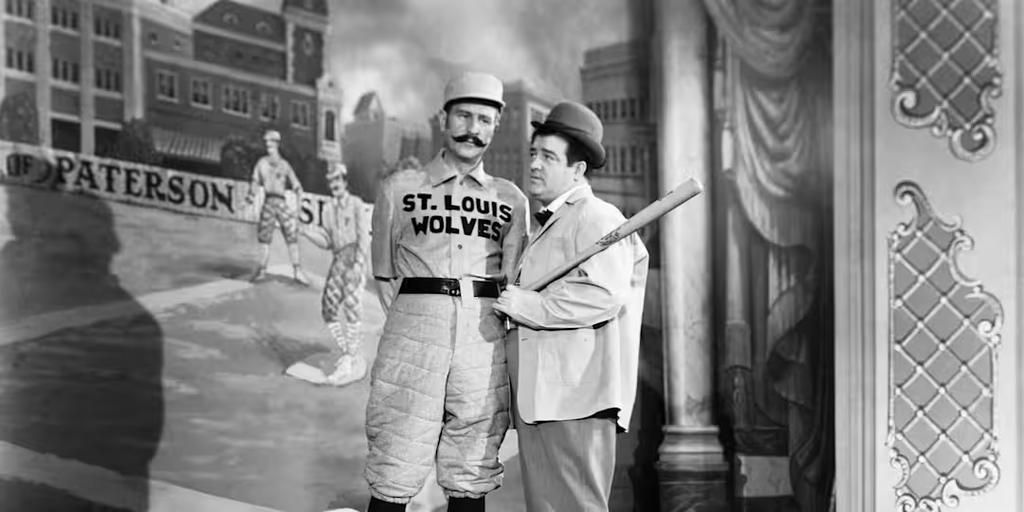
Few comedy routines have remained as recognizable across generations as “Who’s on First?” The legendary baseball sketch performed by Bud Abbott and Lou Costello transformed a simple conversation about a team’s lineup into a masterclass in timing, wordplay, and escalating confusion. What began as a seemingly ordinary exchange between two performers became one of the most celebrated comedy routines in American entertainment history.
The brilliance of “Who’s on First?” lies in its simplicity. Abbott plays a straight-faced manager explaining the names of baseball players to Costello, who becomes increasingly frustrated because the names sound like ordinary questions and answers. The first baseman is named Who, the second baseman is What, and the third baseman is I Don’t Know. As the conversation continues, Costello struggles to understand the lineup, while Abbott calmly insists that everything is perfectly clear.
The result is a comic exchange that feels both ridiculous and surprisingly logical. Every misunderstanding grows naturally from the language itself, creating a rhythm that audiences can follow even as the characters become more exasperated.
More than a century after the birth of its performers, “Who’s on First?” remains an enduring example of how comedy can emerge from everyday conversation. Its history also reveals how two entertainers developed a routine that helped define their partnership and secure their place in American popular culture.
Who Were Abbott and Costello?
Bud Abbott and Lou Costello were one of the most successful comedy teams of the twentieth century. Their partnership combined two contrasting personalities: Abbott’s controlled, deadpan delivery and Costello’s expressive, easily frustrated character.
William Alexander Abbott, known professionally as Bud Abbott, was born in 1897. Louis Francis Cristillo, who became Lou Costello, was born in 1906. Before becoming major stars, both men worked in entertainment and developed their performance skills through live shows and theatrical appearances.
Their professional partnership began in the 1930s, when they worked together in burlesque and other forms of live entertainment. These venues required performers to capture an audience’s attention quickly, maintain momentum, and make material work in front of people who might respond differently from one performance to the next.
Abbott and Costello discovered that their contrasting styles created a natural comic relationship. Abbott often appeared calm and authoritative, even when he was delivering information that made little sense to his partner. Costello, meanwhile, played the increasingly bewildered character who tried to make sense of the conversation.
This contrast became the foundation of their comedy. Abbott did not need to behave foolishly to make audiences laugh. His seriousness made Costello’s confusion even funnier.
The pair eventually moved from live performances into radio, film, and television, building a broad audience across several entertainment formats. Their success rested partly on their ability to make verbal comedy feel physical and dramatic. Costello’s facial expressions, pauses, and gestures allowed audiences to see his frustration, while Abbott’s calm delivery kept the exchange moving.
Among their many routines, “Who’s on First?” became the one most closely associated with their names.
How the Idea Behind “Who’s on First?” Developed
The origins of “Who’s on First?” are more complicated than the idea of two comedians inventing a joke from scratch. Wordplay involving unusual names and misunderstood questions had appeared in earlier entertainment traditions, including vaudeville and burlesque.
Abbott and Costello refined this kind of verbal confusion into a carefully structured baseball conversation. The sport provided an ideal setting because its lineup naturally includes familiar positions and a sequence of questions that someone learning about a team might reasonably ask.
The routine centers on the manager’s explanation of the players’ names. When Costello asks who plays first base, Abbott answers, “Who.” Costello interprets the response as a request for clarification rather than a name. Abbott then repeats the information, while Costello becomes more confused.
The same pattern expands through the lineup. “What” plays second base, and “I Don’t Know” plays third. Other names, including Why and Because, contribute to the growing confusion.
Each exchange follows a recognizable structure: Costello asks a reasonable question, Abbott gives a technically correct answer, and Costello misunderstands the answer because it also sounds like an ordinary word or phrase.
This is what makes the routine more sophisticated than a collection of unrelated jokes. The misunderstanding follows a consistent rule, and every new detail builds on what came before.
The audience understands the system even when Costello does not. That difference in understanding creates dramatic irony, allowing viewers to anticipate the next misunderstanding and enjoy watching the inevitable confusion unfold.
Why Baseball Was the Perfect Setting
Baseball played an important role in the routine’s success because it was deeply embedded in American popular culture. During the early twentieth century, the sport attracted large audiences through professional games, radio broadcasts, newspapers, and local teams.
Even people who did not follow baseball closely were likely to recognize the basic structure of a lineup. The positions were familiar enough to make Abbott’s explanation believable, while the unusual names created an absurd contrast with the ordinary rules of the game.
The baseball setting also gave Costello a clear objective. He was not confused about an abstract philosophical question or an unfamiliar technical subject. He simply wanted to understand who played which position.
That straightforward goal made his frustration relatable. Anyone who has struggled to understand a confusing explanation can recognize the feeling of asking a question, receiving an answer, and somehow ending up more confused than before.
The sport also allowed the comedians to introduce additional details without abandoning the basic premise. References to the catcher, pitcher, and other positions could extend the conversation while keeping it anchored to a recognizable activity.
Baseball therefore served two purposes. It made the setup easy to understand, and it provided enough structure to sustain a lengthy verbal exchange.
The routine did not require elaborate scenery, expensive costumes, or complicated physical stunts. Its effectiveness depended on the performers’ voices, expressions, and ability to maintain precise timing.
The Secret Was Timing, Not Just Wordplay
At first glance, “Who’s on First?” may appear to depend entirely on the amusing names in the lineup. But the words alone do not explain why the routine became so successful.
Timing is central to its effect.
Abbott must deliver each answer with complete confidence, as though he is explaining the most ordinary information in the world. If he showed too much awareness of the absurdity, the contrast would weaken.
Costello’s performance requires a different kind of precision. His confusion must grow gradually, allowing the audience to follow each misunderstanding. He cannot become frustrated too quickly, because the routine needs room to build.
Pauses are equally important. A brief silence after Abbott’s answer gives the audience time to recognize the double meaning. Costello’s reaction then releases the tension through disbelief, irritation, or an increasingly desperate attempt to understand.
The routine also depends on repetition. Abbott repeatedly provides correct answers, while Costello repeatedly interprets them incorrectly. Because the pattern is established early, the audience can anticipate the structure of later exchanges.
Yet repetition alone would become dull without variation. The comedians gradually increase the complexity of the conversation, introducing new names and overlapping meanings that make it harder for Costello to maintain control.
The balance between predictability and escalation is one of the routine’s greatest strengths. Audiences know the kind of misunderstanding that is coming, but they still enjoy seeing how the next exchange develops.
From the Stage to Radio and Film
Abbott and Costello developed their comedy through live performance before reaching a much larger audience through broadcasting and film.
Radio was particularly well suited to “Who’s on First?” because the routine depended heavily on dialogue. Listeners did not need to see elaborate physical action to understand the joke. The voices alone could establish Abbott’s authority and Costello’s growing frustration.
Radio also helped the performers reach people who might never have attended one of their live shows. As the routine became more widely known, it became closely associated with the pair’s public identity.
The comedians later performed versions of the sketch in filmed and televised appearances. One of the best-known filmed performances appeared in the 1945 movie The Naughty Nineties, allowing audiences to experience the exchange through their expressions and physical reactions as well as their dialogue.
The routine could be adjusted for different settings, but its central structure remained recognizable. This flexibility helped it survive as entertainment formats changed.
In an era when comedy increasingly moved between theaters, radio programs, motion pictures, and television, Abbott and Costello demonstrated that a well-designed verbal routine could work across different platforms.
Their performances also helped preserve the sketch for later audiences, allowing new generations to discover a piece of comedy that had originally developed in live entertainment.
Why “Who’s on First?” Still Makes People Laugh
The lasting appeal of “Who’s on First?” comes partly from the fact that its central joke is easy to understand across generations.
The routine does not depend on contemporary politics, current events, or references that quickly become outdated. Its humor comes from a basic feature of language: the same word can serve different purposes depending on how it is used.
In ordinary conversation, people rely on tone and context to understand whether a word is a name, a question, or part of an instruction. Abbott and Costello deliberately exploit that expectation.
Abbott treats the players’ names as straightforward facts. Costello hears them as questions or incomplete statements. Both characters follow a form of logic, but they are operating with different interpretations of the same words.
That conflict gives the sketch an almost mathematical quality. Each line follows from the previous one, even when the overall conversation appears to be collapsing.
Modern audiences can still recognize similar misunderstandings in everyday life. A person might misinterpret a message, misunderstand a name, or become frustrated when someone answers a question in a way that is technically correct but practically unhelpful.
The routine exaggerates these familiar experiences until they become absurd.
Its continued popularity also reflects the appeal of comedy that rewards close attention. Viewers who follow the dialogue can appreciate how each line contributes to the structure, while those who simply enjoy Costello’s escalating frustration can still find plenty to laugh at.
The Cultural Legacy of Abbott and Costello
“Who’s on First?” became more than a successful sketch. It helped establish Abbott and Costello as major figures in American entertainment and became a reference point for generations of comedians.
The routine has been discussed, quoted, parodied, and adapted in different contexts. Its influence can be seen in comedy that relies on misunderstandings, repeated phrases, and characters who interpret language in incompatible ways.
It has also been recognized as an important part of American cultural history. In 1999, Time magazine included “Who’s on First?” on its list of the twentieth century’s most memorable works of entertainment, reflecting its reputation as a lasting comic achievement.
The sketch’s influence extends beyond baseball fans or people familiar with Abbott and Costello’s film career. It is frequently used as an example of verbal comedy because its structure can be explained clearly while still being entertaining to watch.
Its enduring reputation also demonstrates the importance of performance in comedy. The premise can be summarized in a few sentences, but a successful performance requires two skilled comedians who understand exactly how to deliver each line.
Abbott and Costello transformed a simple wordplay idea into something larger through repetition, contrast, and carefully controlled escalation. Their achievement reminds us that comedy does not always require elaborate concepts. Sometimes, a strong premise and exceptional execution are enough.
What Made the Routine Different From Other Comedy Sketches?
Many comedy sketches rely on visual surprises, exaggerated characters, or unexpected events. “Who’s on First?” works differently because its central conflict exists almost entirely in language.
There is no complicated mystery to solve and no elaborate plot to follow. Instead, the same basic misunderstanding becomes increasingly difficult to escape.
The audience is invited to participate mentally. Once viewers understand that Who and What are names rather than questions, they can anticipate why Costello will misunderstand the next answer.
That knowledge creates a special relationship between the audience and the performers. Viewers are ahead of Costello, but they also understand why he finds the conversation impossible to follow.
The sketch also avoids making Abbott’s character openly malicious. He does not need to insult Costello or deliberately invent false information. His matter-of-fact delivery makes the confusion appear to result from the language itself.
Costello’s character, meanwhile, is not foolish simply because he cannot understand the answers. His questions are reasonable within ordinary conversational expectations. The humor emerges because those expectations no longer work in this particular situation.
This combination gives the routine its distinctive appeal. It allows the comedians to sustain an extended argument without relying on cruelty or a conventional punchline at the end of every sentence.
Conclusion: A Comedy Classic Built on a Simple Question
“Who’s on First?” remains one of the most celebrated comedy routines in American entertainment because it transforms an ordinary baseball discussion into an unforgettable battle of words.
Bud Abbott’s calm, authoritative delivery and Lou Costello’s increasingly exasperated reactions create a perfect comic contrast. The unusual player names provide the premise, but precise timing, repetition, and escalating confusion turn it into a lasting performance.
The routine’s journey from live entertainment to radio, film, and television helped introduce it to generations of audiences. Its language-based humor continues to work because it relies on misunderstandings that people can recognize, even when the circumstances are deliberately absurd.
More than a showcase for two gifted performers, “Who’s on First?” is a demonstration of how carefully structured dialogue can become timeless comedy. Its simple premise has survived changing tastes and entertainment technologies, proving that a joke does not need to be complicated to be brilliant.
For Abbott and Costello, the routine became a defining achievement. For audiences, it remains a reminder that sometimes the funniest conversations are the ones in which everyone is speaking clearly—and nobody seems to understand a word.