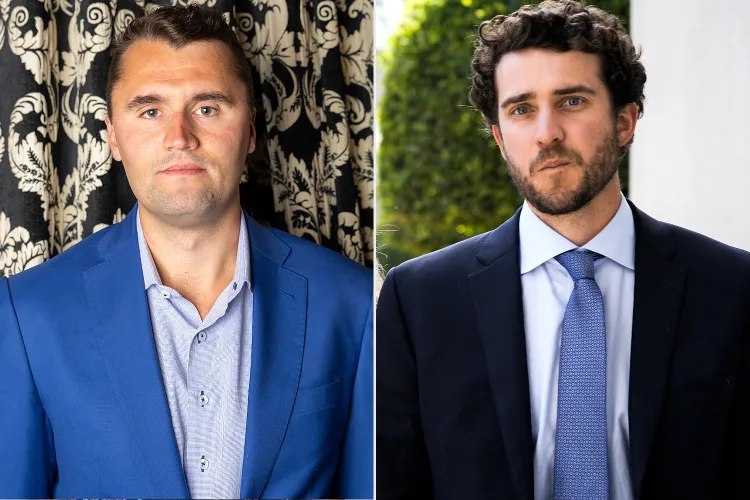
Elizabeth Holmes, the disgraced founder of blood-testing company Theranos, has returned to the headlines as a new documentary sheds light on her relationship with fiancé Billy Evans, his political views, and her efforts to secure a presidential pardon. In You Can See Everything, directors Nathan Fielder and Lance Oppenheim offer an unusually intimate look at the couple’s lives in the period surrounding Holmes’ imprisonment.
One of the film’s most contentious moments involves Evans expressing admiration for conservative activist Charlie Kirk during a tense conversation with actress Amanda Seyfried, who portrayed Holmes in the Hulu miniseries The Dropout. Evans reportedly says he hopes Kirk’s “voice will carry far,” prompting a discussion that reveals sharply different views about the late political commentator.
The exchange has attracted attention not only because of Kirk’s polarizing public reputation but also because Holmes is seeking clemency from President Donald Trump. The timing has encouraged renewed scrutiny of the couple’s public image, their political associations, and the future of Holmes’ legal situation.
Who Is Billy Evans, Elizabeth Holmes’ Fiancé?
Billy Evans became a subject of public curiosity after beginning a relationship with Holmes in 2017, as the Theranos scandal was attracting increasing scrutiny. Evans comes from a family associated with the hospitality industry and has largely maintained a lower public profile than his partner.
Holmes and Evans have two children together. Their relationship continued through Holmes’ criminal proceedings and imprisonment, placing Evans in an unusual position as both her partner and an important figure in managing aspects of her public life.
The documentary reveals a relationship more complicated than the public may have assumed. Rather than presenting Evans merely as a supportive partner standing beside a controversial businesswoman, the film examines his involvement in decisions affecting Holmes’ reputation, online presence, and future ambitions.
One particularly notable revelation concerns his role in managing Holmes’ social media account while she is incarcerated. According to accounts of the documentary, Evans acknowledges that he posts some material without consulting her beforehand. He describes this arrangement in terms of trust, but the admission raises questions about how much control Holmes retains over her own public voice.
These details have become an important part of the conversation surrounding the film, shifting attention from Holmes’ past business dealings to the people and decisions shaping her life today.
What Happened During the Charlie Kirk Exchange?
The conversation about Charlie Kirk is among the most discussed moments in You Can See Everything. During a dinner-table exchange involving Evans, Fielder, and Seyfried, the discussion turns to social media criticism following Kirk’s death.
Kirk, the founder of Turning Point USA, was a prominent conservative political activist whose commentary generated strong support as well as intense criticism. He was fatally shot during a speaking engagement in Utah in September 2025.
In the documentary, Evans expresses support for Kirk and says he hopes the activist’s “voice will carry far.” The statement becomes particularly contentious because Seyfried had previously criticized Kirk’s rhetoric publicly.
Seyfried, known for portraying Holmes in The Dropout, challenges Evans during the exchange. The discussion grows heated as the participants debate social media behavior, political commentary, and the difference between defending someone’s right to speak and endorsing the content of their statements.
The disagreement also becomes personal. Evans reportedly criticizes Seyfried’s online conduct and her portrayal of Holmes, demonstrating how a discussion about politics can become entangled with existing tensions surrounding celebrity, reputation, and public criticism.
The scene offers no simple resolution. Instead, it illustrates the difficulty of navigating politically charged conversations when participants bring sharply different experiences and opinions to the table.
Why Charlie Kirk Remains a Controversial Figure
Charlie Kirk became one of the most recognizable voices in American conservative politics through his work with Turning Point USA, an organization that promotes conservative ideas among young people.
Supporters viewed him as an effective advocate for free speech, conservative principles, and political engagement on college campuses. Critics, meanwhile, objected to some of his comments on social, cultural, and political issues, arguing that his rhetoric could be divisive or harmful.
His death intensified the debate over his public legacy. Many supporters emphasized his influence on young conservatives and condemned political violence, while critics continued to discuss his statements and their impact.
The exchange between Evans and Seyfried reflects this wider divide. Evans’ expression of admiration is presented within a personal conversation rather than a formal political speech, but the scene has attracted attention because it places his views in direct conflict with Seyfried’s previously stated criticism.
The moment also demonstrates how a documentary can turn an apparently private discussion into a wider public controversy. Once recorded and released, a conversation that might otherwise have remained within a small group becomes part of a national debate about politics, celebrity, and free expression.
Elizabeth Holmes’ Request for a Trump Pardon
While Evans’ remarks have generated headlines, Holmes’ legal situation remains the more consequential issue.
Holmes founded Theranos with the promise of transforming medical testing through technology that could perform numerous tests using only a small amount of blood. The company attracted major investors and prominent supporters before serious questions emerged about whether its technology could deliver the results it advertised.
In January 2022, Holmes was convicted of four counts of fraud and conspiracy related to defrauding investors. She was sentenced in November of that year to 135 months in federal prison, equivalent to 11 years and three months. She began serving her sentence in 2023.
Holmes has maintained that she did not intentionally defraud investors. Nevertheless, her conviction established her criminal responsibility under the law.
According to recent reporting, Holmes submitted a formal request for clemency through the Justice Department’s Office of the Pardon Attorney. The petition has been reported as pending, meaning that the request should not be confused with an approved pardon.
A presidential pardon is a significant exercise of executive authority. It can provide relief from federal criminal penalties, but the decision is discretionary and does not simply follow from an applicant’s public statements or political associations.
For Holmes, the prospect of clemency has renewed questions about accountability, the consequences of corporate fraud, and whether influential individuals receive different treatment from people with fewer resources.
Could Billy Evans’ Political Views Affect Holmes’ Chances?
The timing of Evans’ expression of admiration for Kirk has encouraged speculation about the couple’s political positioning. Kirk was a prominent conservative figure and a supporter of Trump-aligned causes, making Evans’ comments particularly noteworthy as Holmes pursues clemency from a Republican president.
However, there is no established evidence that Evans’ statement will influence the outcome of Holmes’ petition. Nor does expressing support for a political figure establish that a person is attempting to secure a pardon through political loyalty.
The question is more complicated because Holmes’ case involves substantial financial consequences. She and former Theranos executive Ramesh “Sunny” Balwani were ordered to pay more than $450 million in restitution connected to their convictions, with liability arrangements and enforcement proceedings involving both defendants.
Some of Theranos’ investors were prominent and influential figures in American business and politics. Their financial losses, along with the broader public significance of the case, could make any clemency decision particularly controversial.
A pardon would not automatically settle every financial obligation associated with a case, and its legal consequences would depend on the terms and applicable law. Any suggestion that Holmes’ request is certain to succeed or fail would therefore be premature.
For now, the reported status of the petition remains more important than speculation about what political associations might mean.
What You Can See Everything Reveals About Holmes’ Public Image
Directed by Nathan Fielder and Lance Oppenheim, You Can See Everything takes an unconventional approach to documenting Holmes and Evans. The filmmakers gained access to the couple’s domestic life during the period leading up to Holmes’ imprisonment, creating a portrait that extends beyond the familiar story of Theranos’ collapse.
The documentary explores Holmes’ continued insistence that she did not deliberately deceive investors, her reaction to dramatizations of her life, and the couple’s discussions about the future.
It also examines Evans’ role in managing the couple’s public narrative. His involvement with Holmes’ social media account raises questions about representation: when a person’s account remains active while they are imprisoned, how can audiences know which posts reflect that person’s own views and which reflect the decisions of someone acting on their behalf?
These questions are especially relevant when the account concerns political matters or a pending legal request. A post may attract attention as an apparent statement from Holmes even when Evans has acknowledged that he sometimes publishes material without consulting her.
The film therefore invites viewers to consider not only what Holmes and Evans say but also who controls the way their story reaches the public.
The Lasting Fallout of the Theranos Scandal
The Theranos scandal remains one of the most consequential corporate fraud cases associated with Silicon Valley. Holmes presented her company as a revolutionary force in healthcare, attracting investment and attention from influential business leaders.
But investigations and trial evidence revealed serious problems with the company’s testing technology and representations to investors. The criminal proceedings established that Holmes had committed fraud, undermining the image of Theranos as a transformative medical enterprise.
The case also prompted wider debate about startup culture, due diligence, and the tendency to celebrate ambitious founders before their claims have been independently verified.
Holmes’ continuing efforts to challenge the public perception of her story now take place against the reality of her conviction and imprisonment. The documentary adds another dimension by showing how her partner participates in that process and how the couple discusses her future.
For observers, the central question is whether Holmes’ public image can change without a corresponding resolution of the concerns that led to her conviction.
Conclusion: A Documentary That Raises More Questions Than Answers
Billy Evans’ expression of admiration for Charlie Kirk has become a prominent talking point in You Can See Everything, particularly because it emerges during a tense conversation with Amanda Seyfried. The exchange reveals a clash over political rhetoric, social media criticism, and the way public figures respond to controversy.
At the same time, Elizabeth Holmes’ reported request for a presidential pardon places the documentary within a broader discussion about criminal accountability and executive clemency.
Evans’ political views do not establish the outcome of Holmes’ petition, and the reported request remains distinct from any decision by the president. What the film does provide is a closer look at the people and choices surrounding Holmes as she continues to navigate the consequences of the Theranos scandal.
Ultimately, You Can See Everything is not simply a story about a disgraced entrepreneur or a contentious political exchange. It is also an examination of reputation, trust, and the power to shape a public narrative. As Holmes’ legal future remains uncertain, the documentary has ensured that questions about her past—and the people speaking on her behalf—remain firmly in the spotlight.