The American Civil Rights Movement was one of the most significant struggles for equality in modern history. During the 1950s and 1960s, African Americans and their allies challenged racial segregation, discrimination and laws that denied Black citizens equal rights. Through peaceful protests, legal challenges, boycotts, marches and community organising, they helped transform American society and secure landmark civil rights legislation.
The movement was not the work of a single leader or one defining event. It developed through decades of resistance, with ordinary people, students, religious leaders, lawyers and activists taking extraordinary risks to challenge injustice. Some actions brought national attention to racial inequality, while others helped change the laws governing American life.
From the Montgomery Bus Boycott to the Freedom Rides and the historic March on Washington, seven key moments illustrate how collective action helped move the United States toward greater equality.
1. The Montgomery Bus Boycott (1955–1956)
The Montgomery Bus Boycott became a defining moment in the modern Civil Rights Movement. It began on December 5, 1955, after Rosa Parks, a Black seamstress and civil rights activist, was arrested in Montgomery, Alabama, for refusing to give up her seat to a white passenger under the city’s segregation rules.
Parks’s action took place within a longer history of Black resistance to discrimination. She was also an experienced activist, and her arrest became the focus of a community campaign against segregated public transportation.
Black residents organised a boycott of the city’s buses, choosing to walk, share rides and use alternative transportation rather than support a system that treated them unequally. The campaign lasted 381 days and required considerable sacrifice from people who depended on public transport to reach their jobs, schools and other destinations.
Martin Luther King Jr., then a young Baptist minister, emerged as a prominent spokesperson for the boycott. The campaign demonstrated the power of sustained, organised nonviolent protest.
In November 1956, the United States Supreme Court upheld a ruling that segregation on Montgomery’s buses was unconstitutional. The city subsequently integrated its bus system.
The boycott showed that coordinated community action could challenge discriminatory institutions. It also helped establish King as a national civil rights leader and inspired activists elsewhere to pursue similar campaigns.
2. The Little Rock Nine and School Integration (1957)
The struggle for civil rights extended beyond public transportation to education, where segregation remained deeply entrenched in many Southern states.
In 1954, the Supreme Court ruled in Brown v. Board of Education that racial segregation in public schools was unconstitutional. However, implementing the decision proved difficult, and some officials actively resisted integration.
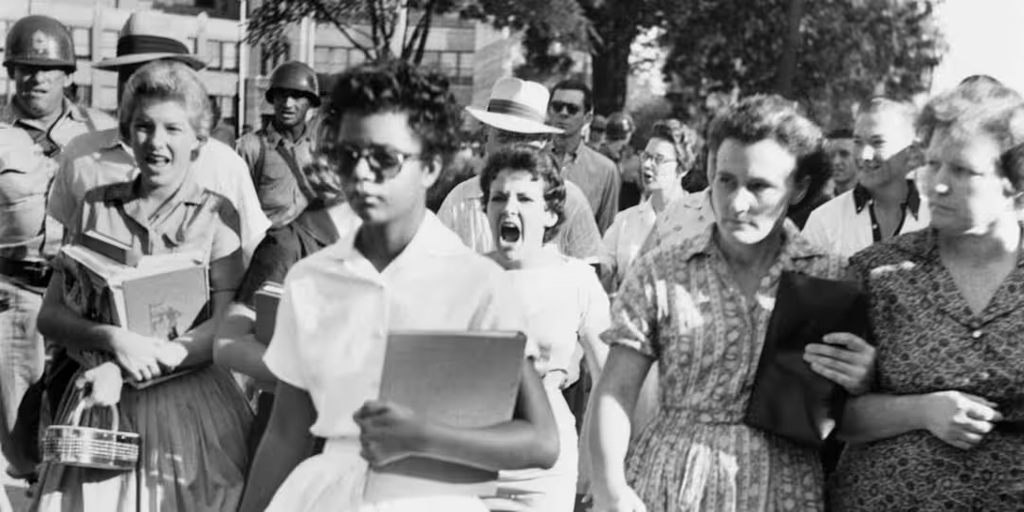
In 1957, nine Black students attempted to attend Central High School in Little Rock, Arkansas. Known as the Little Rock Nine, the students faced intense hostility as they sought to exercise their constitutional rights.
Arkansas Governor Orval Faubus used the state’s National Guard to prevent the students from entering the school. After a federal court ordered integration to proceed, President Dwight D. Eisenhower sent federal troops to Little Rock to enforce the law and protect the students.
The crisis drew national and international attention to the conflict between federal authority and state resistance to school desegregation.
The students endured intimidation and harassment while continuing their education. Their courage demonstrated the personal cost of challenging racial discrimination and exposed the gap between legal rulings and everyday reality.
The Little Rock crisis reinforced the principle that federal authorities could intervene when state officials obstructed constitutional rights. It also made clear that court decisions alone could not eliminate prejudice without enforcement and continued public pressure.
3. The Greensboro Sit-Ins (1960)
On February 1, 1960, four Black students from North Carolina Agricultural and Technical State University entered a Woolworth’s store in Greensboro, North Carolina, and sat at its whites-only lunch counter. When they were denied service, they remained seated.
The students—Ezell Blair Jr., David Richmond, Franklin McCain and Joseph McNeil—helped launch a wave of sit-in protests that spread across the South.
Their strategy was simple but powerful. Instead of responding to segregation through violence, they used peaceful presence and persistence to challenge businesses that refused to serve Black customers equally.
The Greensboro sit-ins attracted growing numbers of students and supporters. Participants often faced insults, threats and arrest, yet many continued returning to segregated lunch counters.
The protests placed economic pressure on businesses by encouraging boycotts of establishments that maintained discriminatory policies. They also demonstrated the growing influence of student activism within the wider movement.
By the summer of 1960, lunch counters in Greensboro began serving Black customers. Similar campaigns helped integrate facilities in other communities.
The sit-ins contributed to the development of student-led civil rights organisations and encouraged a new generation to participate directly in the struggle for equality. Their success showed that disciplined, nonviolent action could disrupt discriminatory practices and force institutions to reconsider established policies.
4. The Freedom Rides (1961)
The Freedom Rides challenged segregation in interstate transportation. Although the Supreme Court had ruled against segregation on interstate buses and in related terminal facilities, discriminatory practices continued across parts of the South.
In May 1961, civil rights activists organised journeys through Southern states to test whether federal desegregation rulings would be enforced.
The Freedom Riders included both Black and white participants who travelled together on interstate buses. Their aim was to expose segregation and demonstrate that existing federal law was being ignored.
The riders encountered violent opposition. In Anniston, Alabama, one bus was attacked and firebombed. In Birmingham and Montgomery, participants faced severe assaults from hostile crowds. Images and reports of the violence brought national attention to the campaign.
Despite the danger, activists continued their journeys. Their persistence placed pressure on the federal government to enforce the law and protect passengers exercising their rights.
The campaign helped prompt the Interstate Commerce Commission to issue stronger rules prohibiting segregation in interstate bus terminals, effective later in 1961.
The Freedom Rides demonstrated that legal victories required practical enforcement. They also showed how determined individuals could expose the consequences of discrimination by insisting that public institutions obey federal law.
5. The Birmingham Campaign (1963)
Birmingham, Alabama, became a major focus of the Civil Rights Movement in the spring of 1963. The city had a deeply segregated public life, and civil rights organisations launched a campaign to challenge discrimination in businesses, employment and public facilities.
Led by local activists and the Southern Christian Leadership Conference, the campaign used boycotts, demonstrations and nonviolent direct action to pressure business and political leaders.
Martin Luther King Jr. was arrested during the campaign. While in jail, he wrote the document widely known as the Letter from Birmingham Jail, defending nonviolent protest and arguing that people could not be expected to wait indefinitely for justice.
The campaign also drew attention to the treatment of young demonstrators. Images of police using attack dogs and high-pressure water hoses against protesters, including schoolchildren, shocked many Americans.
The confrontation placed Birmingham’s segregation policies under intense national scrutiny. Negotiations eventually produced an agreement that included steps toward desegregating public facilities and improving employment opportunities for Black residents, although implementation remained a challenge.
Birmingham helped increase support for federal civil rights legislation. The campaign illustrated how local struggles could influence national politics when protest, media attention and public pressure converged.
6. The March on Washington for Jobs and Freedom (1963)
On August 28, 1963, approximately 250,000 people gathered in Washington, D.C., for the March on Washington for Jobs and Freedom. The event brought together civil rights organisations, labour groups, religious leaders and ordinary Americans calling for racial equality and economic justice.
The march demanded meaningful civil rights legislation, an end to segregation, stronger protections for voting rights and better employment opportunities.
Martin Luther King Jr. delivered his famous “I Have a Dream” speech at the Lincoln Memorial. His address envisioned a nation where people would be judged by their character rather than their skin colour.
King’s speech became one of the most recognised moments in American political history, but the march was much more than a single address. It reflected years of organising by many activists, including prominent figures such as A. Philip Randolph, Bayard Rustin and John Lewis.
The gathering demonstrated the scale of public support for civil rights reform and increased pressure on Congress to act.
In July 1964, President Lyndon B. Johnson signed the Civil Rights Act of 1964. The legislation prohibited discrimination based on race, colour, religion, sex or national origin in several important areas, including public accommodations and employment.
The march did not end racial inequality, but it helped build momentum for one of the most consequential civil rights laws in American history.
7. The Selma Voting Rights Campaign and the March to Montgomery (1965)
Voting rights remained a major barrier to equality, particularly in the South, where discriminatory registration procedures, intimidation and violence prevented many Black Americans from exercising their constitutional rights.
In Selma, Alabama, civil rights activists organised campaigns demanding fair access to voter registration. Although African Americans had a constitutional right to vote, local officials frequently used obstacles such as literacy tests and arbitrary registration practices to exclude them.
On March 7, 1965, hundreds of demonstrators began marching from Selma toward Montgomery to demand voting rights. When they reached the Edmund Pettus Bridge, state troopers and other officers attacked them with clubs and tear gas.
The violence became known as Bloody Sunday. Television coverage and photographs brought the events into homes across the country, prompting widespread outrage and renewed calls for federal action.
After further organising and legal proceedings, a protected march eventually reached Montgomery on March 25. Thousands of people participated in the final stages of the journey.
The campaign helped build support for the Voting Rights Act of 1965, signed into law by President Johnson in August. The law prohibited racial discrimination in voting and authorised federal measures to address discriminatory registration practices.
The Selma campaign marked a major achievement in the struggle for political equality. It demonstrated that access to the ballot box was essential to ensuring that African Americans could influence the laws and leaders shaping their lives.
The Lasting Legacy of the Civil Rights Movement
These seven moments reveal how the Civil Rights Movement developed through a combination of local organising, legal challenges, economic pressure and mass demonstrations.
The Montgomery Bus Boycott showed the strength of collective action. The Little Rock Nine challenged resistance to school integration. The Greensboro sit-ins and Freedom Rides exposed discriminatory practices, while Birmingham and the March on Washington helped build momentum for federal legislation. The Selma campaign brought the fight for voting rights to the centre of national attention.
The movement achieved landmark legal victories, including the Civil Rights Act of 1964 and the Voting Rights Act of 1965. These laws helped dismantle formal systems of racial discrimination and expanded protections for millions of Americans.
Yet legislation did not eliminate every form of inequality. Disparities in education, housing, employment, wealth and access to political power continued after the movement’s most famous campaigns.
Remembering these events is therefore about more than celebrating historical achievements. It is also about understanding how change happens: people identify injustice, organise with others, challenge established systems and continue their efforts even when progress seems uncertain.
The Civil Rights Movement transformed American law and public life, but its deeper legacy lies in the determination of people who insisted that equality should be more than a promise. Their courage helped reshape the nation and continues to influence movements for justice around the world.