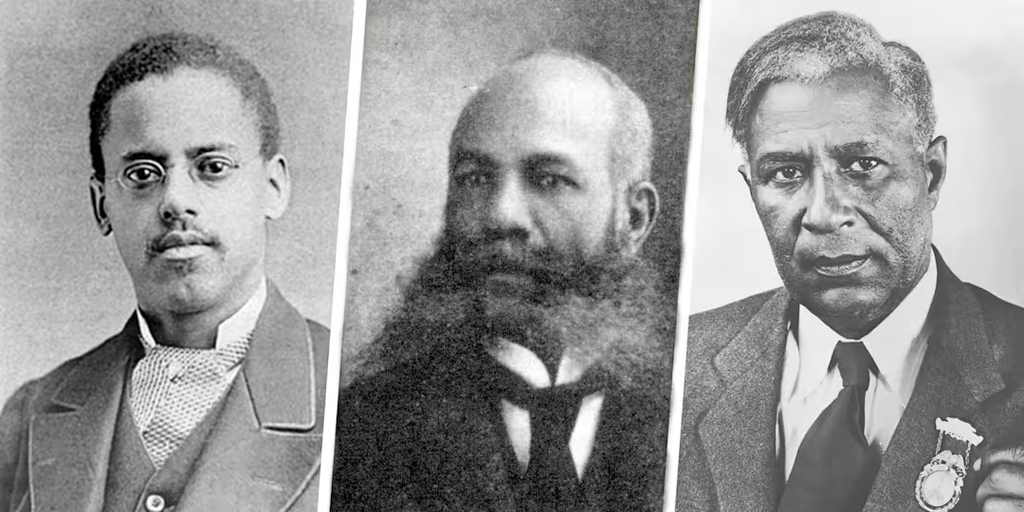
Black inventors have helped shape modern life through innovations that influence transportation, household chores, communication, food preservation and countless everyday activities. From improvements to the traffic signal to practical developments in the ironing board, their work has made daily routines safer, more convenient and more efficient.
Despite facing racial discrimination, limited access to education and significant barriers to patents and business opportunities, many Black innovators developed ideas that addressed real-world problems. Their achievements demonstrate the importance of creativity, persistence and the ability to recognise opportunities for improvement in ordinary life.
Here are eight Black inventors whose contributions helped change the way people live and work.
1. Garrett Morgan: Improving Traffic Safety
Garrett Morgan was an inventor and entrepreneur whose work helped influence the development of traffic safety technology. Born in Kentucky in 1877, Morgan moved to Ohio, where he built a career creating practical inventions to solve everyday problems.
One of his best-known contributions was a traffic signal design that included an intermediate warning position between stop and go. At a time when increasing numbers of automobiles were sharing roads with pedestrians, bicycles and horse-drawn vehicles, traffic management was becoming an important public safety concern.
Morgan’s three-position signal helped address the dangers created when drivers moved through intersections without sufficient warning. His design included a position that alerted road users before traffic was required to stop or proceed. Although modern traffic signals have developed considerably since his invention, Morgan’s work represents an important chapter in the history of traffic control.
Morgan also developed a safety hood that helped protect firefighters and other workers from smoke and hazardous gases. He used the device during rescue work, demonstrating his interest in inventions that could protect human life.
His achievements extended beyond engineering. Morgan established businesses and pursued commercial opportunities at a time when Black entrepreneurs faced substantial barriers. His story illustrates how practical observation and determination can lead to innovations with lasting public value.
2. Sarah Boone: Making Ironing Easier
Sarah Boone was an African American inventor who improved the design of the ironing board during the nineteenth century. Born into slavery in North Carolina around 1832, she later lived in Connecticut, where she worked as a dressmaker.
Traditional ironing surfaces were often inconvenient for shaping fitted garments, particularly women’s clothing. Sleeves, bodices and other narrow sections could be difficult to press evenly using a simple flat board.
Boone developed an improved ironing board designed to make it easier to iron the sleeves and bodies of garments. Her design was narrower and curved, helping users work with the shape of clothing more effectively.
She received a United States patent for her ironing board improvement in 1892. The patent marked a significant achievement for a Black woman working during a period when women, particularly Black women, had limited access to many professional and commercial opportunities.
Boone’s invention did not create the ironing board itself, but it helped refine a familiar household tool. That distinction is important: many inventions improve existing products rather than introducing something entirely new.
Today, ironing boards remain common household items, and their basic purpose is familiar to millions of people. Boone’s contribution is a reminder that small design improvements can make repetitive domestic tasks more manageable.
3. Lewis Latimer: Helping Improve Electric Lighting
Lewis Howard Latimer was an inventor, draftsman and engineer whose work contributed to the development of electric lighting and other technologies.
Born in Chelsea, Massachusetts, in 1848, Latimer developed valuable technical skills despite facing the social and educational barriers of his era. He became an accomplished draftsman and worked with prominent inventors and companies involved in the growth of electrical technology.
One of his most important contributions involved improvements to the production of carbon filaments used in incandescent light bulbs. Early electric lighting systems faced practical challenges involving durability, manufacturing and cost. Latimer patented a method for manufacturing carbon filaments in 1882, helping address some of these difficulties.
His work supported the broader effort to make electric lighting more practical for homes, businesses and public spaces. Although he did not invent the light bulb, his technical contributions helped improve an important component of the technology.
Latimer also worked with major figures in electrical innovation and contributed to the expansion of electric lighting systems. His expertise extended beyond a single invention, reflecting the essential role of engineers and technical specialists in transforming scientific ideas into usable products.
Modern lighting technology has changed dramatically, from incandescent bulbs to LEDs, but the historical development of electric illumination depended on many people improving its performance and reliability. Latimer deserves recognition as one of those important contributors.
4. Frederick McKinley Jones: Transforming Refrigerated Transportation
Frederick McKinley Jones was an inventor whose work helped revolutionise the transportation of perishable goods. Born in Cincinnati, Ohio, in 1893, Jones developed mechanical and electrical skills that later supported his innovative career.
Before reliable mobile refrigeration became widely available, transporting food over long distances presented major challenges. Fresh produce, meat, dairy products and other temperature-sensitive goods could spoil during journeys, limiting how far they could travel safely.
Jones developed a practical mechanical refrigeration system for trucks, helping keep cargo cool while vehicles were moving. His invention made it easier to transport perishable products across longer distances and contributed to the growth of refrigerated delivery networks.
In 1935, Jones received a patent for an air-cooling unit designed for trucks. He later co-founded Thermo King with entrepreneur Joseph Numero, helping turn the technology into a commercial success.
The importance of mobile refrigeration extends far beyond grocery delivery. Temperature-controlled transportation supports food distribution, medical supplies and other products that require carefully managed storage conditions.
Modern refrigerated trucks use more advanced systems, but the underlying need remains the same: maintaining appropriate temperatures while goods move between producers, warehouses, shops and customers.
Jones’s work helped strengthen the infrastructure behind modern supply chains, making a significant difference to the availability and distribution of everyday necessities.
5. Marie Van Brittan Brown: Pioneering Home Security
Marie Van Brittan Brown was an African American nurse who helped develop an early home security system. Living in Queens, New York, during the 1960s, she faced the practical concern of personal safety, particularly because her working hours did not always align with those of her husband, Albert Brown, an electronics technician.
The couple developed a system that allowed a person inside a home to identify visitors without immediately opening the door. Their design included peepholes positioned at different heights, a camera, a monitor and a mechanism for communicating with someone outside.
The system also included features intended to alert the homeowner when an unfamiliar visitor was present. The Browns received a patent for their invention in 1969.
Their work anticipated several ideas that later became familiar in modern home security, including video doorbells and systems that allow residents to observe visitors before granting access.
Today’s technology is more compact and may incorporate smartphone applications, motion detection and internet connectivity. Nevertheless, the central concept remains recognisable: homeowners want to know who is outside before opening the door.
Brown’s invention is an example of how a practical concern in everyday life can inspire technological development. Her work also helped demonstrate that innovation can come from people responding directly to the challenges they experience in their own homes and communities.
6. Patricia Bath: Advancing Cataract Treatment
Patricia Bath was an ophthalmologist, inventor and medical pioneer whose work helped improve the treatment of cataracts. Born in Harlem, New York, in 1942, she pursued a career in medicine at a time when women and Black Americans remained underrepresented in many medical professions.
Cataracts cause clouding of the eye’s natural lens and can interfere significantly with vision. Surgical treatment has helped millions of people regain useful sight, but medical technology has continued to evolve to make procedures more effective.
Bath developed the Laserphaco Probe, a device designed to use laser technology to assist in cataract treatment. She received a United States patent for the invention in 1988, becoming the first Black woman physician to receive a medical patent in the United States.
Her work reflected a broader commitment to improving access to eye care. Bath believed that preventable blindness and visual impairment should be addressed across communities, including populations that had historically received inadequate medical services.
Cataract treatment today involves technologies and techniques that have continued to advance since Bath’s research. Her contribution remains significant because it represents an effort to improve a medical procedure that can restore independence and quality of life.
Her career also challenged assumptions about who could become a medical innovator, showing how scientific achievement and a commitment to public health can reinforce one another.
7. Otis Boykin: Improving Electronic Devices
Otis Boykin was an African American inventor whose work helped advance electrical components used in electronic equipment. Born in Dallas, Texas, in 1920, Boykin studied engineering and developed a career focused on improving the performance and reliability of electrical devices.
He became particularly associated with improvements to electrical resistors, components that regulate current in electronic circuits. Resistors are essential in many devices because they help control electrical behaviour and protect sensitive components from unsuitable current levels.
Boykin patented several inventions during his career, including improvements related to electrical resistors. His work helped address the need for components that could operate reliably in electronic equipment.
The importance of such innovations is easy to overlook because resistors are generally hidden inside devices rather than visible to users. However, electronic products depend on many small components working together correctly.
Boykin’s name has also been associated with the development of electronic circuitry used in medical equipment and other applications. Claims about any single inventor’s influence should be understood within the wider history of engineering, where progress usually results from contributions by many researchers and manufacturers.
Modern electronics are considerably more advanced than the devices available during Boykin’s lifetime, but the need for reliable circuit components remains fundamental. His work illustrates how inventions that receive little public attention can still influence the technologies people depend on.
8. Mark Dean: Helping Shape Personal Computing
Mark Dean is an African American computer engineer whose work contributed to the development of personal computing technology. Born in Jefferson City, Tennessee, in 1957, Dean became a prominent engineer at IBM, where he helped develop important computer hardware.
He was a key member of the team responsible for the original IBM personal computer introduced in 1981. Dean contributed to the design of the computer’s architecture and helped develop technologies that allowed different hardware components to communicate with one another.
He also co-invented the Industry Standard Architecture bus, a technology that helped connect expansion cards and other components to a personal computer. This helped make it possible to expand computer capabilities by adding compatible hardware.
Personal computers have since become central to education, business, communication and entertainment. Their development depended on advances in processors, memory, storage, software and the systems that allow components to work together.
Dean’s career continued beyond the original IBM PC, including work in advanced computing and semiconductor technology. He later became an IBM fellow, one of the company’s highest technical distinctions.
His achievements show how engineers can influence everyday life without creating a product that bears their name. The computers used in homes, schools and workplaces reflect decades of collective innovation, and Dean’s work forms part of that history.
Why Recognising Black Inventors Matters
The stories of these eight inventors reveal the many forms innovation can take. Some improved household tools, others helped make roads safer, and several contributed to technologies used in medicine, transportation and computing.
Their experiences also highlight a historical reality: Black inventors often worked against discrimination and unequal access to education, funding and professional networks. Their accomplishments are therefore important not only for their technical value but also for what they demonstrate about persistence and creativity in the face of obstacles.
It is equally important to recognise inventions accurately. Most modern technologies developed over time through the combined efforts of many people. Giving individual inventors credit for their specific contributions helps preserve a fuller and more truthful understanding of history.
From the traffic signal to refrigerated transportation and personal computing, the influence of Black innovators can be seen in systems that millions of people use every day.
Their achievements remind us that progress does not always arrive through one dramatic breakthrough. Sometimes, it begins with noticing a problem, imagining a better solution and working patiently to bring that idea into the world.