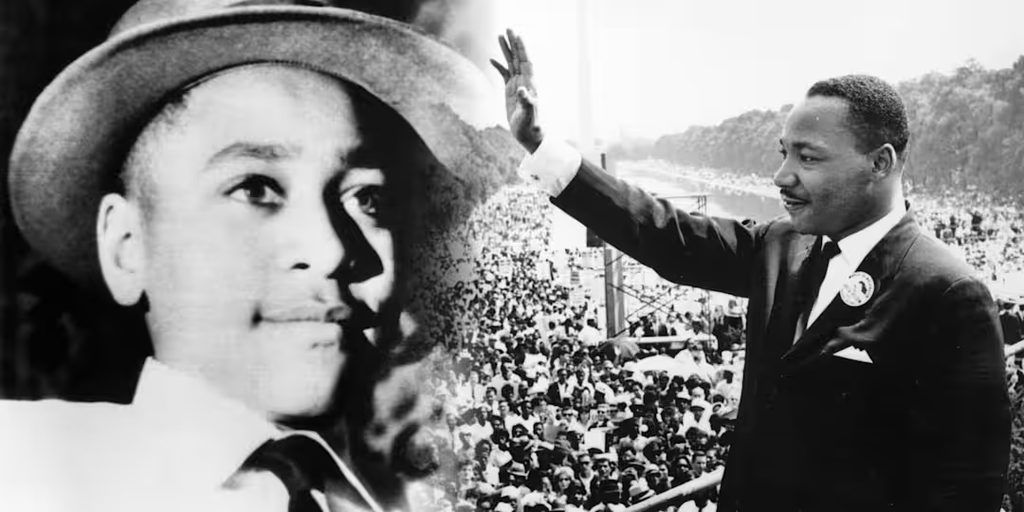
August 28 holds a powerful place in American history. On this date in 1955, 14-year-old Emmett Till was brutally murdered in Mississippi, a crime that exposed the violence of racial hatred and shocked communities across the United States. Eight years later, on August 28, 1963, approximately 250,000 people gathered in Washington, D.C., for the historic March on Washington for Jobs and Freedom, where Dr. Martin Luther King Jr. delivered his famous “I Have a Dream” speech.
The two events, separated by exactly eight years, represent different but deeply connected moments in the struggle for racial equality. Till’s murder became a symbol of the devastating consequences of racism, while the March on Washington demonstrated the determination of millions of Americans to demand civil rights, economic opportunity, and equal treatment under the law.
Photographs from both periods preserve the faces, emotions, and public reactions that written accounts alone cannot fully convey. Images of Till’s funeral helped reveal the human cost of racial violence, while photographs of the 1963 march captured an extraordinary gathering of people united around the demand for a more just nation.
Together, these images tell a story of grief, courage, resistance, and the long struggle to transform American society.
August 28, 1955: The Murder of Emmett Till
Emmett Louis Till was born in Chicago, Illinois, in 1941. Raised primarily by his mother, Mamie Till-Mobley, he grew up in a city that offered opportunities unavailable to many Black Americans in the segregated South, although racial discrimination remained a reality in the North as well.
In August 1955, Till traveled to Mississippi to visit relatives. He was only 14 years old when he was accused of offending a white woman at a grocery store in the small community of Money.
Days later, two white men abducted Till from his relatives’ home. His body was discovered in the Tallahatchie River on August 31, 1955. He had been brutally beaten and shot.
The murder took place in a society where racial segregation and white supremacist violence were deeply entrenched. Black residents in Mississippi faced intimidation, unequal legal treatment, and the constant threat of violence when they were perceived to have challenged the racial order.
Till’s death was particularly shocking because of his age. He was a child visiting family during the summer, yet he became the victim of an act of extraordinary brutality.
The murder exposed the deadly consequences of a system that denied Black Americans equal protection and allowed racial violence to persist with devastating consequences.
The Photographs That Changed Public Understanding
One of the most consequential decisions in the aftermath of Till’s murder was made by his mother.
Mamie Till-Mobley insisted that her son’s body be returned to Chicago. When the funeral took place, she chose to allow the public to see what had been done to him.
She wanted people to understand the reality of the violence that had taken her son’s life.
At the funeral, the open casket revealed the terrible injuries inflicted on Till. Photographs published in Black newspapers and magazines brought the images to audiences far beyond Mississippi and Chicago.
The photographs were painful to see, but their impact was profound. They challenged attempts to minimize racial violence and made it difficult for the public to treat the murder as an abstract legal dispute.
Images of Till’s damaged face became an enduring part of the history of the civil rights movement. They communicated the human consequences of racism with a force that words could not always achieve.
For many Black Americans, the photographs confirmed the dangers they already understood from personal experience. For other audiences, they provided a direct confrontation with the brutality of racial hatred.
Mamie Till-Mobley transformed her personal grief into a public act of remembrance and protest. Her decision helped ensure that her son’s death would not disappear from public attention.
The photographs also demonstrated how images could influence public opinion, strengthen political awareness, and preserve evidence of injustice for future generations.
A Trial That Exposed the Failures of the Justice System
The legal proceedings following Till’s murder became another defining part of the story.
Two white men, Roy Bryant and J. W. Milam, were charged with his kidnapping and murder. In September 1955, an all-white, all-male jury acquitted them after a trial that lasted only a few days.
The verdict exposed the profound inequalities of the American legal system under segregation. Despite the evidence and national attention surrounding the case, the men were not convicted.
The outcome devastated Till’s family and intensified criticism of the racial order that governed Mississippi and much of the South.
In 1956, Bryant and Milam admitted their involvement in the killing during a paid magazine interview, knowing they could not be tried again for the same crime after their acquittal. Their account further demonstrated the injustice of the verdict.
The case became an important reference point for civil rights activists, who argued that racial equality required more than changes in public attitudes. It also required equal protection under the law and accountability for violence.
Till’s murder and the failure to convict his killers helped galvanize support for the growing civil rights movement. His story became a reminder that racial injustice was not simply a matter of prejudice; it was also sustained by institutions that failed to protect Black lives.
August 28, 1963: A Historic March on Washington
Eight years after Till’s death, Washington, D.C., became the setting for one of the largest and most influential civil rights demonstrations in American history.
On August 28, 1963, approximately 250,000 people gathered near the Lincoln Memorial for the March on Washington for Jobs and Freedom.
The event brought together civil rights organizations, labor unions, religious groups, student activists, and ordinary Americans from across the country. Participants called for an end to racial segregation and discrimination, stronger civil rights protections, and better employment opportunities.
The march took place during a period of intense national debate over racial equality. Black Americans continued to face segregated schools, discriminatory hiring practices, unequal access to housing, and barriers to voting.
Civil rights activists had organized demonstrations, boycotts, sit-ins, and voter registration campaigns for years. Their work had brought attention to injustice, but many of the demands for meaningful federal action remained unresolved.
The March on Washington sought to turn that pressure into a powerful public statement.
Photographs show crowds stretching across the National Mall, people holding signs demanding jobs and freedom, and participants listening to speeches beneath the Lincoln Memorial. The images convey the scale of the gathering and the determination of those who traveled to the capital to call for change.
The demonstration was peaceful, disciplined, and diverse in its organizational support. It became a landmark moment in the struggle for civil rights.
Martin Luther King Jr. and the “I Have a Dream” Speech
The most famous moment of the march came when Dr. Martin Luther King Jr. addressed the crowd.
King’s speech connected the promises of American democracy with the lived experiences of Black citizens who continued to face racial discrimination. He called for a nation in which people would be judged by their character rather than the color of their skin.
His “I Have a Dream” address combined moral urgency with a vision of a more equal future. It challenged the country to confront the gap between its founding ideals and the reality of segregation.
Photographs of King speaking at the Lincoln Memorial became some of the most recognizable images of the civil rights movement. His position before the crowd, with the memorial behind him, created a powerful visual connection between the movement’s demands and the principles associated with American democracy.
The speech was not the only important contribution made that day. Other civil rights leaders, labor representatives, and activists addressed the crowd, while the event itself demonstrated the organizational strength of a broad coalition.
Nevertheless, King’s words became the enduring symbol of the march because they articulated a hope that reached beyond the immediate demands of the demonstration.
The speech called for a future in which racial equality would be a practical reality rather than an unfulfilled promise.
The Significance of the Date: Eight Years Between Tragedy and Hope
The fact that the March on Washington took place exactly eight years after Till’s murder gives August 28 an extraordinary historical resonance.
The two events were not the same kind of occurrence. One was a brutal crime against a child; the other was a mass demonstration calling for civil rights and economic justice. Yet their shared date provides a striking way to reflect on the changes and continuities in American life.
In 1955, photographs of Till’s body forced the public to confront the consequences of racial violence. In 1963, photographs of the march showed hundreds of thousands of people demanding that the nation address the conditions that allowed racial inequality to persist.
The images are different in tone, but both reveal the power of visual evidence.
The photographs from Till’s funeral documented the devastating consequences of hatred and the courage of a mother who refused to let the world look away. The images from Washington documented collective action, political determination, and the hope that sustained the civil rights movement.
Neither event alone explains the full history of the struggle for equality. But together, they help illustrate how grief, protest, and organizing shaped the national conversation.
The eight-year interval also reminds us that historical change does not occur automatically. It depends on individuals and communities who challenge injustice, preserve memories, organize movements, and demand accountability.
How the March on Washington Helped Change American Law
The March on Washington strengthened public pressure for federal civil rights legislation.
At the time of the demonstration, President John F. Kennedy’s administration had proposed civil rights measures, but the legislation faced significant political obstacles. The march helped demonstrate that the demand for change extended across a broad coalition of Americans.
The Civil Rights Act of 1964 subsequently prohibited discrimination in important areas of public life and employment. It also strengthened the federal government’s ability to address segregation and discriminatory practices.
The Voting Rights Act of 1965 followed, establishing important protections against racial discrimination in voting.
These laws represented major advances, although they did not immediately eliminate every form of racial inequality. Discrimination in housing, education, employment, and the criminal justice system continued to shape the lives of many Black Americans.
The legislation nevertheless demonstrated that organized public pressure could help produce substantial changes in national policy.
The March on Washington remains an important example of how demonstrations can connect local struggles to national political decisions.
Its legacy also extends beyond legislation. The event helped establish a lasting image of a multiracial coalition demanding that the country live up to its democratic principles.
The Women and Organizers Behind the Movement
Although King’s speech dominates many popular accounts of the march, the event depended on the work of numerous organizers and activists.
Bayard Rustin played a major role in coordinating the demonstration, managing logistics, and helping bring together the participating organizations. A. Philip Randolph had advocated for a march on the capital for decades and helped lead the campaign that ultimately brought the 1963 gathering together.
Women also played essential roles in the broader civil rights movement, organizing communities, coordinating demonstrations, registering voters, and challenging discriminatory institutions.
Daisy Bates, a civil rights leader from Arkansas, was among the women who spoke during the program, representing the determination of activists working to desegregate schools and protect Black students.
The history of the march therefore extends far beyond a single speech. Its success depended on months of planning and the efforts of people whose names were not always given the same public attention as those of the movement’s most famous leaders.
Recognizing these contributions helps provide a more complete understanding of how social movements develop. Large demonstrations require leadership, but they also rely on the often-unseen labor of organizers, volunteers, workers, and community members.
Why These Photographs Still Matter Today
Historical photographs can preserve details that later generations might otherwise struggle to imagine.
The images of Emmett Till document the human cost of racial violence and the determination of his mother to bring public attention to the crime. The photographs from the March on Washington preserve the scale of a demonstration that helped change the course of American history.
Both sets of images invite viewers to consider the relationship between individual lives and larger social forces.
Till’s story reminds audiences that racial hatred can have devastating consequences when it is reinforced by unequal institutions. The march demonstrates that sustained organizing can challenge those institutions and create pressure for change.
These photographs also raise questions about how history is remembered. Which people are placed at the center of the story? Whose suffering is acknowledged? Which organizers and participants receive recognition? And how can historical evidence help future generations understand the struggles that shaped their society?
The answers matter because the civil rights movement was not an isolated event. It was part of a long effort involving multiple generations, communities, and strategies.
The images remain relevant not because history repeats itself in precisely the same way, but because questions about equality, accountability, and human dignity continue to shape public life.
From Emmett Till’s Murder to the Dream of Equality
August 28, 1955, and August 28, 1963, represent two deeply connected moments in the American struggle for civil rights.
Emmett Till’s murder exposed the brutality of racial violence and the failures of a justice system that denied his family a conviction. His mother’s decision to make his injuries visible to the public helped ensure that the crime became a lasting symbol of injustice.
Eight years later, the March on Washington brought approximately 250,000 people together to demand racial equality, economic opportunity, and federal action. Martin Luther King Jr.’s “I Have a Dream” speech gave lasting expression to the movement’s vision of a more just society.
The photographs from these events preserve both the pain and the possibility that shaped the era. One set documents a family’s unimaginable loss; the other captures a vast public gathering determined to change the country.
Together, they reveal that the struggle for equality involved both bearing witness to injustice and organizing to overcome it.
The passage of time has not diminished the significance of these images. They continue to remind Americans that progress requires courage, collective action, and a willingness to confront uncomfortable truths.
Eight years separated Emmett Till’s murder from the March on Washington, but both events remain essential to understanding the civil rights movement. Their photographs tell a story of grief transformed into public awareness, and of hope strengthened by the determination of people who refused to accept racial inequality as the nation’s permanent condition.