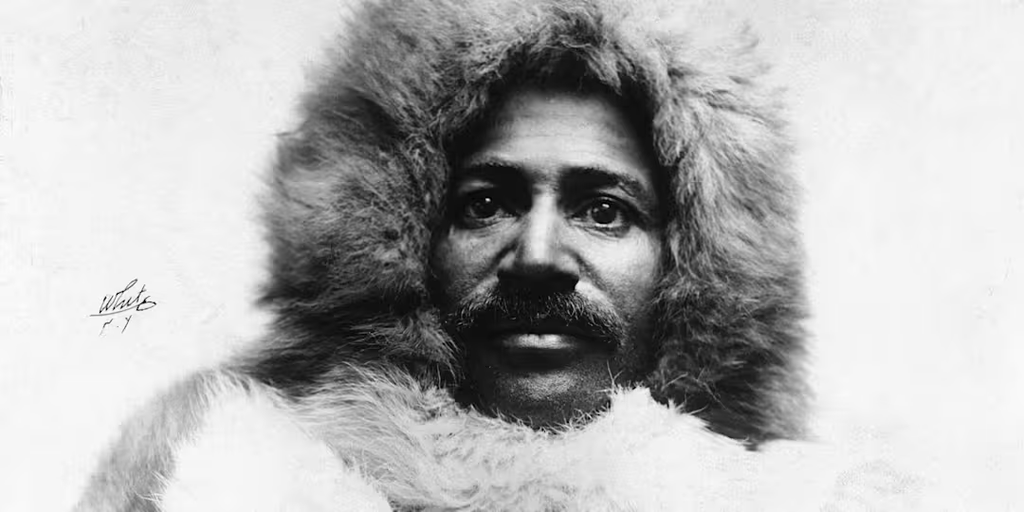
In April 1909, American explorer Robert Peary announced that he had reached the North Pole, achieving what generations of explorers had attempted and failed to accomplish. Yet one member of his expedition played a crucial role in the journey and later claimed that he may have arrived at the destination before Peary himself. His name was Matthew Alexander Henson, an African American explorer whose remarkable Arctic achievements were overshadowed for decades by the fame of his white expedition leader.
Henson’s story is one of extraordinary endurance, practical skill, and historical injustice. Born into a society deeply divided by race, he became an experienced Arctic traveler, learned from Inuit communities, and helped lead expeditions across some of the most dangerous terrain on Earth. His knowledge of sled dogs, navigation, hunting, and survival proved essential to Peary’s efforts to reach the northernmost point on the globe.
But the question at the heart of their story remains complicated: Did Matthew Henson reach the North Pole before Robert Peary? And can historians establish whether their expedition actually reached the geographic pole at all?
The answers reveal not only the challenges of early polar exploration but also the difficulties of determining historical credit when the surviving evidence is incomplete.
Who Was Matthew Henson?
Matthew Alexander Henson was born in Maryland in 1866, shortly after the end of the American Civil War. He grew up during a period when African Americans faced widespread discrimination and had limited opportunities in many professions.
Henson experienced hardship early in life. After losing his parents, he eventually found work aboard a merchant ship as a young teenager. His time at sea introduced him to navigation, travel, and the practical skills required to survive in unfamiliar environments.
Working on ships also exposed him to a wider world beyond the United States. He learned to read and write with the help of a ship captain and developed the independence that would later serve him during demanding expeditions.
In 1887, Henson met Robert Edwin Peary in Washington, D.C. Peary, a United States Navy civil engineer with ambitions to explore the Arctic, hired Henson to accompany him on an expedition to Central America.
Their professional relationship continued after that journey. Peary recognized Henson’s abilities and brought him along on subsequent explorations, eventually relying on him as one of his most experienced companions.
Over the following two decades, Henson participated in several Arctic expeditions. He became skilled at handling sled dogs, repairing equipment, hunting, and traveling across snow and ice. He also learned the Inuit language and developed relationships with Inuit people whose knowledge of the Arctic was essential to the expeditions’ survival.
These abilities made Henson much more than an assistant. He was an experienced explorer whose contribution helped make Peary’s increasingly ambitious journeys possible.
The Partnership Between Matthew Henson and Robert Peary
The relationship between Henson and Peary was central to the history of American Arctic exploration.
Peary supplied leadership, organized expeditions, secured financial support, and pursued the goal of reaching the North Pole. Henson brought extensive field experience and practical expertise developed through years of travel in the Arctic.
Their earlier expeditions pushed farther north than previous explorers had managed. They learned how to transport supplies, manage teams of dogs, and survive in a region where extreme cold, shifting ice, and unpredictable weather could turn a minor mistake into a life-threatening emergency.
Henson also learned from Inuit communities about clothing, transportation, hunting, and other techniques adapted to the Arctic environment. These methods were often more suitable for polar conditions than the equipment and practices favored by inexperienced outsiders.
The knowledge gained from these experiences became particularly important during the expedition of 1908–1909.
Reaching the North Pole was not simply a matter of traveling north until the destination appeared. The team had to cross sea ice that could crack, drift, or shift beneath their sledges. Temperatures could be severe, and navigation depended on instruments and calculations that were difficult to use accurately in such conditions.
Every member of the expedition depended on the others. Experienced dog handlers had to keep the teams moving, hunters helped secure food, and explorers had to judge the safest routes across constantly changing terrain.
Henson’s experience made him a critical member of this effort. Even accounts sympathetic to Peary acknowledge that his practical knowledge was indispensable to the expedition’s success.
The 1909 Expedition to the North Pole
Peary and Henson began their final major attempt to reach the North Pole aboard the ship Roosevelt, which departed the United States in 1908.
The expedition traveled north toward Ellesmere Island, where the team prepared for the difficult journey across the Arctic Ocean’s ice-covered surface.
The plan involved a larger group carrying supplies and establishing depots along the route. As the expedition advanced, some members returned while a smaller party continued toward the ultimate objective.
The final party included Peary, Henson, and four Inuit men: Ootah, Egingwah, Seegloo, and Ooqueah. Their knowledge and labor were integral to the journey, although historical accounts often concentrated on the two American explorers.
The team set out from the northern coast of Ellesmere Island in early March 1909. They traveled by dogsled, moving across ice ridges, snowfields, and stretches of rough terrain.
Progress was physically exhausting. The sledges had to carry food, equipment, and other supplies, while the travelers faced the possibility of open water, unstable ice, and severe weather.
Henson often traveled ahead to scout the route and help guide the sledges. His familiarity with Arctic conditions allowed him to make practical decisions that could save time and reduce danger.
On April 6, 1909, Peary’s party believed it had reached the North Pole. The men established a camp and made observations intended to determine their position.
Peary subsequently announced that the expedition had achieved its goal. The claim brought international attention and made him one of the most celebrated explorers of his era.
However, the question of exactly where the party had arrived—and which member reached that location first—would become the subject of a long-running historical debate.
Did Matthew Henson Reach the Pole Before Peary?
Henson later described himself as having traveled ahead of Peary during the final stage of the expedition.
According to his account, he was leading the way when the team approached what it believed to be the North Pole. He reported that Peary was behind him and that his own tracks were already present when the party established its position.
Henson later recalled that Peary arrived after him and that he believed he had been the first member of the American party to reach the spot.
This claim is central to Henson’s place in exploration history. If the expedition did reach the geographic North Pole, Henson may have arrived before Peary.
Yet there is an important distinction between being first to reach the party’s estimated destination and conclusively establishing who first stood at the precise geographic pole.
The North Pole is defined by Earth’s rotational axis, corresponding to 90 degrees north latitude. Unlike a mountain summit or a permanent landmark, it has no fixed physical marker. The surrounding sea ice moves, and accurate navigation is essential to determining a position.
Peary and his companions used the navigational methods available at the time, including observations of the sun and calculations of their progress. However, the conditions made precise measurements difficult.
Henson’s account provides evidence about the sequence of events as he remembered them. It does not independently establish the exact coordinates of the party or conclusively prove that he reached 90 degrees north.
For that reason, historians must consider his claim alongside Peary’s records, the expedition’s observations, and later assessments of the journey.
The Controversy Over Whether Peary Reached the North Pole
The debate over Henson’s achievement cannot be separated from the larger controversy surrounding Peary’s claim.
When Peary returned in 1909, his announcement was challenged by another explorer, Frederick Cook, who claimed that he had reached the North Pole in April 1908.
Cook’s claim was eventually widely rejected because he could not provide convincing evidence to substantiate it. Nevertheless, the dispute intensified public interest in the race to the pole and encouraged scrutiny of Peary’s own account.
Questions emerged about the accuracy of Peary’s navigational calculations, the limited opportunities for independent verification, and the speed of the final journey.
In such a remote environment, there were few observers who could independently confirm the explorers’ position. The expedition’s records therefore became especially important.
The National Geographic Society initially supported Peary’s claim after examining his documentation. However, later assessments questioned whether the available evidence was sufficient to establish that he had reached the precise geographic North Pole.
The controversy has never been resolved to the satisfaction of every historian and researcher.
Some accounts defend the expedition’s achievement, while others argue that the surviving records do not conclusively prove that the team reached its stated destination.
This uncertainty affects the question of who arrived first. If the expedition fell short of the pole, neither Henson nor Peary can be definitively credited with reaching it on that journey. If it did reach the pole, Henson’s recollections suggest that he may have been the first member of the party to arrive.
The most responsible historical conclusion is therefore that Henson may have reached the pole before Peary, but neither the exact order nor the expedition’s precise position can be established with complete certainty from the surviving evidence.
The Essential Contributions of the Inuit Members
Discussions of the North Pole expedition often focus on Peary and Henson, but the four Inuit men who accompanied them also deserve recognition.
Ootah, Egingwah, Seegloo, and Ooqueah were members of the final party and contributed their knowledge, labor, and experience to the journey.
The expedition depended on dogsled transportation, local knowledge, and the ability to survive in an environment that could quickly become dangerous. Inuit expertise in these areas was essential.
Arctic travel required an understanding of snow conditions, ice movement, hunting, clothing, and the behavior of dogs. Such knowledge had been developed over generations by people who lived in the region.
The historical record has often given the American expedition leaders more attention than the Inuit participants, even though the journey would have been extremely difficult without their contributions.
A fuller account of the expedition recognizes that reaching the Arctic’s farthest regions was a collective effort. The achievement cannot be understood accurately by treating it as the accomplishment of a single individual.
Henson’s own success was closely connected to his ability to learn from Inuit communities and apply their methods. His experience demonstrates that exploration was not only about personal courage but also about cooperation and respect for knowledge developed by people who understood the environment.
How Racism Shaped Henson’s Recognition
Even as Henson’s importance to the expedition became apparent, he did not receive the same public recognition as Peary.
At the beginning of the twentieth century, racial discrimination shaped American institutions, employment opportunities, and public attitudes. A white explorer could be celebrated as a national hero while a Black colleague who had contributed substantially to the same achievement received far less attention.
Peary was widely presented as the leader who had discovered the North Pole. Henson was frequently described as his assistant, a description that failed to communicate the extent of his field experience and practical responsibilities.
Henson’s own account of the expedition suggested that the relationship between the two men became strained after they believed they had reached the pole. He later recalled feeling hurt by Peary’s behavior during their return.
The precise reasons for their personal difficulties remain a matter of historical interpretation. Nevertheless, the imbalance in their public recognition is clear.
Henson spent years working in the Arctic, mastering skills that were essential to the expedition. Yet his contribution was often overshadowed by the fame of the expedition leader.
His experience reflects a broader problem in the history of exploration: achievements are frequently remembered through the names of prominent leaders, while the labor and expertise of assistants, local guides, and Indigenous participants receive less attention.
Recognizing Henson does not require diminishing Peary’s role. It requires acknowledging that the expedition depended on a partnership and that the history of exploration is incomplete when the contributions of important participants are overlooked.
Matthew Henson’s Later Life and Legacy
After his Arctic expeditions, Henson returned to the United States and spent years seeking wider recognition for his work.
He published an account of his experiences, A Negro Explorer at the North Pole, in 1912. The book helped preserve his perspective on the expedition and his role in the journey.
Henson lived until 1955, but broader public recognition of his accomplishments grew gradually over the decades that followed.
In 1944, he received recognition from the United States Congress connected to the North Pole expedition. In 2000, the National Geographic Society posthumously awarded him the Hubbard Medal, one of its highest honors for exploration.
In 1988, Henson and his wife were reinterred at Arlington National Cemetery, where he rests near Peary. The location symbolizes their shared place in the history of American Arctic exploration, even though their contributions were not always recognized equally during their lifetimes.
Henson’s legacy extends beyond the unresolved question of who arrived first. His life demonstrates the importance of perseverance, practical expertise, and the willingness to pursue ambitious goals despite social barriers.
He also serves as an example of how historical narratives can change as researchers examine overlooked participants and reconsider whose achievements deserve recognition.
So, Who Reached the North Pole First?
More than a century after the 1909 expedition, the question remains difficult to answer definitively.
Matthew Henson said he was ahead of Peary during the final approach and believed he had reached the destination first. His experience, Arctic skills, and role in guiding the expedition make his account important to the historical discussion.
However, uncertainty surrounding the expedition’s navigational records means that it is impossible to state with complete confidence that either man reached the exact geographic North Pole on April 6, 1909.
If the expedition reached the pole, Henson may have arrived before Peary. If it did not, the claim that either explorer was first cannot be conclusively sustained.
What is clear is that Henson was far more than a supporting figure in someone else’s story. He was an accomplished explorer whose knowledge and determination helped carry the expedition toward its goal.
His story also reminds us that historical recognition does not always reflect the full contributions of the people involved. For decades, Henson’s work received less attention than it deserved, partly because of the racial attitudes of his era.
Today, his place in the history of Arctic exploration is increasingly acknowledged. Whether or not he was the first person to stand at the North Pole, Matthew Henson deserves recognition as one of the most important explorers of his generation.
His journey remains a powerful reminder that history is not simply about who receives credit. It is also about examining the evidence, recognizing overlooked contributions, and understanding the many people whose efforts make extraordinary achievements possible.