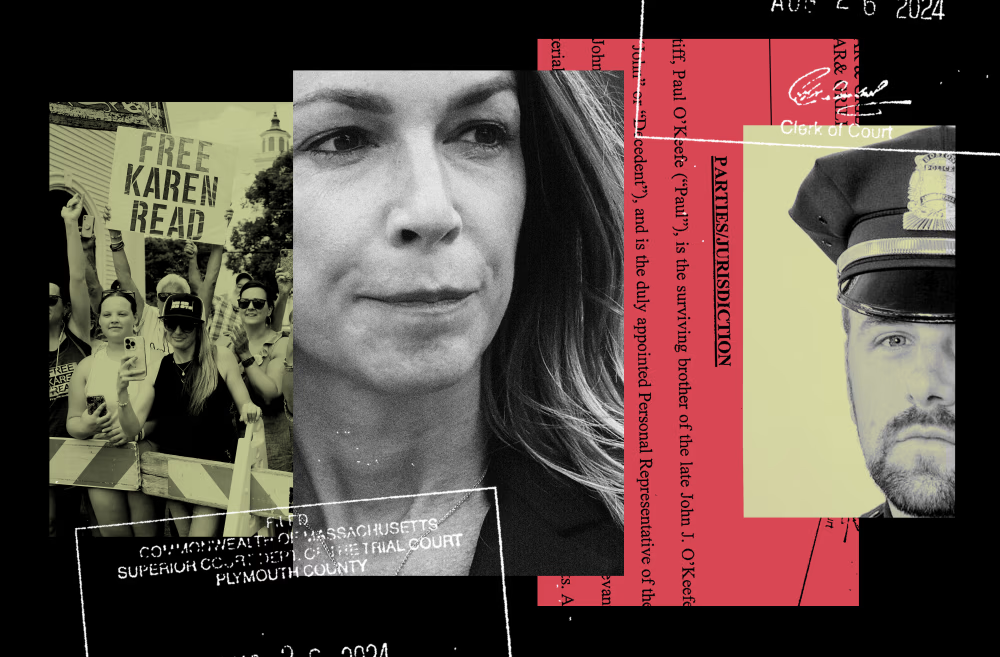
The family of John O’Keefe, a Boston police officer who died in January 2022, faced an agonizing wait for answers after his girlfriend, Karen Read, was accused of killing him. When Read’s first murder trial ended without a unanimous verdict in 2024, the case entered another uncertain chapter. For O’Keefe’s relatives, the prospect of a second trial meant preparing to revisit painful memories while continuing to seek accountability for a loss that had changed their lives forever.
A relative of O’Keefe’s extended family, identified only as Beth in an interview with Dateline, described the emotional toll of the case. Although she said the family had been put “through hell,” she expressed determination to continue pursuing justice for O’Keefe.
“No matter what we have to deal with, justice for Johnny,” she said.
Her words captured the grief and resolve surrounding one of Massachusetts’ most closely watched criminal cases. The investigation, courtroom proceedings and competing accounts of O’Keefe’s death attracted widespread public attention, transforming a family’s private tragedy into a national debate about evidence, police investigations and the criminal justice system.
The case has since moved beyond the retrial anticipated in 2024. In June 2025, a jury found Read not guilty of murder and manslaughter, as well as leaving the scene of a fatal accident, while convicting her of operating under the influence of alcohol. The verdict marked a significant turning point in the criminal proceedings, although the wider legal disputes surrounding O’Keefe’s death have continued.
Who Was John O’Keefe?
John O’Keefe was a Boston police officer who had spent years serving the city. At 46, he was known to family and friends as Johnny, a familiar name that became a recurring expression of affection and remembrance throughout the case.
O’Keefe’s death on January 29, 2022, left his loved ones searching for answers. He was found unresponsive in the snow outside a home in Canton, Massachusetts, during a winter storm. He later died, and the circumstances surrounding his injuries became the subject of a lengthy investigation.
At the center of the investigation was Karen Read, his girlfriend at the time. Prosecutors eventually accused her of causing his death with her SUV and leaving him outside in the cold. Read denied the allegations, and her defense team argued that investigators had reached the wrong conclusion about what happened.
Those competing accounts shaped the proceedings that followed. For O’Keefe’s family, the legal case was inseparable from the loss of someone they loved. Each new development brought renewed attention to the circumstances of his death, along with another round of questions about what the evidence could establish.
The case also generated intense discussion online, where supporters of Read and people who believed the prosecution’s account often interpreted the same developments in sharply different ways.
For families experiencing a death under investigation, such public attention can create an additional burden. Private grief may become intertwined with news coverage, online commentary and repeated discussion of painful details.
Why the First Trial Ended Without a Verdict
Read’s first criminal trial began in 2024 and attracted extensive media coverage. Prosecutors presented their theory of how O’Keefe sustained his fatal injuries, while the defense challenged the investigation and disputed the allegation that Read had killed him.
The prosecution argued that Read struck O’Keefe with her vehicle and left him outside. The defense maintained that she had been framed and questioned the reliability of the investigation. The competing narratives made the proceedings closely watched and deeply contentious.
After weeks of testimony and deliberations, jurors were unable to reach a unanimous verdict on the charges. The judge declared a mistrial in July 2024.
A mistrial did not establish Read’s guilt or innocence. Instead, it meant the jury had not reached the agreement necessary to deliver a verdict on the disputed charges. Prosecutors subsequently pursued another trial, setting the stage for a second round of courtroom proceedings.
For O’Keefe’s relatives, the outcome meant that the criminal case would continue rather than conclude. The prospect of another trial brought the possibility of renewed testimony, additional legal arguments and further public scrutiny.
The emotional impact of that uncertainty was central to Beth’s comments. Her statement reflected a willingness to endure another difficult legal process because the family continued to believe that pursuing justice for O’Keefe mattered.
Yet the decision to continue was not simply a matter of attending court. A high-profile case can keep a family connected to the circumstances of a loved one’s death for years, making it difficult to separate ordinary life from the next legal development.
‘Through Hell’: The Emotional Toll on O’Keefe’s Family
The phrase “through hell” conveyed the depth of the family’s frustration and exhaustion. Although the legal process focused on determining criminal responsibility, the people closest to O’Keefe had already experienced the irreversible loss of a family member.
A criminal trial can offer a formal setting for evidence to be examined, but it cannot restore someone who has died. Nor can a verdict necessarily resolve every question or ease every aspect of grief.
For relatives, the proceedings may require repeatedly hearing descriptions of a loved one’s final hours. Witness testimony, forensic evidence, photographs and arguments between attorneys can bring difficult memories into the public arena. The possibility of a retrial means preparing to confront those details again.
Beth’s remarks also illustrated the distinction between seeking justice and finding emotional closure. Her declaration that the family was ready to proceed did not suggest that the experience had been easy. Rather, it indicated that the pain had not erased the family’s determination to keep O’Keefe’s memory at the center of their efforts.
The experience of a family in a high-profile criminal case can be complicated by the public’s expectations. Some observers may expect relatives to comment on every development, while others may judge their reactions without understanding the private grief behind them.
In reality, people respond to loss in different ways. Some seek privacy, while others speak publicly because they want their loved one remembered or believe that public attention can help keep a case from fading from view.
Beth’s decision to speak under her first name only also reflected the difficult environment surrounding the case. Public interest can bring scrutiny and unwanted attention to people who were not accused of any crime but became associated with a widely debated investigation.
The Defense Challenged the Investigation
While O’Keefe’s family continued to seek answers, Read’s defense team maintained that the prosecution’s account was wrong. The defense raised questions about investigative procedures, the interpretation of evidence and the conduct of officials involved in the case.
Read’s supporters also advanced theories that other people were responsible for O’Keefe’s death and that investigators had failed to pursue the truth. Those claims became a major part of the public debate surrounding the proceedings.
It is important to distinguish allegations made by attorneys or supporters from facts established in court. A defense theory is not automatically proof of misconduct, just as a criminal charge is not proof of guilt. The purpose of a trial is to examine the evidence and determine whether the prosecution has met its legal burden.
The intense public debate made that distinction especially important. Social media discussions frequently presented disputed interpretations with considerable confidence, even when the underlying issues remained contested.
For O’Keefe’s relatives, the arguments were not merely an abstract legal dispute. They concerned the death of someone they knew personally and the question of how that death should be understood.
For Read, the prosecution’s allegations carried the possibility of a lengthy prison sentence and lasting damage to her reputation. She continued to deny that she murdered O’Keefe, and the eventual criminal verdict would reject the most serious charges against her.
A Retrial Took Place in 2025
The second trial began in April 2025, following months of legal disputes and pretrial proceedings. It once again placed the circumstances of O’Keefe’s death under intense examination.
Prosecutors continued to argue that Read was responsible for his death, while the defense challenged the state’s evidence and maintained that she had been wrongly accused. The case drew national attention, with observers following courtroom testimony and debating the competing explanations.
In June 2025, the jury delivered its verdict. Read was found not guilty of second-degree murder, manslaughter and leaving the scene of a fatal accident. Jurors convicted her of operating under the influence of alcohol.
The verdict was a decisive legal development. Read was acquitted of the charges accusing her of causing O’Keefe’s death, meaning those criminal allegations did not result in convictions. The separate operating-under-the-influence conviction remained.
The outcome also changed the context of Beth’s earlier comments about preparing for a new trial. Her statement came during the period after the first trial ended in a hung jury, when the prospect of another criminal proceeding was still ahead.
The second trial ultimately took place, and its verdict differed from the outcome the prosecution had sought. Any account of the family’s earlier determination to continue must therefore be understood in light of what happened afterward.
The Case Continued Beyond the Criminal Verdict
Although the 2025 verdict resolved the principal criminal charges against Read, it did not bring every legal dispute connected to O’Keefe’s death to an end.
O’Keefe’s family pursued a wrongful-death lawsuit against Read, seeking civil accountability. A civil case follows different legal rules from a criminal prosecution, including a different standard of proof. A civil claim is not itself a criminal conviction, and allegations made in such proceedings must be evaluated through that separate process.
The investigation also became the focus of controversy over police conduct. In 2026, Read filed a lawsuit against Massachusetts State Police and Canton police, alleging misconduct and bias in the investigation. Those allegations formed part of the continuing legal disputes surrounding the case and should not be confused with findings made by the jury in her criminal trial.
The continuing litigation demonstrates how a single death can lead to years of legal proceedings involving different parties and questions. Criminal charges, civil claims and allegations about investigative conduct each have their own procedures and standards.
For O’Keefe’s family, the criminal verdict did not erase the loss that prompted the case. For Read, the acquittals on the most serious charges did not immediately end the public scrutiny or all of the legal battles connected to the events of January 2022.
A Family’s Determination to Remember Johnny
Beth’s statement, made before the second trial, reflected the determination of a relative who believed that pursuing justice for O’Keefe was worth enduring another difficult courtroom experience.
Her words also underscored the human reality behind the headlines. Legal cases are often discussed through charges, evidence, verdicts and procedural decisions. For the families involved, however, those developments unfold alongside birthdays, anniversaries, memories and the daily work of living with an absence that cannot be reversed.
The phrase “justice for Johnny” became a concise expression of the family’s position. It communicated their commitment to O’Keefe’s memory without resolving the disputed questions that the courts were asked to consider.
The eventual acquittals on the murder-related charges must be acknowledged alongside that earlier determination. Respecting O’Keefe’s family does not require treating an accusation as proof, just as reporting the jury’s verdict does not diminish the reality of the family’s grief.
The case remains a reminder of the importance of careful evidence, fair legal procedures and restraint when discussing unresolved or disputed allegations. It also shows how public attention can magnify the pain experienced by people who have already suffered a profound personal loss.
For O’Keefe’s loved ones, the challenge has been to remember the person behind the case while navigating a process that brought their private tragedy into the national spotlight.
The Lasting Impact of the Karen Read Case
The Karen Read case has become more than a story about a single criminal trial. It has raised questions about investigative accountability, the responsibilities of prosecutors and defense attorneys, the influence of social media, and the difficulties families face when a death leads to years of legal uncertainty.
The first trial’s failure to produce a verdict in 2024 prolonged the uncertainty. The second trial in 2025 brought acquittals on the most serious charges and a conviction on a lesser offense. Subsequent civil litigation has continued to generate legal and public attention.
Throughout those developments, O’Keefe’s death has remained the central tragedy. His family’s grief and determination are part of the story, but so are the legal standards that protect every defendant’s right to a fair process and require criminal guilt to be proved beyond a reasonable doubt.
Beth’s words captured a moment when the family was preparing to face the prospect of another trial. “No matter what we have to deal with, justice for Johnny,” she said—a statement of resolve during a period of uncertainty.
The proceedings that followed did not produce the murder conviction prosecutors had sought. Nevertheless, the family’s loss remains real, and the wider legal disputes have continued to shape the story.
Ultimately, the case illustrates the difficult distance between a family’s desire for answers and the conclusions a court can legally reach. The search for accountability may continue through different legal channels, but the need for accuracy, fairness and respect remains essential whenever a tragedy becomes the subject of a national debate.