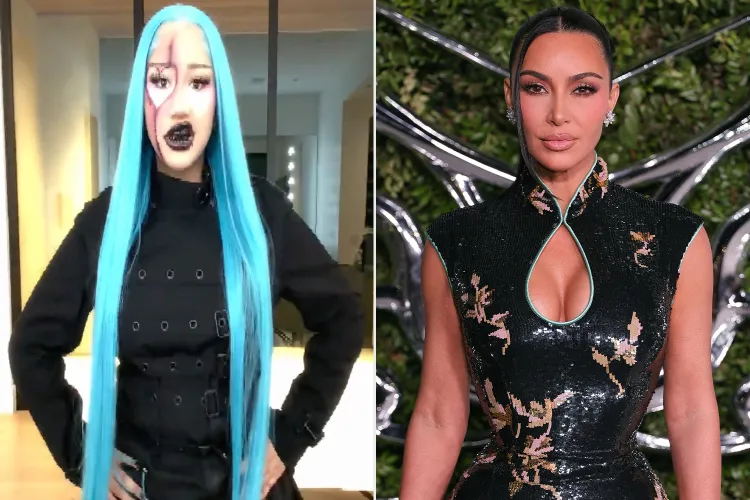
North West is speaking out about the attention surrounding her personal style, making it clear that the way she dresses should not define who she is. The 13-year-old daughter of Kim Kardashian and Kanye West recently addressed comments about her appearance during a livestream with her mother, responding to criticism and speculation about her look.
“Just because I like to dress this way, don’t judge a book by its cover,” North said in videos from the mother-daughter livestream. She also pushed back against being characterized as “demonic,” a label that has circulated in online conversations about her alternative fashion choices.
The comments have drawn renewed attention to the young teenager’s evolving style and the challenges of growing up in the public eye. As the daughter of two internationally recognized celebrities, North has been the subject of public discussion since childhood. Now that she is entering her teenage years, her fashion choices, piercings and self-expression are attracting a different kind of scrutiny.
Kim Kardashian has also defended her daughter’s right to experiment with her appearance, including her piercings. The conversation highlights a broader issue familiar to many parents and teenagers: how to balance personal expression, family guidance and the pressure of public judgment.
North West Responds to Comments About Her Appearance
North’s message was direct: people should not assume they understand someone’s character simply by looking at them.
Her remark, “Just because I like to dress this way, don’t judge a book by its cover,” reflects a frustration that many teenagers experience when their clothing, hairstyles or accessories become the basis for assumptions about their personalities.
For North, however, the situation is complicated by the fact that even ordinary experiments with fashion can become major talking points online. A hairstyle or piercing that might attract little attention on another teenager can prompt widespread discussion when the person involved is part of a famous family.
Her reported response to being called “demonic” pushes back against the tendency to attach exaggerated meanings to an individual’s appearance. Alternative fashion can include dark clothing, dramatic makeup, unconventional accessories and distinctive hairstyles. None of these choices, on their own, establishes anything about a person’s character, beliefs or intentions.
North’s statement asks viewers to look beyond those surface details and recognize that style is only one aspect of an individual’s identity.
At 13, she is also at an age when personal tastes naturally begin to develop. Teenagers often explore different ways of expressing themselves as they figure out what they enjoy and how they want to present themselves to the world.
That process can involve trying looks that differ significantly from what parents, classmates or online audiences expect. North’s experience illustrates how much more complicated that process can become when millions of people feel entitled to comment.
Why North West’s Alternative Style Has Sparked Conversation
North has increasingly become known for experimenting with fashion and beauty choices that stand out from more conventional children’s styles. Her looks have prompted conversations about everything from hairstyles to accessories, with social media users offering opinions that range from supportive to sharply critical.
Alternative fashion is not a new phenomenon. Across generations, teenagers have used clothing, music, makeup and body accessories to explore their identities and communicate their interests. What seems unusual to one person may be an ordinary form of creativity to another.
For young people, clothing can be a way to express independence without necessarily making a statement about anything deeper. A dramatic look may reflect an interest in a particular aesthetic, an appreciation for music or simply a desire to try something different.
The problem arises when observers treat these choices as evidence of a person’s moral character or assume that an unconventional appearance must have a negative meaning.
North’s reported response challenges that assumption. Her message suggests that viewers should not confuse an aesthetic preference with a complete understanding of who she is.
Online discussions can make that distinction difficult to maintain. Images and short videos often circulate without much context, encouraging people to form immediate impressions. Once a particular interpretation gains attention, it can be repeated until it appears more meaningful or widespread than the available information supports.
In North’s case, the attention surrounding her appearance also reflects the public’s longstanding interest in the Kardashian-West family. That visibility can turn an ordinary teenage fashion experiment into a much larger conversation.
Kim Kardashian Defends Her Daughter’s Piercings
Kim Kardashian’s response to the discussion has added another dimension to the story. As a mother, she has defended North’s self-expression, including the piercings that have attracted public attention.
Parenting a teenager often involves navigating questions about appearance, independence and boundaries. Hairstyles, makeup, clothing and body accessories can become subjects of negotiation as young people seek more control over how they present themselves.
For parents, the challenge is to distinguish between choices that are primarily matters of taste and decisions that require additional consideration because of safety, health or long-term consequences.
Kardashian’s defense of North’s piercings has prompted discussion about where that balance should lie. Some people believe parents should give teenagers considerable freedom to explore their personal style, while others prefer a more cautious approach to body modifications at a young age.
There is no single approach that works for every family. Decisions can depend on the type of piercing, the teenager’s maturity, applicable rules, hygiene considerations and the parents’ own values.
What matters in any family is that the decision is handled thoughtfully and that a young person understands the responsibilities associated with it.
Kardashian’s position also highlights a distinction between parenting decisions made within a family and the public’s reaction to those decisions. People may disagree with a particular choice, but public criticism does not automatically mean that a parent has acted irresponsibly.
Without making assumptions about the family’s private discussions, it is possible to recognize that Kardashian is navigating a familiar parenting challenge under unusually intense scrutiny.
Growing Up as Kim Kardashian and Kanye West’s Daughter
North West’s public profile is inseparable from the fame of her parents. Kardashian built a global business and entertainment presence through reality television, fashion and beauty ventures. Kanye West, who has also been known professionally as Ye, has had a major influence on music and popular culture.
Their daughter was introduced to public attention at a very young age. As a result, milestones that might otherwise remain private have often become subjects of online conversation.
Growing up in a celebrity family can offer opportunities that most children do not experience, but it can also bring unusual challenges. Public recognition may make it harder to experiment with identity without feeling watched. Photographs and videos can be shared widely, and comments may continue long after the original moment has passed.
For a teenager, this environment can complicate the normal process of discovering personal preferences. A look chosen for fun may be interpreted as a carefully calculated public statement. A candid remark may become a headline, while a temporary fashion experiment can be treated as a defining feature of someone’s personality.
North’s situation illustrates why it is important to remember that celebrity children are still children. Their famous parents may be accustomed to public attention, but their sons and daughters must develop their own identities while dealing with an audience they did not personally choose.
As North grows older, she may continue to experiment with fashion, interests and creative pursuits. Her preferences may also change over time, just as they do for many teenagers.
Neither outcome needs to be treated as a controversy. Personal style is not a permanent declaration of character, and young people should have room to discover what feels right for them.
The Meaning Behind “Don’t Judge a Book by Its Cover”
North’s reported statement carries a familiar message, but its relevance is particularly clear in an era when social media encourages quick judgments.
The expression “don’t judge a book by its cover” reminds people that outward appearances reveal only part of the story. Clothing, hairstyles and accessories can communicate something about personal taste, but they cannot provide a complete picture of someone’s values, behavior or personality.
That distinction becomes especially important when the person being discussed is a minor.
Public conversations about teenagers can easily cross the line from commenting on a fashion choice to making sweeping judgments about the person wearing it. Labels such as “demonic” can make an aesthetic preference sound like a statement about someone’s character or beliefs, even when there is no basis for that conclusion.
North’s response challenges viewers to question those assumptions rather than repeat them.
Her message does not require everyone to like her style. People naturally have different tastes, and disagreement about fashion is normal. The important difference is between expressing a personal preference and using that preference to demean another person.
Someone can find a particular look unusual without describing the person wearing it in insulting terms. Similarly, a parent can decide that a fashion choice is not right for their own child without assuming that every family should follow the same rules.
This approach leaves room for disagreement while preserving basic respect.
For North, the message appears to be about being recognized as more than her appearance. For the wider audience, it offers a reminder that online commentary can have real consequences, particularly when it targets young people who are still developing their sense of self.
Social Media and the Pressure on Celebrity Teenagers
Social media has changed the way celebrity families interact with the public. Photos, livestreams and short videos allow audiences to see moments that once might have remained within a family or among close friends.
That access can create a sense of familiarity, but it does not mean viewers know the people they watch. A brief video cannot reveal every detail of a person’s life, and a public image is not a complete representation of someone’s private experiences.
The pressure can be especially intense for celebrity teenagers because they are navigating adolescence while being discussed by adults and strangers across the internet.
Appearance-based criticism can affect young people regardless of their family background. For teenagers who receive widespread attention, however, negative comments may be repeated by numerous accounts and amplified far beyond the original conversation.
That does not mean public figures and their families should be immune from all discussion. Fashion, celebrity culture and parenting decisions are legitimate topics of conversation. But there is a meaningful difference between thoughtful discussion and personal attacks directed at a minor.
North’s reported response illustrates the importance of that distinction. Rather than allowing an online label to define her, she has pushed back against the idea that her appearance should determine how people perceive her.
Her words may also resonate with young people who have been judged because of their clothes, hair color, makeup or interests. Although their circumstances may differ from hers, the underlying experience of being misunderstood based on appearance is widely recognizable.
A Parenting Conversation About Freedom and Boundaries
Kardashian’s defense of North’s piercings also raises a broader question about how parents should respond when teenagers develop styles that differ from their own preferences.
Some parents encourage experimentation as a way for young people to build confidence and independence. Others place greater limits on clothing and body accessories, believing that certain choices should wait until a child is older.
Many families fall somewhere between those approaches, allowing freedom in some areas while setting clear boundaries in others.
The most constructive conversations often involve listening, explaining expectations and considering the circumstances rather than reacting solely to how a choice looks to outsiders.
Piercings, for example, involve practical considerations that go beyond appearance. Appropriate placement, professional procedures, aftercare and the risk of infection are relevant factors. A parent considering any body modification for a minor may need to weigh those concerns alongside the teenager’s wishes and local requirements.
At the same time, a teenager’s interest in a distinctive look does not automatically signal a deeper problem. Personal expression can be a normal part of growing up, and a style that surprises adults may simply reflect changing tastes.
The broader lesson is that family decisions are often more nuanced than online discussions suggest. A photograph may show the result of a choice, but it rarely reveals the conversations, compromises or considerations that preceded it.
Kardashian’s public defense of her daughter places that familiar parenting issue in the spotlight, but families everywhere face their own versions of the same question: how much freedom should a teenager have, and how can parents provide guidance without dismissing a young person’s individuality?
What North West’s Comments Mean for Her Public Image
North’s reported remarks offer a glimpse of how she is responding to attention surrounding her appearance. Rather than accepting the labels used by some online commenters, she has emphasized that her style should not be mistaken for a complete reflection of who she is.
Her comments also demonstrate how celebrity children can become participants in conversations about their own public identities. They may not control every headline or social media discussion, but they can sometimes speak directly to the assumptions being made about them.
Still, it is important not to treat one livestream as a definitive statement about North’s personality or her relationship with public attention. Like other teenagers, she is growing and changing. Her views and preferences may evolve as she gains more experience and independence.
The most reasonable response is to take her words at face value without assigning them meanings that go beyond what she expressed.
Her request is straightforward: do not judge her character solely by the way she dresses.
That message leaves plenty of room for people to have different opinions about fashion while recognizing that appearance is only one part of a person.
Conclusion: North West Asks for Understanding Beyond Her Style
North West, 13, has pushed back against being described as “demonic” amid discussion of her alternative appearance, telling viewers not to judge her by the way she dresses. Her comments during a reported livestream with Kim Kardashian have brought renewed attention to the teenager’s fashion choices and her mother’s defense of her piercings.
The conversation reflects more than a disagreement about clothing or accessories. It highlights the challenges of growing up under public scrutiny and the difficulty of developing an individual identity when personal choices can quickly become online talking points.
Kardashian’s response also underscores the complicated role parents play as teenagers seek greater independence. Families must consider personal expression alongside safety, maturity and appropriate boundaries, often while navigating opinions from people outside the household.
Ultimately, North’s message is a reminder that an unconventional appearance does not tell the whole story about a person. People do not have to share her fashion preferences to respect her individuality, and public discussion does not need to become personal judgment.
As she continues growing up, North deserves the same opportunity as other teenagers to explore her interests, develop her own style and learn from experience. Beyond the headlines about piercings and alternative fashion, she is a young person asking to be seen as more than the image people encounter online.