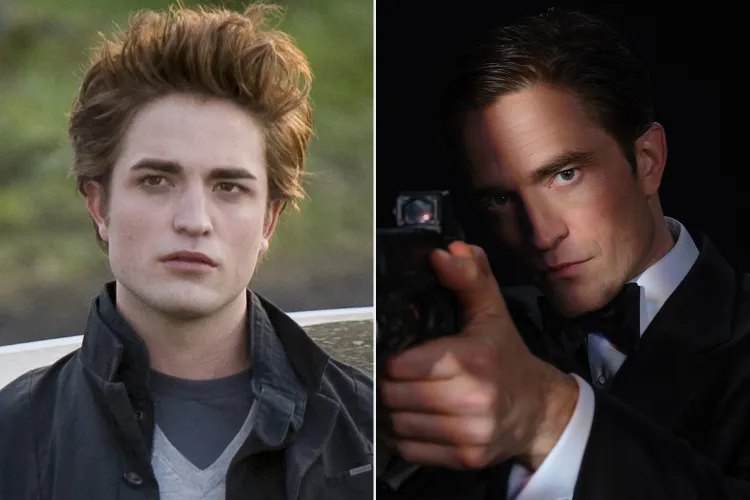
Could a moment from Twilight have hinted at Robert Pattinson’s future connection to one of cinema’s most iconic roles? Nearly two decades after the supernatural romance introduced Pattinson to a global audience, fans are revisiting an intriguing coincidence involving the actor and the legendary James Bond franchise.
The idea that Twilight somehow predicted Pattinson’s potential James Bond casting has sparked curiosity among movie lovers, particularly those who remember how dramatically his career changed after playing Edward Cullen. What once seemed like an ordinary detail from a hugely successful fantasy film now feels surprisingly relevant to conversations about the actor’s future in Hollywood.
Of course, there is no confirmed evidence that the filmmakers intended to foreshadow a Bond connection. Nevertheless, the coincidence offers an entertaining reason to look back at Pattinson’s early career, his transformation as an actor, and why the possibility of him becoming the next 007 continues to attract attention.
Robert Pattinson’s Journey From Edward Cullen to Hollywood Leading Man
When Twilight arrived in theaters in 2008, Robert Pattinson was still establishing himself as an actor. Although he had appeared in earlier projects, including Harry Potter and the Goblet of Fire, his portrayal of Edward Cullen changed his professional life almost overnight.
Based on Stephenie Meyer’s bestselling novels, Twilight introduced audiences to Bella Swan, a teenager who falls in love with Edward, a mysterious vampire hiding a dangerous secret. The film became a worldwide phenomenon, inspiring an enormous fan community and turning its young cast into international stars.
Pattinson quickly became one of the most recognizable faces in popular culture. His portrayal of Edward made him a romantic fantasy figure for millions of viewers, but the sudden attention also created a challenge: proving that he could become much more than the character who made him famous.
Over the following years, the actor made increasingly unexpected career choices. Instead of remaining exclusively within mainstream romantic dramas, he pursued complex characters and worked with filmmakers known for distinctive storytelling.
That decision would eventually reshape his reputation and establish him as one of the most interesting actors of his generation.
The Twilight Coincidence That Has Fans Talking
The suggestion that Twilight predicted Robert Pattinson’s James Bond casting is an intriguing example of how fans revisit older films through the lens of new developments.
When an actor becomes associated with a major franchise years after appearing in another successful series, viewers naturally begin searching for details that connect the two chapters of their career. A particular visual reference, line of dialogue, costume choice, or unexpected resemblance can suddenly take on a completely different meaning.
That is part of the appeal behind the Twilight and James Bond conversation.
However, it is important to distinguish between an amusing coincidence and an actual prediction. Without evidence from the filmmakers or a documented connection to the Bond franchise, the idea should be treated as fan speculation rather than proof that Twilight deliberately anticipated Pattinson’s future.
Still, the discussion highlights something fascinating about Hollywood careers: moments that seem insignificant when a film is released can become interesting again years later.
For Pattinson, the contrast between his early vampire image and the sophisticated, potentially action-oriented world of James Bond makes the comparison particularly entertaining.
Why Robert Pattinson Could Be an Interesting James Bond
The possibility of Robert Pattinson playing James Bond has an obvious appeal. The British actor possesses a combination of screen presence, intensity, and versatility that could support a fresh interpretation of the famous secret agent.
Bond is traditionally associated with confidence, intelligence, physical ability, and a distinctive sense of style. But every generation of the franchise has an opportunity to reconsider what those qualities look like.
Pattinson’s performances suggest that he could bring a more psychologically layered approach to the character.
In films such as The Batman, he demonstrated his ability to portray a troubled hero whose strength is accompanied by vulnerability and internal conflict. His interpretation of Bruce Wayne was darker and more introspective than several previous versions, giving audiences a different perspective on a familiar character.
That experience could be useful in a Bond film, particularly if the next creative team wants to explore the emotional cost of being a secret agent.
Pattinson could potentially portray a Bond who is stylish and charismatic while also appearing unpredictable, thoughtful, and emotionally complicated.
His acting range would allow him to move between quiet tension, dry humor, dramatic confrontation, and large-scale action.
From Edward Cullen to Bruce Wayne: A Career Built on Reinvention
One reason the James Bond conversation feels so compelling is that Pattinson has repeatedly challenged expectations.
After the enormous success of the Twilight films, he could easily have continued choosing projects that relied on his popularity as a romantic leading man. Instead, he explored independent cinema and characters that were often uncomfortable, unconventional, or deliberately difficult to understand.
His performances in films such as Cosmopolis, Good Time, and The Lighthouse demonstrated a willingness to take creative risks.
In Good Time, Pattinson played a desperate man navigating a chaotic night in New York City. The performance revealed a raw intensity that was very different from Edward Cullen’s restrained romantic personality.
In The Lighthouse, he appeared alongside Willem Dafoe in a psychological drama that demanded an unusual level of physical and emotional commitment.
These projects helped critics and audiences reconsider his abilities. Rather than being defined by one blockbuster franchise, Pattinson became an actor associated with ambitious filmmaking and unpredictable performances.
His later appearance as Bruce Wayne in The Batman further strengthened that reputation.
The journey from vampire romance to psychological drama and superhero filmmaking demonstrates why he could be an appealing choice for another major franchise.
Why the Next James Bond Casting Is Such a Big Deal
Few film roles generate as much speculation as James Bond.
Since Sean Connery first established the character’s cinematic identity in the 1960s, several actors have brought their own personalities and interpretations to the role. Roger Moore emphasized charm and humor, Timothy Dalton explored a tougher approach, Pierce Brosnan combined sophistication with action, and Daniel Craig introduced a more physically intense and emotionally vulnerable Bond.
Each casting decision has helped shape the franchise’s identity.
Following Daniel Craig’s departure after No Time to Die, attention naturally turned toward the question of who might inherit the famous role. Fans have discussed numerous possibilities, with different actors attracting attention for their age, nationality, screen presence, and suitability for the character.
Pattinson’s name is particularly interesting because he has already demonstrated that he can lead a major franchise while maintaining a distinctive acting identity.
However, speculation about his suitability should not be confused with an official casting announcement. Unless the producers formally confirm a decision, the identity of the next James Bond remains a matter of franchise developments and public discussion.
Could Pattinson Bring Something New to 007?
If Robert Pattinson were ever selected to play James Bond, one of his biggest advantages could be his ability to balance familiar characteristics with unexpected choices.
He has demonstrated that he can portray characters who are physically capable but emotionally complicated. That combination could create an interesting version of 007, especially in a story that explores the pressure and isolation associated with intelligence work.
His British background also makes him a natural candidate for discussions about the future of the franchise.
Another advantage is his experience working on large productions. The Batman required him to carry a major studio film, handle physically demanding scenes, and build a recognizable interpretation of an established fictional character.
Those responsibilities are closely connected to the challenges of playing James Bond.
At the same time, Bond requires a particular combination of elegance, humor, confidence, and action skills. Pattinson would need to make those qualities feel authentic rather than simply reproducing the performances of previous actors.
That challenge could also be what makes the idea so exciting.
Why Fans Love Discovering Unexpected Connections Between Films
The Twilight and James Bond discussion reflects a broader habit among movie fans: revisiting familiar films to discover details that seem more meaningful with hindsight.
An actor’s early performance can look completely different after a major career transformation. A costume, expression, or line of dialogue may suddenly inspire comparisons that viewers would never have considered when the film originally premiered.
Social media makes these discoveries even more entertaining. Fans can share clips, compare performances, and debate whether an apparent connection is meaningful or simply an extraordinary coincidence.
For longtime Twilight viewers, seeing Pattinson discussed in connection with James Bond is especially striking. The actor who once became internationally famous as a romantic vampire is now recognized for his work in challenging dramas and major superhero productions.
That evolution is arguably more remarkable than any supposed prediction hidden in an earlier movie.
The Final Verdict: A Coincidence Worth Revisiting
Did Twilight really predict Robert Pattinson’s James Bond casting 18 years ago? At this stage, the idea is best understood as an entertaining fan theory rather than a confirmed piece of cinematic foreshadowing.
Nevertheless, the conversation highlights just how far Pattinson has come since his breakthrough as Edward Cullen. His career has developed through ambitious roles, unexpected creative decisions, and performances that have challenged the image audiences first associated with him.
Whether or not he ever becomes 007, the possibility is an interesting reflection of his transformation into a versatile Hollywood leading man.
And perhaps that is the real surprise: the actor who once defined a generation’s favorite vampire has built a career that makes audiences willing to imagine him as almost anything — even the next James Bond.