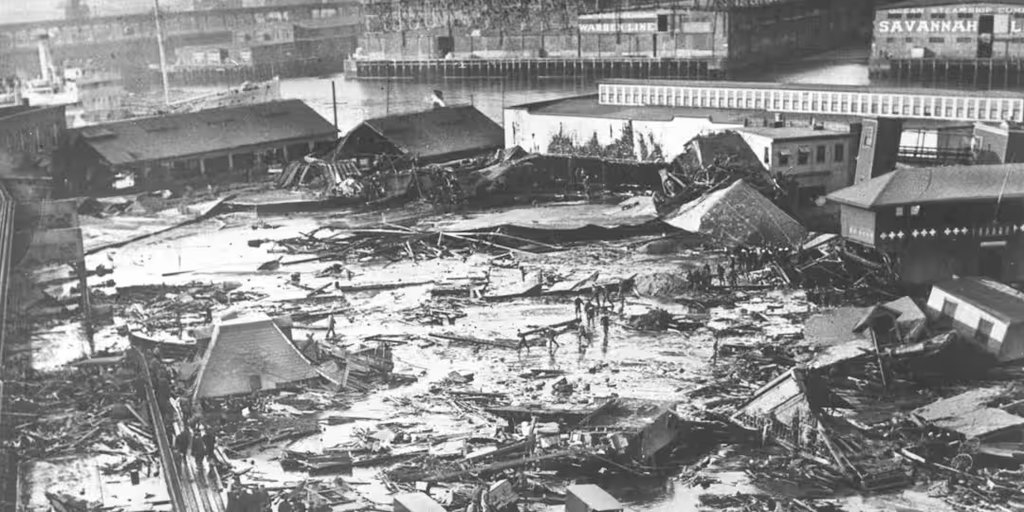
On January 15, 1919, one of the strangest and deadliest industrial disasters in American history struck Boston, Massachusetts. A massive storage tank burst in the city’s North End, releasing approximately 2.3 million gallons of molasses into nearby streets. What initially seemed like an ordinary industrial accident quickly became a terrifying catastrophe as a powerful wave of thick, sticky syrup swept through the neighborhood, destroying buildings, damaging infrastructure, and claiming human lives.
Known as the Great Molasses Flood, the disaster killed 21 people and injured approximately 150 others. Horses, vehicles, and buildings were caught in the rushing liquid, while rescuers struggled through a thick mixture that made every movement difficult. The tragedy became one of Boston’s most memorable historical events, not because of a conventional flood of water, but because of the unusual substance that turned an ordinary winter afternoon into a nightmare.
More than a century later, the Great Molasses Flood remains a powerful reminder of the importance of industrial safety, responsible engineering, and corporate accountability. Behind its unusual name lies a devastating story of human loss, preventable danger, and the lasting consequences of overlooking potential risks.
What Was the Great Molasses Flood?
The Great Molasses Flood occurred in Boston’s North End, a densely populated neighborhood near the city’s waterfront. At the time, molasses was an important commercial product used in food production, industrial processes, and the manufacture of alcohol, including industrial ethanol.
The disaster began when a large steel storage tank owned by the Purity Distilling Company ruptured. The tank stood near Commercial Street, close to homes, businesses, railroad infrastructure, and other industrial facilities. It measured approximately 50 feet tall and 90 feet in diameter, making it a substantial structure designed to hold enormous quantities of liquid.
On that January afternoon, the tank failed catastrophically. Its contents poured into the surrounding area, creating a fast-moving mass of molasses that overwhelmed people and structures in its path.
Although molasses is thick and moves differently from water, the sudden release of millions of gallons created a dangerous surge. The liquid was under substantial pressure, and the force of its movement caused severe destruction.
The flood damaged buildings, swept away structures, and disrupted transportation routes. People who happened to be nearby had little time to escape. For those caught in the flow, the sticky liquid presented a danger that was difficult to imagine before the accident occurred.
The event became widely known as the Great Molasses Flood, a name that sounds almost comical when separated from its tragic consequences. In reality, it was a deadly industrial disaster that devastated a working-class neighborhood and left families grieving for years.
Why Was There So Much Molasses in Boston?
To understand the disaster, it is important to consider Boston’s industrial economy in the early twentieth century.
The city was a major commercial port, connecting manufacturers, distributors, and international markets. Molasses was transported and stored in large quantities because it served several economic purposes. It was used as a sweetener, an ingredient in food production, and a raw material for industrial alcohol.
The Purity Distilling Company used molasses in connection with the production of industrial ethanol. During the First World War, ethanol became particularly important because it had applications in manufacturing and other industrial processes. Demand for certain industrial products increased during wartime, placing additional pressure on businesses to store and process materials efficiently.
The enormous tank in Boston’s North End was part of this industrial activity. However, storing millions of gallons of a heavy liquid in a residential and commercial area created a serious potential hazard if the structure failed.
The tank had been constructed in 1915. Concerns about its design and construction would later become central to investigations into the disaster. Questions arose about whether it had been adequately tested, whether its structure was strong enough to withstand the pressure inside, and whether the company had taken appropriate precautions.
These questions became especially important after the tank burst. Investigators eventually examined the company’s practices, engineering decisions, and responsibility for the deaths and destruction that followed.
January 15, 1919: The Day the Tank Burst
The afternoon of January 15 began like an ordinary winter day in Boston. The weather was relatively mild for the season, and people were going about their daily routines in the North End.
Some workers were near the storage tank, while residents, children, and passersby occupied the surrounding streets. Nearby, an elevated railway and other industrial structures formed part of the neighborhood’s busy landscape.
At approximately 12:30 p.m., the tank suddenly failed.
Witnesses described a tremendous noise as the structure ruptured. Its steel walls gave way, releasing an enormous volume of molasses in a matter of moments. The resulting surge swept through nearby streets with devastating force.
The liquid was not simply a slow-moving pool spreading across the pavement. The sudden release created a powerful wave that struck buildings, overturned objects, and caught people by surprise.
Wooden structures were damaged or destroyed, and parts of the surrounding infrastructure suffered serious harm. Railroad supports were affected, and debris became mixed with the thick syrup.
People in the path of the flood were knocked down and trapped. Some were unable to move because the molasses surrounded their bodies, while others were struck by debris or caught beneath damaged structures.
The disaster unfolded so quickly that escape was difficult. People who might have survived an ordinary spill found themselves facing a sudden, overwhelming force.
For the victims, the danger came from several directions at once. The rushing liquid could knock them over, the debris could cause severe injuries, and the thick substance could make it extremely difficult to stand or move.
Within minutes, the North End had become the scene of a major emergency.
Why Was the Molasses Flood So Deadly?
The Great Molasses Flood was deadly because of the combination of the liquid’s enormous volume, the force of its release, and the crowded environment surrounding the tank.
Molasses is far more viscous than water, meaning it resists flowing and is difficult to move through. However, viscosity does not make a large, rapidly released volume harmless. When millions of gallons escape from a damaged tank, the initial surge can carry substantial force.
The tank’s contents moved into streets and structures before people had time to react. Anyone caught in the flow faced the possibility of being knocked down, trapped, or injured by collapsing debris.
Once the initial surge slowed, the thick liquid created another serious challenge. Rescuers and survivors had to navigate streets covered in sticky molasses, which clung to clothing, equipment, and other surfaces.
People who were trapped could not simply swim or push their way through the substance as they might through water. Moving required considerable effort, and the syrup could restrict their ability to free themselves.
Cold weather also complicated the aftermath. As temperatures dropped, the molasses became even more difficult to remove. The sticky material mixed with mud, debris, and other substances, turning rescue and cleanup operations into exhausting work.
The disaster killed 21 people, including children and adults. Approximately 150 others were injured, with some suffering severe trauma.
The victims included workers and residents who had been going about their daily lives. Their deaths transformed the incident from an industrial accident into a community tragedy that affected families across Boston.
The Rescue Effort in the North End
Emergency responders, police officers, firefighters, medical personnel, and ordinary residents rushed to help after the tank burst.
The rescue operation was complicated by the physical conditions left behind. Streets were covered in molasses, damaged structures created additional hazards, and debris obstructed access to victims.
Rescuers had to search through the wreckage while trying to locate people who were trapped beneath broken wood and metal. Some victims were difficult to reach because the sticky liquid surrounded them or had become mixed with other debris.
The work required patience and physical effort. Tools and equipment became coated in syrup, while people attempting to move through the area struggled to maintain their footing.
Survivors were transported for medical treatment, and the injured required care for wounds, fractures, and other trauma. Families searched for missing relatives, while emergency workers continued to examine the affected streets.
The disaster also placed enormous pressure on the surrounding community. People who had witnessed the flood or helped with the rescue effort were confronted with the sudden loss of neighbors, coworkers, and loved ones.
In the days that followed, the North End faced a long and difficult cleanup. Removing millions of gallons of sticky molasses from streets, buildings, and public infrastructure was not a simple task.
The cleanup required extensive labor and continued long after the immediate emergency had ended. The substance spread across a wide area, entering places that were difficult to reach and leaving behind persistent residue.
The incident became part of Boston’s collective memory, with stories of the flood passed down through generations.
Who Was Responsible for the Great Molasses Flood?
One of the most important questions after the disaster was whether the tank’s failure could have been prevented.
The Purity Distilling Company faced scrutiny over the tank’s design, construction, maintenance, and safety practices. Investigators examined the structure and considered whether it had been built and operated according to appropriate engineering standards.
The tank had reportedly shown signs of trouble before the disaster, including leaks. Concerns were also raised about the adequacy of its construction and the testing performed before it was put into service.
These issues mattered because a storage tank holding such an enormous volume of liquid needed to withstand the pressure exerted by its contents. A failure could have catastrophic consequences for anyone living or working nearby.
After the flood, a lengthy legal investigation examined the circumstances surrounding the rupture. Hundreds of witnesses were questioned, and engineering evidence played a significant role in determining what had happened.
The proceedings helped establish the company’s responsibility for the disaster. The case became an important example of how civil litigation could hold a business accountable for an industrial failure.
Although modern engineering standards and safety regulations have developed considerably since 1919, the underlying questions remain relevant. Companies that store hazardous materials must consider the consequences of structural failure, maintain their equipment properly, and take reasonable precautions to protect the public.
The Great Molasses Flood demonstrated that an industrial accident does not need to involve fire, explosives, or toxic chemicals to become deadly. A common commercial substance can cause enormous harm when it is stored or handled unsafely.
The Long-Term Impact on Industrial Safety
The Great Molasses Flood contributed to a broader discussion about engineering accountability and public safety in the United States.
In the early twentieth century, many American cities were expanding rapidly. Industrial facilities operated close to residential neighborhoods, and large storage tanks were increasingly common near ports, railroads, and factories.
As industrial activity grew, the potential consequences of equipment failure became more significant. The Boston disaster showed how a single structural failure could damage an entire neighborhood and threaten people who had no control over the industrial operation.
The legal proceedings that followed helped draw attention to the importance of engineering expertise, proper testing, and reliable documentation. Professional engineers became increasingly important in evaluating industrial structures and determining whether they met appropriate safety requirements.
The tragedy also illustrated the value of independent scrutiny. When companies are responsible for facilities that could endanger the public, safety decisions cannot depend solely on business priorities or internal assurances.
Modern industrial safety practices involve multiple layers of protection. Depending on the facility and the material being stored, these can include structural calculations, inspections, pressure assessments, maintenance schedules, emergency planning, and regulatory oversight.
The precise rules differ by industry and jurisdiction, but the fundamental principle is consistent: risks must be identified and managed before an accident occurs.
The Great Molasses Flood remains a historical example of why engineering decisions matter beyond the boundaries of a factory or storage facility. When industrial infrastructure is located near homes and public streets, the safety of that infrastructure becomes a community concern.
How Boston Remembers the Great Molasses Flood
Today, the Great Molasses Flood is remembered as one of Boston’s most unusual historical disasters. Its name often attracts attention because of the surprising image of a city street overwhelmed by syrup.
Yet the story is much more than an unusual historical anecdote. It represents the lives lost, the injuries suffered, and the disruption experienced by an entire neighborhood.
The disaster has also become part of Boston’s local identity. Historical accounts, books, public discussions, and walking tours have helped preserve its memory and explain how the event unfolded.
A commemorative plaque in the North End marks the location and reminds visitors of the tragedy. The surrounding area has changed significantly since 1919, but the memorial provides a connection to the people who experienced the flood.
For residents and visitors, the site offers an opportunity to reflect on a chapter of Boston’s history that might otherwise seem almost impossible to believe.
The story also illustrates how local history can reveal broader lessons. A disaster that occurred in a single neighborhood can help explain changing expectations for public safety, corporate responsibility, and the role of engineering in modern cities.
Remembering the victims is an important part of that history. Behind the extraordinary circumstances were ordinary people whose lives were interrupted without warning.
Myths and Facts About the Great Molasses Flood
Because the disaster was so unusual, the Great Molasses Flood has attracted colorful stories over the years. Separating the established facts from exaggeration helps preserve an accurate understanding of what happened.
Fact: The disaster occurred on January 15, 1919. The storage tank ruptured in Boston’s North End, releasing an enormous quantity of molasses into the surrounding streets.
Fact: Approximately 2.3 million gallons of molasses escaped. The sheer volume contributed to the scale of the destruction and made rescue and cleanup operations particularly difficult.
Fact: Twenty-one people died. Approximately 150 others were injured, making the flood a serious mass-casualty event.
Fact: The molasses caused real structural damage. The force of the initial surge damaged buildings and infrastructure. The disaster was not merely a matter of sticky streets or inconvenient cleanup.
Fact: The company faced legal accountability. Investigations and court proceedings examined the tank’s failure and the company’s responsibility.
One common misconception is that the molasses simply crept slowly through the streets, giving everyone plenty of time to escape. In reality, the initial release was powerful and sudden. The substance’s thickness made movement and rescue difficult, but it did not prevent the flood from causing severe damage.
Another misconception is that the event was harmless because molasses is a familiar food ingredient. The disaster demonstrates why the danger of a material depends not only on its chemical properties but also on its volume, speed, storage conditions, and surroundings.
The Great Molasses Flood: A Tragedy That Still Matters
More than a century after the Great Molasses Flood, the event continues to capture public attention because of the extraordinary contrast between its cause and its consequences.
Molasses is normally associated with baking, sweet treats, and traditional recipes. In Boston in 1919, however, millions of gallons of the sticky substance became the source of a devastating industrial disaster.
The tank’s rupture killed 21 people, injured approximately 150 others, and damaged a busy neighborhood. Rescue workers faced difficult conditions, residents endured a lengthy cleanup, and the company responsible faced serious legal scrutiny.
The tragedy also left a lasting lesson about the relationship between industry and public safety. Structures that hold large quantities of material must be designed, tested, and maintained with the consequences of failure in mind. When those responsibilities are neglected, the effects can extend far beyond a company’s property.
The Great Molasses Flood is remembered today not simply because it was strange, but because it was deadly and deeply consequential. Its unusual name makes it memorable, while its human cost gives it enduring significance.
Ultimately, the story of the Great Molasses Flood is a reminder that disasters can emerge from unexpected places. A familiar substance, stored in an industrial tank, became the center of a tragedy that changed a Boston neighborhood forever. Remembering what happened on January 15, 1919, helps ensure that the victims are not forgotten and that the lessons of the disaster continue to inform discussions about engineering, responsibility, and the protection of human life.