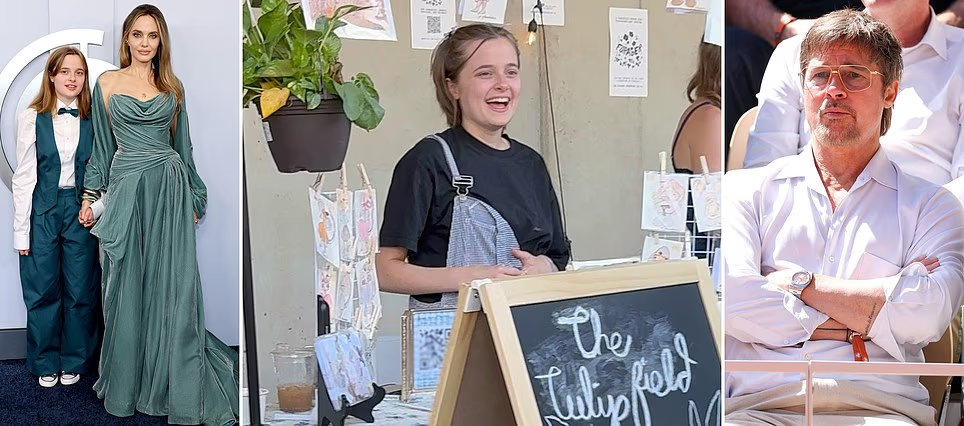
In a deeply personal revelation, Vivienne Jolie, the 18-year-old daughter of Hollywood stars Brad Pitt and Angelina Jolie, has opened up about a difficult chapter in her life, revealing that she was hospitalized earlier this year while struggling with an eating disorder. Rather than sharing her experience through a traditional interview, the young artist chose a more intimate form of expression: a collection of paintings and personal writings inspired by her time receiving treatment.
Vivienne’s disclosure emerged through an art exhibition in Los Angeles titled The Tulip Field: A Gallery on Patience of Patients. The project offered visitors a glimpse into memories she had previously kept private, including feelings of loneliness, emotional pain and the gradual experience of finding support in an unfamiliar environment.
In a statement accompanying the exhibition, Vivienne described the beginning of her hospitalization as an especially difficult period. She wrote that she had felt “angry, sick, and very alone” when she entered the hospital.
However, her account did not end with those painful emotions. She also expressed gratitude for the kindness of the young patients and hospital staff who helped her feel less isolated, explaining how their warmth gradually broke down the emotional barriers she had built around herself.
Her decision to share such a personal experience through art has brought renewed attention to the young woman, while also highlighting the importance of compassion and understanding for people living with eating disorders.
Vivienne Jolie Opens Up About Her Hospitalization
For someone who grew up in one of Hollywood’s most recognizable families, Vivienne has generally maintained a relatively private public profile. Although she has occasionally appeared alongside her mother and siblings at important entertainment events, she has largely avoided making her personal life the center of public attention.
That makes her recent disclosure particularly meaningful.
According to the statement presented with her exhibition, Vivienne was hospitalized at the beginning of 2026 for an eating disorder. She acknowledged that the experience was emotionally challenging and that, at first, she struggled with feelings of anger, illness and isolation.
Her words offered a rare look at the emotional side of receiving treatment. Hospitalization can be an overwhelming experience, particularly for a young person facing complicated feelings about health, identity and vulnerability.
Vivienne’s account also emphasized the importance of the people around her. She explained that the kindness of the other children and the hospital staff eventually helped her lower the walls she had built to protect herself.
Reflecting on the experience, she described it as a time when she had never laughed or cried harder, and had never felt more honest or more like herself.
She also characterized the period as both the worst and best time of her life, suggesting that although it brought considerable difficulty, it also gave her an opportunity to experience connection, understanding and personal growth.
Vivienne has not publicly shared every detail of her treatment, and her story does not provide a complete picture of her medical journey. What she has chosen to reveal, however, is an honest reflection of a difficult experience and the support that helped her through it.
The Tulip Field: Turning Painful Memories Into Art
One of the most striking aspects of Vivienne’s revelation is the way she transformed her memories into an artistic project.
Her exhibition, The Tulip Field: A Gallery on Patience of Patients, featured handmade illustrations accompanied by excerpts from personal journal entries. Rather than presenting a conventional collection of artwork, the project connected images with fragments of writing that reflected her emotions during hospitalization.
The name The Tulip Field carried a personal meaning. Vivienne and her friends used the phrase as a nickname for the hospital where she received treatment.
Through her paintings, she attempted to preserve moments that could otherwise have faded from memory. She explained that photographs were not taken during her time there, making the artwork an important way to document what she experienced.
The illustrations included scenes inspired by loneliness, moments of connection, difficult emotions and the feeling of being supported by others.
Tulips appeared throughout the collection, giving the exhibition a recognizable visual identity. These flower characters allowed Vivienne to represent complicated experiences through images that were expressive without needing to explain every detail directly.
The accompanying journal entries added another emotional dimension. Some reflected the desire for comfort and human connection, while others captured the complicated feelings that can accompany treatment.
One entry expressed an intense longing for a hug, describing how strongly the absence of physical comfort could be felt. Another reflection suggested that allowing herself to fall apart was part of learning how to heal.
Together, the paintings and writings created a personal record of a period that Vivienne clearly found difficult to navigate.
The exhibition also demonstrated how art can provide a way to process memories that may be challenging to communicate through ordinary conversation.
Why Vivienne Chose to Share Her Story Through Art
Vivienne’s decision to reveal her hospitalization through an exhibition rather than a traditional celebrity interview makes the project especially distinctive.
Art allowed her to communicate on her own terms. She could decide which memories to include, how to represent them and how much of her personal experience she wanted the public to see.
For many people, discussing an eating disorder can be difficult. The subject can involve deeply personal emotions, complicated relationships with food and body image, and experiences that are not always easy to put into words.
By using paintings and diary excerpts, Vivienne created a space where those feelings could be expressed without requiring her to disclose every detail of her private life.
Her work also challenged the idea that difficult experiences must always be presented as simple stories of struggle followed by immediate recovery.
Her account acknowledged that hospitalization was painful, but it also recognized the importance of the people who supported her. Both sides of that experience could exist at the same time.
That complexity is part of what makes her statement so powerful. Healing is not necessarily a straight line, and receiving help does not mean that every difficult feeling disappears overnight.
Vivienne’s exhibition offered a more thoughtful perspective on the experience of being vulnerable, accepting support and finding ways to move forward.
Angelina Jolie and Brad Pitt’s Daughter Has Grown Up in the Public Eye
Vivienne is the youngest daughter of Angelina Jolie and Brad Pitt, one of Hollywood’s most famous former couples. She was born in July 2008 alongside her twin brother, Knox, and grew up with four older siblings: Maddox, Pax, Zahara and Shiloh.
Although her parents’ careers have kept their family in the public spotlight for many years, Vivienne has gradually developed interests of her own.
She has shown an interest in theater and creative production, most notably through her involvement in the Broadway musical The Outsiders. In 2024, she worked with her mother on the production, receiving a credit as a producer’s assistant.
The experience offered an opportunity to explore the world of theater from behind the scenes and demonstrated her interest in creative projects beyond simply appearing at public events.
Her recent art exhibition represents another step in that direction. Instead of being known only as the daughter of two internationally recognized actors, Vivienne is beginning to share more of her own creative perspective.
The decision to present such personal work also suggests that she is interested in using artistic expression to communicate ideas that matter to her.
As she enters adulthood, Vivienne appears to be finding her own voice while maintaining control over how much of her life she shares publicly.
A Reminder of the Importance of Support and Understanding
Vivienne’s story has also brought attention to the broader issue of eating disorders, which can affect people of different ages, backgrounds and body types.
These conditions are complex health issues rather than matters of personal choice or appearance. They can involve serious physical and emotional challenges, and people experiencing them may need professional care and understanding from those around them.
One important message in Vivienne’s account is the role that compassion played during her hospitalization.
She specifically remembered the kindness of fellow patients and hospital staff. Their support helped her feel less alone at a time when she was struggling emotionally.
That detail is significant because people facing eating disorders may experience shame, fear or isolation, making it difficult to ask for help or accept support.
A compassionate environment can make a meaningful difference. Listening without judgment, avoiding comments about someone’s body or eating habits, and encouraging professional support are all important ways to help.
Vivienne’s story should not be treated as a medical guide or as evidence that everyone’s recovery follows the same path. Each person’s circumstances are different, and treatment decisions should be made with qualified healthcare professionals.
Nevertheless, her willingness to share part of her experience may help others recognize that they are not alone.
Vivienne Jolie’s Courageous New Chapter
For Vivienne Jolie, the exhibition was more than an opportunity to display paintings. It became a way to revisit a difficult period, preserve important memories and acknowledge the people who helped her through it.
Her description of hospitalization was honest about the pain she experienced, but it also recognized the unexpected connections that emerged during treatment.
By presenting her story through art, she allowed audiences to see a side of her life that had remained largely private. The result was a deeply personal project that placed emotional honesty above celebrity attention.
The public may know Vivienne as the daughter of Angelina Jolie and Brad Pitt, but her recent work offers a different perspective: that of a young woman developing her own identity and using creativity to express experiences that matter to her.
Her revelation also serves as a reminder that serious personal struggles can exist behind even the most recognizable family names. Fame does not make someone immune to illness, loneliness or the need for support.
As Vivienne continues exploring her creative interests, her exhibition may become an important milestone in her journey as an artist.
Most importantly, her story is not simply about a difficult hospitalization. It is about the value of kindness, the courage to accept help and the possibility of finding connection during an uncertain time.
Through The Tulip Field, Vivienne has turned private memories into a public expression of resilience, offering a thoughtful reminder that healing deserves patience, understanding and compassion.