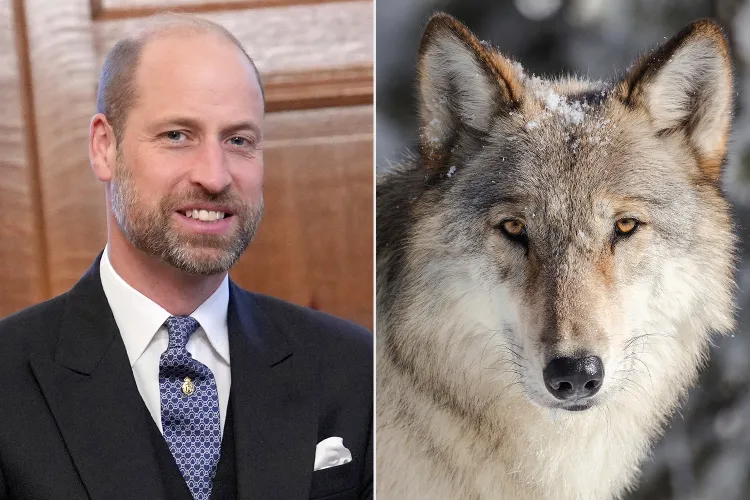
A remarkable conservation movement that began with the journey of a single wandering wolf is now receiving international recognition, thanks to Prince William’s prestigious Earthshot Prize. The wolf, named Pluie, traveled across an extraordinary stretch of North America in 1991, revealing something that would eventually change the way scientists and conservationists thought about protecting wildlife.
Her journey helped inspire the Yellowstone to Yukon Conservation Initiative, an ambitious project dedicated to connecting and protecting one of the most important natural regions in North America. Spanning thousands of miles across the Rocky Mountains, the initiative aims to give animals the freedom to move through their natural habitats without being stopped by borders, roads and expanding human development.
More than three decades after Pluie’s travels first captured researchers’ attention, the conservation organization is now among the finalists for Prince William’s Earthshot Prize. Its recognition highlights how one animal’s extraordinary journey helped spark a much larger effort to protect wildlife and preserve the natural world for future generations.
The Lone Wolf Whose Journey Changed Conservation Thinking
In 1991, researchers tracking a grey wolf named Pluie discovered that her movements covered a far greater area than they had anticipated. Beginning near Banff in Alberta, Canada, Pluie traveled through Montana, Idaho and Washington before making her way back toward Canada and into British Columbia.
Her journey was remarkable not simply because of the distance she covered, but because of what it revealed about wildlife movement.
At the time, scientists often studied animals within specific research areas. However, Pluie’s travels demonstrated that wildlife does not recognize the boundaries created by researchers, governments or national borders. Animals move according to their natural needs, following food sources, suitable habitats and opportunities to find mates.
Dr. Jodi Hilty, president and chief scientist of the Yellowstone to Yukon Conservation Initiative, has described the discovery as a significant moment for scientists and conservationists. For the first time, researchers could clearly see what happened when an animal moved beyond the boundaries of a particular study area.
Pluie’s journey helped demonstrate that protecting one isolated habitat would not necessarily be enough. If animals were to survive and thrive over the long term, they needed connected landscapes that allowed them to travel safely.
Her story became a powerful reminder that conservation must consider entire ecosystems rather than focusing only on individual protected locations.
How Pluie Inspired the Yellowstone to Yukon Conservation Initiative
The Yellowstone to Yukon Conservation Initiative, often known as Y2Y, emerged from the growing understanding that wildlife needed room to move across large landscapes.
The project focuses on connecting and protecting a vast region of the Rocky Mountains stretching approximately 2,100 miles from the Greater Yellowstone Ecosystem in the United States to the Yukon in northwestern Canada.
The area covers five U.S. states and two Canadian provinces and territories, creating an enormous conservation landscape that is roughly three times the size of California.
Rather than treating parks and protected areas as separate islands, the initiative works to connect them through wildlife corridors and other conservation measures. The goal is to make it possible for animals to move between habitats, maintain healthy populations and adapt to environmental changes.
This approach is particularly important for species that need extensive territories. Large mammals such as wolves, bears and other wildlife may travel considerable distances in search of food, suitable breeding grounds and new habitat.
When roads, cities, industrial development or other barriers divide natural landscapes, animals can become isolated. Over time, that separation can reduce opportunities for breeding and make populations more vulnerable to disease, environmental pressures and habitat loss.
Y2Y seeks to address these challenges by bringing different communities and organizations together around one shared vision: a connected Rocky Mountain region where people and wildlife can coexist.
Why Wildlife Corridors Matter
One of the most important parts of the Yellowstone to Yukon initiative is its focus on wildlife crossings.
Roads are essential to modern communities, but they can create serious obstacles for animals. Busy highways may divide habitats, prevent wildlife from reaching important feeding areas and increase the risk of dangerous encounters between vehicles and animals.
Wildlife crossings offer a practical way to reduce these problems.
These structures can include bridges, overpasses and underpasses designed to allow animals to travel safely across roads. When combined with appropriate fencing and habitat protection, they can help reconnect areas that would otherwise remain separated.
For wildlife, the benefits can be significant. Animals can move more freely, reach different parts of their natural range and maintain connections with other populations.
The crossings also offer benefits to people by helping reduce collisions involving large animals.
However, building a wildlife crossing is only one part of a much larger process. Successful conservation requires careful planning, scientific research and cooperation among the communities responsible for managing the surrounding land.
That is why the Yellowstone to Yukon initiative places so much emphasis on working across different jurisdictions rather than relying on individual projects.
A Major Conservation Achievement After Three Decades
When the initiative first began, the idea of coordinating conservation across such an enormous region seemed difficult to achieve.
Protecting a landscape that crosses international borders and involves multiple governments requires patience, resources and a willingness to cooperate. Different communities may have different economic priorities, land-use policies and concerns about development.
Yet the initiative has continued to make progress.
According to Dr. Hilty, protected areas across the region have increased by more than 80% since the conservation effort began roughly three decades ago.
That figure illustrates how a long-term vision can develop into measurable progress. The work is not limited to creating protected spaces. It also involves strengthening connections between existing habitats and encouraging people with different interests to work toward common goals.
Indigenous peoples, local communities, scientists, conservation groups, businesses and governments all have important roles to play.
The involvement of Indigenous communities is particularly important because many have longstanding relationships with the lands and wildlife within the region. Their knowledge, priorities and participation can help shape conservation efforts that respect both nature and the people who depend on it.
For Y2Y, lasting protection requires more than drawing boundaries on a map. It requires building relationships and finding solutions that can continue working for generations.
Prince William’s Earthshot Prize Recognizes the Initiative
The Yellowstone to Yukon Conservation Initiative is now receiving international attention as a finalist in the Protect and Restore Nature category of the Earthshot Prize.
Founded by Prince William in 2020, the Earthshot Prize was created to identify and support innovative solutions to some of the world’s most urgent environmental challenges.
The prize has a ten-year mission to encourage practical ideas that can help repair the planet. Instead of focusing only on the scale of environmental problems, it highlights people and organizations demonstrating that meaningful progress is possible.
The recognition of Y2Y is particularly significant because its work reflects the kind of large-scale collaboration that the Earthshot Prize seeks to encourage.
The initiative is not a single wildlife project operating in one location. It is a coordinated conservation effort that connects communities, landscapes and organizations across an enormous geographical area.
The 2026 awards ceremony is scheduled to take place in Mumbai, India, on November 17. Finalists across five categories will be recognized for their environmental solutions, with winners set to receive approximately $1.3 million each to help expand and accelerate their work.
For the Yellowstone to Yukon team, becoming a finalist provides an opportunity to share its approach with a global audience and connect with other organizations working toward a more sustainable future.
Dr. Jodi Hilty Sees the Power of Global Collaboration
Dr. Jodi Hilty has emphasized that protecting a landscape on this scale is complicated. It requires people from different backgrounds and institutions to find common ground and work toward a shared objective.
Her comments also underline why recognition from the Earthshot Prize matters beyond the possibility of financial support.
A global platform can bring attention to conservation work that often takes place far from the public spotlight. It can introduce successful approaches to new communities, encourage partnerships and demonstrate that large-scale environmental cooperation is achievable.
Hilty has praised Prince William’s willingness to use his position and network to bring different groups together around environmental challenges.
The Earthshot Prize has identified thousands of environmental innovations from more than 150 countries since its launch. Its wider mission is to encourage solutions that can be developed, expanded and adapted to different parts of the world.
For conservationists, that kind of visibility can be valuable. Protecting wildlife is rarely the work of one person or one organization. It depends on a much wider community of people who are willing to contribute time, knowledge and resources.
Why Pluie’s Story Still Matters Today
More than 30 years after her remarkable journey, Pluie remains an important symbol of what wildlife can teach humanity.
Her travels revealed that animals need connected landscapes, not simply isolated pockets of protected land. They also demonstrated that conservation plans must reflect how nature actually works.
The challenges facing wildlife have not disappeared. Roads, urban expansion, habitat fragmentation and environmental changes continue to affect ecosystems around the world.
That makes the Yellowstone to Yukon initiative’s work especially relevant. By focusing on connections between habitats, it offers a model for protecting biodiversity across large regions rather than treating each protected area as a separate destination.
The story also shows how scientific discoveries can inspire action far beyond their original purpose. A wolf wearing a tracking device could never have known that her journey would help influence a conservation movement spanning two countries.
Yet Pluie’s movements provided researchers with a new perspective, and that perspective helped shape a project with lasting ambitions.
A Small Beginning With a Lasting Legacy
The story of Pluie and the Yellowstone to Yukon Conservation Initiative is ultimately about the power of seeing the natural world as one connected system.
What began as the tracking of a single wolf became a much larger effort to protect wildlife corridors, strengthen ecosystems and encourage cooperation across borders. The initiative’s progress demonstrates that conservation on a massive scale is possible when people share a clear vision and commit to working together.
Now, with recognition from Prince William’s Earthshot Prize, the project has an opportunity to bring its message to an even wider audience.
Pluie’s journey may have taken place decades ago, but its lesson remains important: animals need space, freedom and connected habitats to survive.
Her story is a reminder that sometimes a single journey can change the way people understand an entire landscape. And in this case, the path of one lone wolf helped inspire a conservation mission that could benefit countless generations of wildlife to come.