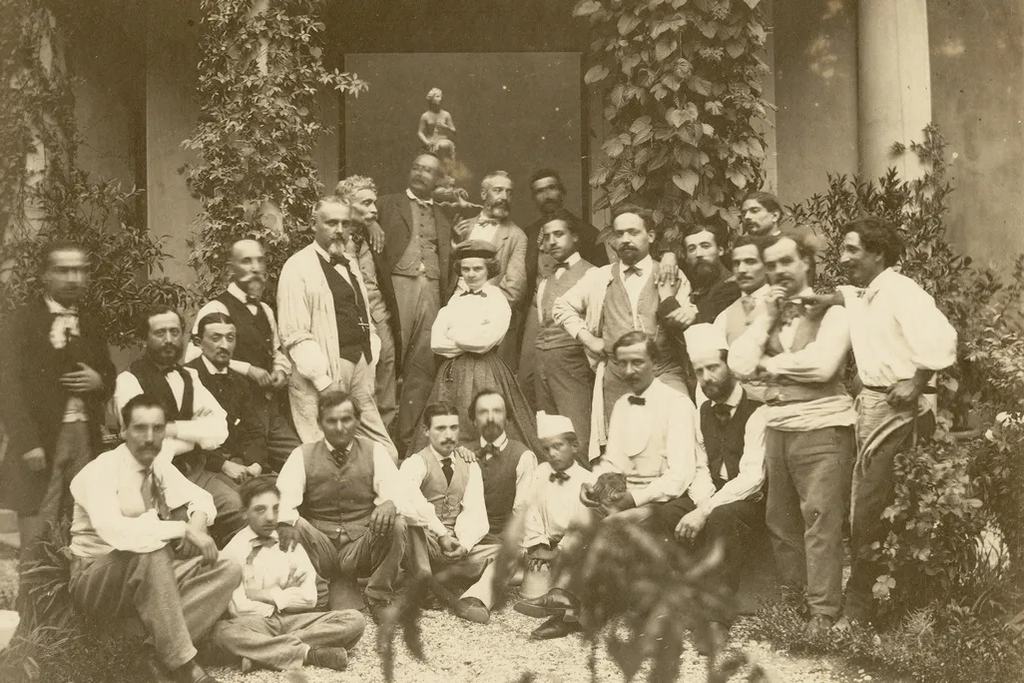
A remarkable discovery during a routine house appraisal has brought renewed attention to Harriet Goodhue Hosmer, the pioneering American sculptor whose early marble bust of the Greek mythological figure Daphne was mistaken for an ordinary garden ornament for more than 70 years.
For decades, a weathered sculpture stood quietly in an English garden, blending into its surroundings beneath a layer of lichen. To the family who owned it, the bust appeared to be little more than a decorative object. Its true significance remained unnoticed until a routine property valuation revealed that the sculpture could be a rare work by Harriet Goodhue Hosmer, one of the most important female sculptors of the 19th century.
The discovery took place in the Cotswolds, a picturesque region of England known for its historic homes and countryside. Thomas Jenner-Fust, director of Chorley’s Auctioneers, examined the sculpture while assessing the property and recognized that the object deserved closer attention. Further examination revealed a marble bust depicting Daphne, a nymph from Greek mythology, believed to date to 1854.
The sculpture’s identification transformed an overlooked garden decoration into a potentially significant piece of art history. Its estimated auction value reached as much as £18,000, or approximately $24,300, according to reports surrounding the discovery.
More importantly, the find has renewed interest in Hosmer’s early career and the obstacles she overcame as a woman pursuing professional sculpture at a time when the art world was largely dominated by men.
A Garden Ornament With an Extraordinary History
The bust had reportedly remained outdoors for more than seven decades. Exposed to the elements, its surface gradually accumulated lichen, obscuring the marble beneath and making the sculpture appear far less remarkable than it truly was.
The owners reportedly believed the object was made from reconstituted stone rather than valuable marble. They did not recognize the name of its creator or realize that the piece might have a connection to a major figure in American art.
The discovery illustrates how historical objects can remain unnoticed when their appearance and surroundings encourage people to overlook them. A sculpture displayed in a museum would likely attract close examination, but one placed beside a garden wall can become part of the everyday landscape.
In this case, the turning point came when Jenner-Fust examined the property as part of a professional valuation. Rather than accepting the bust as a common decorative feature, he investigated its material and artistic characteristics.
The back of the sculpture provided a particularly important clue. It bears Hosmer’s name alongside the Latin inscription “Me Fecit Roma,” meaning “Rome made me.” The inscription connects the work to the city where Hosmer spent a significant part of her early professional life.
Once the sculpture was cleaned, the marble surface became visible again, revealing an artwork whose importance had been concealed by years of outdoor exposure.
Although its precise journey from Hosmer’s studio to the English garden remains a separate historical question, the discovery offers a striking example of how an artist’s work can survive far from its original setting.
Who Was Harriet Goodhue Hosmer?
Harriet Goodhue Hosmer was born in Watertown, Massachusetts, in 1830. She would become widely recognized as one of the leading American sculptors of the 19th century and is often described as America’s first professional female sculptor.
Her achievement was especially remarkable because women faced significant barriers to artistic training and professional recognition during her lifetime. Sculpture required specialized technical knowledge, access to materials and workshops, and opportunities to study the human body—resources that were not equally available to women.
Hosmer’s early life was shaped by personal hardship. Her mother and three siblings died of tuberculosis, and her physician father encouraged her to pursue physical activity and outdoor interests. She developed a strong, independent character and eventually pursued an artistic career that challenged conventional expectations about women’s roles.
Her interest in sculpture led her to study anatomy in St. Louis, Missouri. Such training was particularly valuable for an artist who wanted to create convincing human figures in three dimensions.
In 1852, Hosmer traveled to Rome, Italy, where she studied with the respected British sculptor John Gibson. Rome offered access to classical sculpture, artistic communities, skilled marble workers and a long tradition of sculpting figures inspired by Greek and Roman mythology.
The city became central to Hosmer’s development. She established herself among an international circle of artists and writers and gradually built a professional reputation through her work.
Her success did not eliminate the prejudice she faced. Some critics struggled to accept that a woman could produce sculpture of the quality associated with leading male artists. Hosmer’s career therefore represented not only artistic accomplishment but also a challenge to deeply rooted assumptions about gender and creative ability.
The Story Behind Daphne in Greek Mythology
The newly identified bust depicts Daphne, a figure from Greek mythology whose story has inspired artists for centuries.
In the best-known version of the myth, Daphne is a nymph pursued by Apollo, the god of music, poetry, prophecy and the sun in later traditions. Apollo’s pursuit is unwanted, and Daphne seeks to escape him. When she can no longer flee, she calls upon her father, the river god Peneus, for help. She is transformed into a laurel tree, ending the pursuit but also bringing her human life to a close.
The myth explores themes of desire, escape, vulnerability and transformation. Its dramatic ending has made Daphne a recurring subject in painting, sculpture, poetry and other art forms.
For a sculptor working in the 19th century, the story offered a way to explore emotion and human experience through the idealized language of classical art. A marble bust could communicate a character’s mood through the tilt of the head, the direction of the gaze and the treatment of the face and shoulders.
Hosmer’s Daphne is shown looking downward, creating a restrained and contemplative impression. The composition has similarities to her later sculpture of Oenone, another tragic figure from Greek mythology. Hosmer’s Oenone was sold in 1856, two years after the date attributed to the Daphne bust.
The relationship between these works helps place the newly identified sculpture within the early development of Hosmer’s artistic career. It also gives researchers and art enthusiasts another opportunity to examine how she approached mythological subjects as she developed her distinctive style.
The bust is believed to be an early work from 1854, but the discovery should be understood in the context of continuing art-historical research. Its attribution and significance are important precisely because early works by a major artist can provide evidence of her development and working methods.
Why the Sculpture Matters to Art History
The rediscovered bust is significant for more than its estimated monetary value. If correctly attributed to Hosmer, it represents an important example of her early work and offers a tangible connection to a period when she was establishing herself as a professional sculptor.
Early works can be particularly valuable to historians because they show how an artist’s ideas and techniques evolved. Later masterpieces may demonstrate a mature style, but an early sculpture can reveal the beginnings of the decisions, subjects and visual approaches that shaped a career.
Hosmer’s work also challenges a narrow view of 19th-century art history in which women are often remembered as exceptions rather than as professionals who built sustained careers. She worked within an international artistic community, produced works for patrons, and developed a reputation that extended beyond the United States.
Her sculptures were not simply private experiments. They circulated among collectors and audiences, helping establish her position in a competitive market.
The Daphne bust also highlights the role of classical mythology in 19th-century sculpture. Artists frequently turned to ancient stories because they offered recognizable characters and dramatic situations through which to explore universal themes. Hosmer’s interpretation belongs to that broader tradition while also forming part of her personal artistic history.
The discovery in England demonstrates how the history of an artwork does not necessarily end when it leaves the artist’s studio. Objects can pass through generations of owners, move between countries, and become separated from the records that would explain their importance.
Sometimes, a signature or inscription can restore part of that lost connection.
A Pioneer Working Against Gender Barriers
Hosmer’s professional achievements took place during a period when women were often discouraged from pursuing careers that demanded public recognition, financial independence or technical expertise.
Sculpture presented particular challenges. Working with marble required knowledge of anatomy, tools, materials and the physical processes involved in shaping stone. Large projects could also require workshops and teams of skilled assistants.
Hosmer developed the knowledge and professional network needed to work at this level. Her time in Rome placed her within a community of expatriate artists, including women who sought opportunities beyond the restrictions they encountered at home.
Female sculptors in this circle were sometimes collectively described as the “white marmorean flock,” a phrase that reflected both their use of marble and the dismissive attitudes that women artists could face.
Despite such attitudes, Hosmer attracted patrons and critical attention. Her success challenged the assumption that sculpture was a field naturally suited to men alone.
One of her best-known works, Zenobia in Chains, completed in 1859, depicts Zenobia, the third-century queen of Palmyra, after her capture by the Roman emperor Aurelian. The powerful subject gave Hosmer an opportunity to explore dignity, strength and resistance through a historical female figure.
The work became an important part of her reputation. When it was exhibited in London in 1862, its reception reflected the tension between the quality of her art and the reluctance of some observers to acknowledge women as serious professional sculptors.
Hosmer’s career therefore carries significance beyond individual sculptures. It forms part of a wider history of women gaining access to education, professional opportunities and recognition in the arts.
Hosmer’s Legacy as an Artist and Feminist Icon
Hosmer’s life and work have attracted renewed attention in modern discussions of women’s history and LGBTQ+ history. She maintained long-term relationships with women during a period when same-sex relationships were often stigmatized, and she moved within artistic and intellectual circles that allowed some room for unconventional lives.
Historical descriptions of her personal relationships must be approached with care, because the language and categories used today do not always match those used in the 19th century. Nevertheless, modern scholars and audiences have increasingly examined her life as part of a broader history of queer artists and women who resisted restrictive social expectations.
Her professional independence was central to her public identity. She built a career in a demanding field, cultivated relationships with patrons and fellow artists, and pursued subjects that frequently placed women at the center of stories about power, courage and vulnerability.
The Daphne bust offers another point of entry into that legacy. Although the sculpture is small compared with some of her monumental works, its early date makes it potentially valuable for understanding the artist’s development.
It also reminds audiences that historical recognition is not always immediate or permanent. An artist may be celebrated in one period, overlooked in another, and rediscovered by new generations seeking to understand the past more fully.
What Happens Next for the Rediscovered Marble Bust?
The sculpture’s discovery has attracted attention because it combines an unusual find, an important artist and the possibility of a rare work entering the art market.
Reports have placed its estimated value at up to £18,000, approximately $24,300. An estimate, however, is not the same as a final sale price. The amount a sculpture ultimately achieves can depend on its condition, provenance, authentication, buyer interest and the circumstances of an auction.
The sculpture’s decades outdoors also raise conservation questions. Marble can withstand considerable exposure, but weathering and biological growth may affect its surface over time. Careful cleaning and professional assessment are important when revealing details without damaging the material.
The inscription on the back provides a particularly useful starting point for further research. Experts may examine the signature, carving style, dimensions and other physical characteristics alongside historical records to clarify the work’s place in Hosmer’s body of sculpture.
Researchers may also investigate how the bust reached England and how it remained in a private garden for so long. Its ownership history could offer clues about the networks through which Hosmer’s works circulated during and after her lifetime.
Even if some questions remain unanswered, the discovery has already drawn attention to an artist whose career helped change the place of women in professional sculpture.
Conclusion: A Forgotten Sculpture, a Remarkable Rediscovery
For more than 70 years, a marble bust depicting Daphne stood in an English garden, its significance hidden beneath lichen and mistaken assumptions about its material. A routine house appraisal brought the sculpture to the attention of an auction specialist, leading to its identification as a rare early work attributed to Harriet Goodhue Hosmer.
The discovery reconnects a quiet corner of the Cotswolds with the life of a pioneering American artist who built a career in a world that often questioned women’s ability to succeed professionally. It also offers a fresh opportunity to explore Hosmer’s interpretation of classical mythology and the development of her sculptural style.
The bust’s story is a reminder that valuable cultural objects do not always reside in museums or carefully maintained collections. Some remain in private homes and gardens, overlooked until someone takes a closer look.
For Hosmer’s legacy, the rediscovery is more than a surprising valuation. It is another chance to recognize the artistic skill, independence and determination of a woman who helped reshape expectations about who could become a professional sculptor.