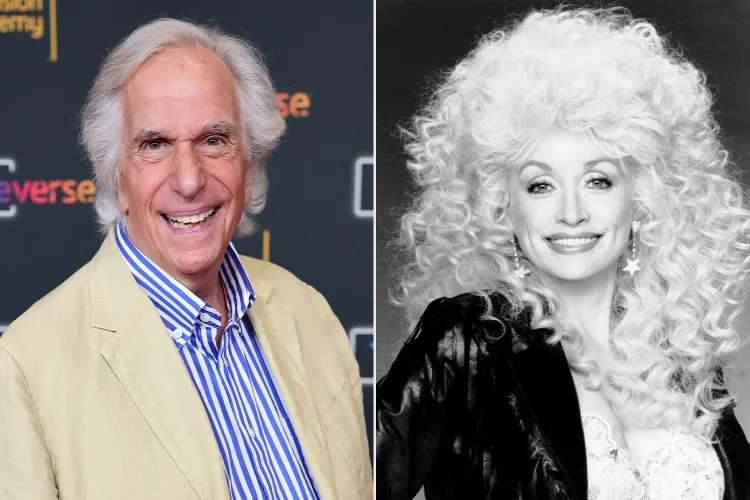
Henry Winkler has shared a charming behind-the-scenes story about his experience directing Dolly Parton in the 1986 holiday television movie A Smoky Mountain Christmas, revealing how a piece of the country music legend’s discarded sheet music unexpectedly became a treasured souvenir for one lucky cast member.
The actor and director recalled the amusing incident during a Happy Days panel at Rhode Island Comic Con on November 7, where he appeared alongside his former co-star Anson Williams. What began as a simple request from an actor hoping to take home a keepsake from the film set turned into an unforgettable moment involving Parton’s music, a resourceful crew member and Winkler’s strict rules about protecting production property.
The story offered a delightful reminder of the atmosphere behind the making of the Christmas fantasy film and gave fans another glimpse of Parton’s personality. Winkler also took the opportunity to reflect on what it was like working with the legendary entertainer, describing the experience as even more extraordinary than he had imagined.
Henry Winkler Reveals the Story Behind Dolly Parton’s Unusual Souvenir
During the Rhode Island Comic Con panel, Winkler revisited a scene from A Smoky Mountain Christmas in which Parton’s character, country singer Lorna Davis, is kidnapped.
In the sequence, police officers arrive at her apartment and begin searching the room for clues that might help them understand what happened. While filming the scene, one of the actors portraying a police officer became interested in taking a small souvenir from the set.
According to Winkler, the actor approached him and asked what he might be allowed to take home.
The director, however, was not immediately enthusiastic about the idea. He remembered telling the actor that taking anything from the production without permission would amount to stealing.
Winkler’s response was understandable. Film and television productions rely on carefully selected props, costumes and set decorations to create believable scenes. Even objects that appear ordinary on screen can be important to the production, and removing them without approval can create unnecessary problems.
But the situation soon took an unexpected turn.
A member of the crew operating the boom microphone came up with a clever solution. During the scene, Parton had been writing music before crumpling up a piece of sheet music and throwing it into a trash can.
The boom operator suggested that the actor could take one of those discarded sheets.
Since Parton had already thrown the paper away as part of the scene, it was no longer something the production needed to preserve. The actor could therefore have a keepsake without violating Winkler’s no-stealing rule.
The director remembered the suggestion with amusement, explaining that the paper was going to be thrown away anyway.
It was an unusual souvenir, certainly, but one that carried a special connection to a major music star. Rather than leaving the set with a conventional prop or piece of costume, the actor had the opportunity to take home something that had actually been handled by Dolly Parton.
For a fan of the singer, even a crumpled piece of discarded sheet music could become a memorable treasure.
Henry Winkler Praises Dolly Parton as an Extraordinary Star
Beyond the humorous souvenir story, Winkler spoke warmly about his experience working with Parton.
He described her as an extraordinary presence, saying that she was everything he could imagine and more. He also praised her as a powerful figure and expressed how honored he felt to direct her first made-for-television movie.
His comments reflected the admiration he had developed for Parton while working with her on the 1986 production.
Parton was already an established country music superstar by that point, known for her distinctive voice, songwriting talent, glamorous appearance and ability to connect with audiences. Moving into a leading television movie role gave her another opportunity to demonstrate her talents beyond the recording studio and concert stage.
For Winkler, directing an entertainer with such a recognizable personality was clearly a memorable professional experience.
His recollection also highlighted something that has long been associated with Parton’s public image: her ability to make an impression on people through both her professional achievements and her personality.
Although the story focused on a small piece of discarded paper, Winkler’s admiration made it clear that the real souvenir was the memory of working with someone he considered truly exceptional.
What Is A Smoky Mountain Christmas About?
Released in December 1986, A Smoky Mountain Christmas was a holiday fantasy television movie starring Dolly Parton.
The film follows Lorna Davis, a successful country music singer who decides to leave the pressures of her professional life behind and spend time in the Tennessee mountains. Hoping to find some peace, she travels to a secluded area where she encounters an unexpected situation involving a reclusive mountain man, a group of children and a mysterious witch.
What begins as an attempt to escape the demands of fame gradually becomes an adventure filled with unexpected friendships, danger and Christmas magic.
The story combines several familiar ingredients of holiday entertainment, including a snowy mountain setting, music, romance and a touch of fantasy. Its unusual characters and fairy-tale atmosphere give it a distinctive place among the television Christmas movies of the 1980s.
Parton’s character also allowed the film to make use of her musical identity. As a country singer playing another country singer, she brought a natural connection to the role, blending elements of her real-life career with the fictional story.
The production also featured a cast that included Lee Majors, Bo Hopkins and Dan Hedaya.
With Winkler behind the camera and Parton leading the story, the film brought together two recognizable entertainment personalities from different corners of Hollywood and popular culture.
Dolly Parton’s First Made-for-TV Movie Marked a Special Career Moment
For Parton, A Smoky Mountain Christmas represented an important step in her screen career.
By the mid-1980s, she had already established herself as one of country music’s most successful and recognizable performers. Her songwriting had produced numerous memorable hits, while her distinctive stage presence had helped her build an audience well beyond traditional country music fans.
She had also begun exploring acting opportunities, bringing her natural charisma and sense of humor to film roles.
Her performance in A Smoky Mountain Christmas demonstrated how comfortably she could carry a television production while remaining connected to the musical personality audiences already knew and loved.
The film’s setting was also fitting for Parton. The Great Smoky Mountains of Tennessee are closely connected to her upbringing and personal history. Born in Sevier County, Tennessee, she grew up in a large family in the Appalachian region, an experience that would influence much of her music and storytelling.
The mountain landscape, local traditions and strong sense of community that appear throughout her work have often reflected the world in which she was raised.
Although the movie tells a fictional story, its setting gave Parton an opportunity to bring some of that familiar Appalachian atmosphere to a holiday production.
Winkler’s recollections now provide another piece of the film’s history, showing how even the smallest moments on set could become lasting memories.
Henry Winkler’s Career Behind and in Front of the Camera
Many audiences know Henry Winkler best for his iconic role as Arthur “Fonzie” Fonzarelli on the television sitcom Happy Days.
His portrayal of Fonzie made him one of the most recognizable television stars of the 1970s and helped establish a character whose influence continued long after the original series ended.
However, Winkler’s career has extended far beyond acting. He has worked as a producer and director, taking on projects that allowed him to explore different aspects of television and filmmaking.
Directing A Smoky Mountain Christmas gave him the opportunity to work with Parton during an important moment in her acting career.
His story about the discarded sheet music also reveals something about the collaborative nature of filmmaking. While directors are responsible for guiding a production, good ideas can come from any member of the crew.
In this case, the boom microphone operator found a practical solution to a small problem, helping an actor get a souvenir while respecting the production’s rules.
It was a simple moment, but one that Winkler clearly remembered decades later.
Why Dolly Parton’s Smallest Keepsakes Could Mean So Much
The story of the crumpled sheet music is particularly charming because it highlights how ordinary objects can become meaningful when connected to someone admired.
For the actor who received the paper, the value was not necessarily in the material itself. It was in knowing that the sheet had been part of a scene involving Parton.
A discarded piece of paper might have seemed insignificant to anyone else, but its connection to the singer transformed it into a personal reminder of a special experience.
The anecdote also reflects Parton’s longstanding relationship with music. Throughout her career, songwriting has been central to her identity. Her songs have told stories about family, love, hardship, ambition and the communities that shaped her.
Even a brief moment of writing music for a fictional scene could therefore carry a special association for someone who admired her work.
Winkler’s recollection turned that small production detail into a story worth sharing decades later.
A Lasting Memory of Dolly Parton’s Legacy
Winkler’s comments at Rhode Island Comic Con offered fans a warm reminder of the joy and personality Parton brought to her work.
Her death on August 25, 2026, at the age of 80 has prompted renewed reflection on her remarkable career as a singer, songwriter, actress and philanthropist. Stories from colleagues and collaborators have helped audiences remember not only her achievements but also the personal impressions she left behind.
For Winkler, the experience of directing her first made-for-TV movie clearly remained special. His description of Parton as an extraordinary star showed how much he valued the opportunity.
And the story of the crumpled sheet music added a humorous detail to that memory.
More than four decades after A Smoky Mountain Christmas first brought its holiday fantasy to television, the production continues to offer fans a reason to revisit Parton’s screen work.
The unusual souvenir may have started out as nothing more than discarded paper, but it became a small piece of entertainment history.
Sometimes, the most memorable stories from a film set are not about expensive costumes, dramatic scenes or major production moments. They are about the unexpected details that stay with people long after filming ends.
Thanks to Henry Winkler, one of those details now has a life of its own — proving that when Dolly Parton is involved, even something destined for the trash can become a treasured memory.