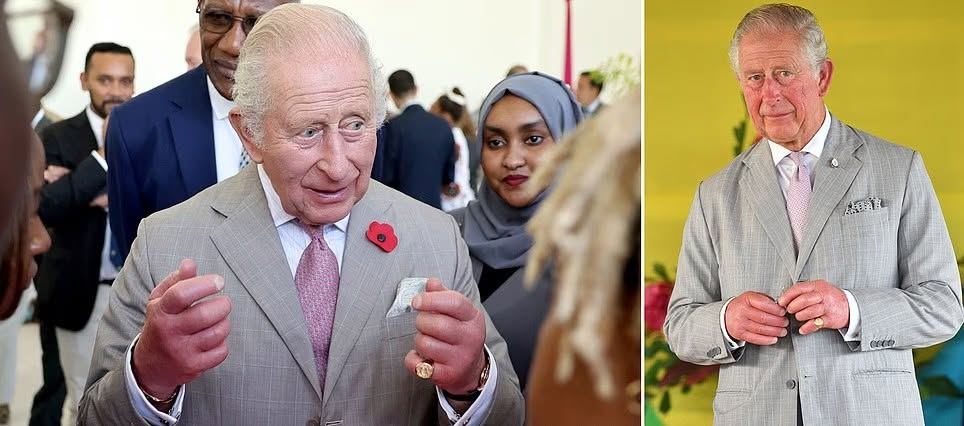
King Charles III has once again attracted public attention after his fingers appeared noticeably swollen during a recent Caribbean tour, prompting fresh questions about the monarch’s health. While royal appearances are often focused on diplomatic engagements, cultural celebrations, and meetings with local communities, even small details about the King’s appearance can quickly become a topic of discussion.
Photographs and public footage showing the monarch greeting officials and meeting members of the public have encouraged renewed speculation about his well-being. However, questions about swollen fingers should be treated carefully. An appearance alone cannot establish a medical diagnosis, and Buckingham Palace has not necessarily provided an explanation for every physical detail noticed by observers.
As King Charles continues his royal responsibilities, public interest in his health remains particularly strong. His recent medical history has made people more attentive to changes in his appearance, especially during demanding overseas engagements.
King Charles’s Swollen Fingers Draw Public Attention
King Charles has never been a monarch who can easily avoid public scrutiny. From his clothing choices and facial expressions to his walking pace and hand movements, almost every aspect of his public appearances can attract attention.
During the Caribbean tour, observers noticed that the King’s fingers appeared fuller or more swollen in certain photographs. The images quickly raised questions about whether the change might be connected to his age, general health, or another medical factor.
Swollen fingers can have many possible explanations, ranging from temporary fluid retention and inflammation to circulation-related issues and other medical conditions. Some causes are relatively minor, while others may require medical assessment. Without reliable medical information, it would be inappropriate to draw conclusions about the King’s condition based on photographs.
Lighting, camera angles, temperature, and natural variations in appearance can also influence how a person’s hands look in pictures. What appears unusual in one image may not necessarily indicate a significant health problem.
Nevertheless, the public’s curiosity is understandable. King Charles is not only the head of the British royal family but also an important national figure whose health is closely connected to questions about the monarchy’s future.
His Previous Cancer Diagnosis Keeps Health Concerns in Focus
Interest in the King’s physical condition has remained elevated since Buckingham Palace announced in February 2024 that he had been diagnosed with cancer. The announcement followed a period of medical treatment after he underwent a procedure for an enlarged prostate.
The Palace clarified that the King did not have prostate cancer, but further tests identified a separate form of cancer. His diagnosis led to an unprecedented level of public attention and prompted widespread messages of support from people across the United Kingdom and around the world.
Although King Charles temporarily reduced his public-facing duties while receiving treatment, he continued working behind the scenes. His determination to maintain some royal responsibilities became an important part of the public conversation about his recovery.
In April 2024, the monarch gradually returned to public engagements, demonstrating his intention to resume a more visible role while following medical advice.
His cancer diagnosis also changed how people interpret his public appearances. Any noticeable physical change can now prompt questions about whether his treatment is progressing as expected. However, a swollen appearance in the fingers does not, by itself, demonstrate that cancer has returned or that his condition has worsened.
Why the King’s Hands Have Become a Talking Point
King Charles’s hands have attracted public curiosity on several occasions throughout his life. His fingers have sometimes appeared puffy in photographs, leading to speculation about possible causes.
There are several medical reasons why fingers can become swollen. Fluid retention, arthritis, inflammation, circulation problems, and certain medications are among the possible explanations. Age can also influence how the body manages fluid and responds to physical stress.
Long periods of travel, changes in climate, and extended schedules may affect comfort and circulation for some people. A Caribbean tour can involve warm temperatures, long flights, formal receptions, and numerous public appearances, all of which may make observers pay closer attention to the monarch’s physical condition.
Still, none of these possibilities should be treated as an explanation for the King’s appearance without medical confirmation.
The important distinction is between noticing a visible change and knowing what caused it. Royal watchers may discuss photographs, but only the King’s medical team can assess his health accurately.
A Demanding Caribbean Tour Adds to the Spotlight
Royal tours are carefully planned, but they can still be physically demanding. Overseas visits often require long-distance travel, frequent changes of location, formal ceremonies, public walkabouts, and meetings with government representatives and community leaders.
For King Charles, these responsibilities come with the additional pressure of representing the Crown. Every appearance carries diplomatic and symbolic importance, particularly in countries with historical connections to the British monarchy.
The Caribbean also holds a special place in the history of the Commonwealth. The King’s visits provide opportunities to strengthen relationships, recognize local achievements, and discuss the evolving relationship between Britain and Caribbean nations.
During such engagements, the monarch is expected to remain attentive, approachable, and energetic despite a busy schedule. His ability to continue participating in public events is therefore closely watched.
The renewed attention to his fingers reflects a wider reality of royal life: even when the main purpose of a visit is diplomacy, personal health can become part of the public conversation.
King Charles Continues to Balance Duty and Recovery
Since becoming monarch in September 2022, King Charles has faced the challenge of leading the royal family while adapting to a role that carries significant constitutional and ceremonial responsibilities.
His cancer diagnosis added another layer of difficulty. The King has had to balance medical treatment and recovery with the demands of his position, while maintaining a visible connection with the public.
His approach has often been described through his continued commitment to work. Even when his schedule has been adjusted, he has remained involved in official matters and maintained contact with senior members of the royal household.
The monarch’s return to public engagements was widely viewed as an encouraging development. However, recovery from cancer is a personal and potentially lengthy process. The details of treatment, medical progress, and long-term health remain matters that should be discussed only through reliable official information.
The public may naturally hope that King Charles remains well enough to continue his duties, but it is equally important to respect the privacy surrounding his medical care.
What Swollen Fingers Could Mean for an Older Adult
Swollen fingers are a common symptom and can occur for many different reasons. In older adults, changes in circulation, joint health, inflammation, and fluid balance may contribute to swelling.
For example, arthritis can cause stiffness, tenderness, and swelling around the joints. Fluid retention may make fingers appear temporarily larger, while injuries or inflammatory conditions can produce more localized changes.
Some medications may also contribute to swelling as a side effect. In other situations, persistent swelling can be associated with underlying health conditions that require professional evaluation.
However, these general medical explanations should not be used to diagnose King Charles. The fact that a person has swollen fingers does not automatically indicate a serious illness, and photographs cannot reveal the full medical picture.
The King’s age and previous diagnosis naturally make the subject more sensitive, but responsible reporting should distinguish between confirmed information and public speculation.
The Monarchy Faces Questions About Leadership and Continuity
King Charles’s health is not simply a personal matter in the eyes of royal watchers. It also connects to broader questions about the future of the British monarchy.
Since his accession, the King has worked to establish his own style of leadership while preserving traditions associated with the Crown. His public commitments, charitable interests, and international relationships have helped define the early years of his reign.
At the same time, Prince William and Princess Catherine have taken on increasingly important roles within the royal family. Their visibility has encouraged discussions about how the monarchy may evolve over the coming years.
The royal institution is designed to continue regardless of the health challenges faced by an individual monarch. Constitutional arrangements and established royal responsibilities provide a framework for continuity.
Nevertheless, King Charles’s well-being remains important to the institution. His presence at major events and overseas engagements carries symbolic weight, making any uncertainty about his health a subject of considerable public interest.
Royal Watchers Await Reliable Updates
For now, the discussion surrounding King Charles’s swollen fingers remains a matter of public observation rather than confirmed medical news. Unless Buckingham Palace releases additional information, there is no reliable basis for linking the appearance of his hands to a specific condition or a change in his cancer status.
The monarch’s Caribbean engagements have once again highlighted the intense attention surrounding his health. His age, previous diagnosis, and demanding royal schedule all contribute to public curiosity.
Yet there is a difference between concern and speculation. Supporters can wish the King well without assuming that every visible change signals a medical setback.
As King Charles continues his work, the most meaningful updates will come from official statements and confirmed information about his health and public duties.
For a monarch whose life is constantly documented, privacy can be difficult to maintain. Still, his medical journey deserves the same care and respect that should be extended to anyone facing a serious health challenge.
Ultimately, the renewed questions about his swollen fingers reveal how closely the public continues to follow King Charles. Beyond the photographs and headlines, many people simply hope that he remains healthy, receives the care he needs, and can continue serving the Crown at a pace that supports his recovery.