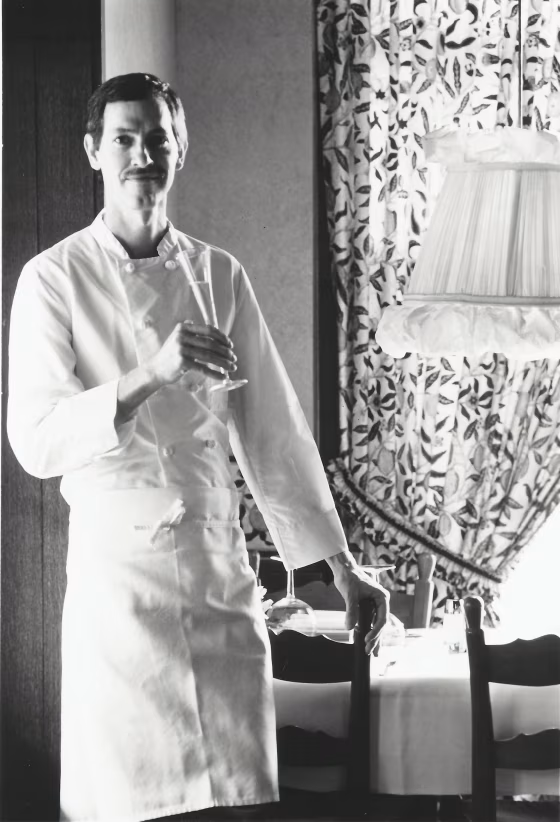
Jeremiah Tower’s life has all the ingredients of a Hollywood drama: an unusual childhood, a complicated relationship with family, a determination to live on his own terms, and a career that helped transform the American restaurant industry. Long before celebrity chefs became familiar faces on television, Tower was building a reputation as a culinary innovator whose personality could command as much attention as the food he served.
As a gay man navigating a world where traditional expectations shaped both professional kitchens and public life, Tower developed a distinctive identity. He cultivated an unmistakable sense of style, pursued his own vision of fine dining, and eventually became one of the most influential figures associated with California cuisine.
Yet his story was never simply a straightforward journey from hardship to success. Behind the glamour were experiences of loneliness, complicated relationships, professional disagreements, and a dramatic rise and fall that would eventually inspire the documentary Jeremiah Tower: The Last Magnificent, produced by the late Anthony Bourdain.
Tower’s life demonstrates how a person can turn personal experiences into creative ambition. His achievements also reveal the complicated reality behind the image of a celebrated chef: success can bring recognition and influence without necessarily resolving every private struggle.
A Childhood Filled With Luxury but Short on Attention
Jeremiah Tower was born in Stamford, Connecticut, in 1942. His early life exposed him to extraordinary privileges, including international travel, elegant hotels, and memorable dining experiences. From the outside, his childhood might have appeared enviable.
But material comfort does not automatically provide emotional security. Accounts of Tower’s upbringing describe parents who were frequently absent or inattentive, leaving him with experiences of loneliness despite the luxurious surroundings.
Travel became an important part of his early education. Staying in hotels and eating in sophisticated restaurants introduced him to the details of hospitality long before he became a professional chef. He learned to notice the atmosphere of a dining room, the presentation of a meal, and the way an entire experience could make an ordinary evening feel special.
Those impressions would later become central to his approach to restaurants.
Tower’s story complicates the familiar assumption that difficult childhoods always involve financial deprivation. His early circumstances included wealth and privilege, but they also involved emotional challenges that shaped his outlook.
Food offered something tangible in a world where personal relationships could feel uncertain. A carefully prepared meal could create pleasure, structure, and a sense of occasion. Hospitality could turn a room full of strangers into a temporary community.
Looking back at Tower’s career, it is possible to see how those early experiences helped shape his interest in creating memorable environments. They do not explain every decision he made, but they form an important part of the background to his later success.
Growing Into His Identity as a Gay Man
Tower understood from an early age that he was attracted to men. However, growing up in an era when homosexuality was far less openly discussed meant that expressing his identity was not always straightforward.
Social expectations were particularly restrictive in many professional environments during the middle of the twentieth century. Men who did not fit conventional ideas of masculinity could face judgment, discrimination, or pressure to keep their private lives separate from their public identities.
Tower developed a distinctive public persona. He was stylish, confident, and comfortable occupying the center of attention. His appearance and manner helped distinguish him from the conventional image of a professional chef, while his ambition pushed him toward a more visible role in the restaurant world.
His experience also reflected a broader tension within the culinary industry. Kitchens were demanding workplaces, and professional success often depended on navigating powerful personalities and established hierarchies. Being openly different could complicate those relationships.
Tower’s sexuality did not define every aspect of his professional life, but it formed part of the environment in which he built his reputation. His later prominence as a gay chef made him a notable figure in an industry that had not always offered equal acceptance or visibility.
His experiences also demonstrate why representation in the culinary world matters. When a successful professional challenges assumptions about who can lead a kitchen or become a public figure, that achievement can have significance beyond the individual’s own career.
From Harvard to the World of Professional Cooking
Before becoming a celebrated chef, Tower pursued an academic path that might have led him toward architecture and design. He studied at Harvard University and earned a master’s degree from the Harvard Graduate School of Design.
Cooking, however, gradually became a more compelling direction.
Tower did not follow the conventional route of attending culinary school before entering professional kitchens. Instead, he developed his knowledge through experience, observation, reading, and an intense interest in food.
A visit to Chez Panisse in Berkeley, California, helped change the course of his life. The restaurant, associated with Alice Waters and a growing movement toward fresh, seasonal ingredients, offered an approach to cooking that resonated with him.
Tower joined the restaurant in 1972 and quickly became an important force in its kitchen. His interest in sophisticated technique, regional ingredients, and carefully constructed menus helped shape the restaurant’s developing identity.
At Chez Panisse, food was not treated simply as a product to be delivered to customers. Ingredients, sourcing, seasonality, and the relationship between cooking and place all mattered.
Tower brought his own perspective to that philosophy. His experience of international travel and fine dining informed his approach, while his attention to presentation helped make the restaurant’s food distinctive.
His time at Chez Panisse was also marked by creative and professional disagreements. His relationship with Waters and other people associated with the restaurant eventually deteriorated, and Tower left in 1978.
The departure marked the end of one chapter, but it also created an opportunity for him to pursue a more independent vision.
Stars: The Restaurant That Helped Make Him Famous
In 1984, Tower opened Stars in San Francisco. The restaurant became the defining achievement of his career and helped establish him as one of the most recognizable figures in American dining.
Stars was not designed to be merely a place where customers ate dinner. It offered an atmosphere in which food, service, design, and social life came together.
Its open kitchen was an important part of the experience. Rather than hiding the work of the chefs behind closed doors, the restaurant allowed diners to watch the activity and energy of the kitchen.
That approach helped reinforce the idea that the chef could be a central figure in the restaurant experience. Cooking became something to observe and appreciate, not simply a service performed out of sight.
Stars also embraced glamour and spectacle. The restaurant attracted influential guests and became a destination for people interested in food, socializing, and the wider culture surrounding dining.
Tower himself was part of the attraction. His confidence, personal style, and ability to create a sense of occasion made him a memorable presence.
In an era before television cooking competitions and celebrity-chef empires became commonplace, Tower embodied an emerging model of the chef as both artist and public personality.
His restaurant helped demonstrate that a dining establishment could have a recognizable identity shaped by the person leading its kitchen. That concept would later become familiar throughout the restaurant industry.
How Jeremiah Tower Influenced California Cuisine
Tower’s influence extended beyond his own restaurant. His work contributed to a broader transformation in American cooking that emphasized seasonal ingredients, regional identity, and a more flexible approach to fine dining.
California cuisine developed through the efforts of many chefs, farmers, restaurant owners, and food writers. It cannot be attributed to one individual alone. Nevertheless, Tower became an important figure in its evolution.
His cooking combined technical skill with a strong interest in ingredients. He drew inspiration from French culinary traditions while exploring the possibilities offered by California’s produce and regional food culture.
This approach helped challenge the idea that sophisticated American dining needed to imitate European restaurants in every detail. A restaurant could draw from international techniques while creating something rooted in its own location.
The physical environment mattered, too. Tower understood that customers responded to more than the food on their plates. Lighting, room design, service, music, and the rhythm of a meal all contributed to the overall experience.
That philosophy anticipated many features of modern restaurant culture, where the chef’s vision can extend from the menu to the architecture and atmosphere of the dining room.
Tower’s influence is also reflected in the careers of chefs who worked within the professional networks surrounding Stars. Several people who passed through those kitchens went on to develop important careers of their own.
His legacy is therefore not limited to a collection of recipes. It includes a way of thinking about restaurants as creative spaces in which food and hospitality work together.
The Challenges Behind the Glamorous Image
The public image of a successful chef can make a demanding career appear effortless. Tower’s story reveals a more complicated reality.
Running a high-profile restaurant requires balancing creativity with financial management, staff relationships, customer expectations, and the pressure to maintain standards. The atmosphere that makes a restaurant exciting can also make it difficult to manage.
Stars became a major success, but its story eventually took a dramatic turn. After Tower sold part of his interest, the restaurant’s ownership changed, and Stars closed in 1999.
The closure marked a significant break in his career. A restaurant that had become closely associated with his identity was no longer operating, and Tower moved away from the center of American culinary culture.
His life after Stars included periods abroad and a much lower public profile. For someone who had once occupied such a prominent place in the restaurant scene, the change was striking.
The contrast between his rise and his later absence from the spotlight became a central element of the fascination surrounding his life. His career was not a simple story of uninterrupted success, but one involving reinvention, conflict, and the loss of a defining professional achievement.
Those experiences also reveal a limitation of celebrity. Public recognition can create opportunities, but it does not guarantee stability. Businesses change, partnerships break down, and reputations evolve.
Tower’s story became compelling partly because it showed how quickly a seemingly secure position can change—and how difficult it can be to determine what comes next.
A Return to the Spotlight at Tavern on the Green
More than a decade after Stars closed, Tower returned to a prominent restaurant role when he became executive chef at New York City’s Tavern on the Green in 2014.
The appointment attracted attention because the restaurant was an established New York landmark and Tower remained a figure of considerable historical importance in American cuisine.
His return suggested the possibility of a new chapter, one that might reconnect him with the public after years away from the center of the industry.
However, the position was short-lived. Tower left Tavern on the Green in 2015, ending another highly visible but brief period in his career.
The episode reinforced the unpredictability that had marked his professional life. Even a chef with a celebrated history could find that returning to a famous restaurant did not necessarily recreate the circumstances of earlier success.
Still, the appointment demonstrated that Tower’s reputation had not disappeared. His name continued to carry significance among people interested in the evolution of American dining.
His career could not be reduced to a single restaurant, a single period of fame, or a simple comeback narrative. It was a sequence of achievements and setbacks that reflected both his individual ambitions and the changing nature of the restaurant business.
The Documentary That Made His Life Feel Like a Movie
Tower’s unusual biography eventually became the subject of Jeremiah Tower: The Last Magnificent, a documentary directed by Lydia Tenaglia and produced by Anthony Bourdain.
The film examines his childhood, his work at Chez Panisse, the success of Stars, and his later return to professional cooking. Through archival material, interviews, and a close examination of his career, it presents a portrait of a chef whose public achievements were accompanied by considerable personal complexity.
The documentary’s structure gives Tower’s life a cinematic quality. There is the early environment that shaped his tastes, the discovery of a professional calling, the rise to extraordinary influence, the collapse of a defining enterprise, and the question of what remains after fame fades.
Yet the film also avoids reducing his life to a straightforward inspirational story. Tower emerges as a complicated individual whose talents, confidence, relationships, and decisions all contributed to the course of his career.
Bourdain’s involvement was particularly fitting. As a chef and writer who understood the pressures and contradictions of professional kitchens, he was well placed to recognize the significance of Tower’s contribution to the industry.
The documentary also helped introduce Tower’s story to audiences who may not have experienced Stars during its heyday. For them, the film offers a way to understand why his name mattered and how his approach helped influence the restaurant culture that exists today.
The result is a portrait that feels cinematic without needing to turn every episode into a neat lesson about success.
A Legacy Bigger Than One Chef’s Fame
Jeremiah Tower’s influence can be seen in the modern understanding of the chef as a creative leader. Today’s restaurant culture often places the chef at the center of a larger experience, with menus, design, sourcing, and public identity all contributing to a recognizable vision.
That model has many contributors, but Tower helped establish its possibilities during a period when American dining was changing rapidly.
His work also illustrates the importance of experimentation. He drew from established traditions without treating them as unchangeable rules, and he approached restaurants as places where food could be combined with design and performance.
At the same time, his legacy is not without complexity. Historical figures can be influential without being flawless, and acknowledging their contributions does not require ignoring the difficult aspects of their careers.
Tower’s story is most interesting when viewed in full: the talent, the ambition, the loneliness, the professional conflicts, the public success, and the periods when he stepped away from the spotlight.
His experiences as a gay man also form part of the history of a culinary industry that has changed considerably over the decades. Greater visibility for LGBTQ+ professionals has not eliminated every challenge, but the presence of influential figures like Tower helps show how varied the history of professional cooking really is.
Conclusion: A Life More Complicated Than Fiction
Jeremiah Tower’s life contains the elements of a remarkable film, but its significance extends beyond dramatic twists. His childhood introduced him to the pleasures of fine dining while leaving him with complicated personal experiences. His interest in food became a professional calling, and his work at Chez Panisse and Stars helped change the way many Americans thought about restaurants.
His success demonstrated the power of a strong culinary vision. His setbacks showed that fame and professional achievement do not protect anyone from uncertainty or loss.
As a gay chef who built a highly visible career in a changing cultural landscape, Tower also occupies an important place in the wider story of representation within the restaurant industry.
The documentary Jeremiah Tower: The Last Magnificent brought these different chapters together, offering audiences a chance to consider the person behind the reputation.
Perhaps the most compelling part of his story is that it resists a simple ending. Tower’s life was neither an uninterrupted triumph nor a conventional tale of downfall and redemption. It was a complicated journey shaped by talent, ambition, personal choices, and changing circumstances.
And that may be what makes his biography feel more memorable than a traditional Hollywood movie: its contradictions, unexpected turns, and imperfect human details are precisely what make it real.