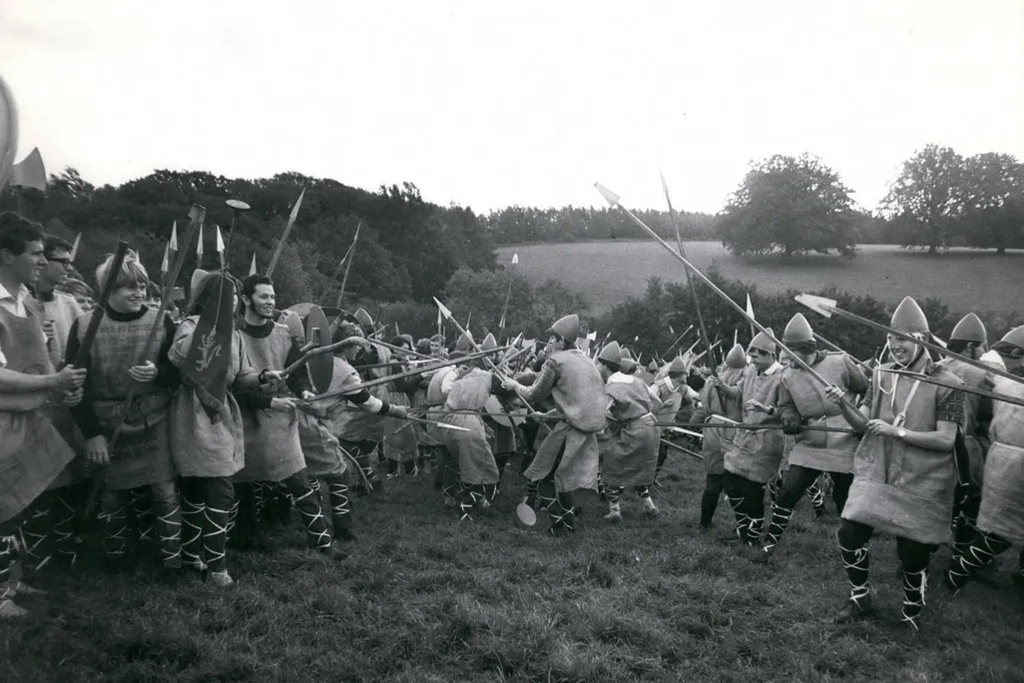
A remarkable piece of British history has returned to the spotlight after nearly 60 years. Newly restored color footage shows hundreds of university students recreating the Battle of Hastings in 1966, charging across a field with wooden swords, improvised shields, and homemade costumes to commemorate the 900th anniversary of one of England’s most consequential battles.
The event was far from a perfectly choreographed historical production. Participants wore makeshift armor, the fighting became surprisingly physical, and the organizers faced practical problems that included delays before the action could begin. Yet the energetic gathering captured the imagination of spectators and helped establish a tradition of Battle of Hastings re-enactments that continues today.
The rediscovered film was originally recorded by local filmmaker Alan Wootton and his team. Decades later, his son, Cliff Wootton, helped bring the footage back to life, working with heritage specialists to preserve a vivid record of the unusual celebration.
Released by English Heritage in October 2026, the restored film offers more than a humorous look at students pretending to be medieval warriors. It documents a local anniversary event, captures changing attitudes toward historical re-enactment, and reveals how an improvised spectacle became part of a lasting British heritage tradition.
The 1966 Battle of Hastings Re-enactment: A Day to Remember
On October 14, 1966, several hundred students from the universities of Kent and Sussex gathered near Battle in East Sussex to recreate the Battle of Hastings. The event marked 900 years since the original confrontation in 1066, when William, Duke of Normandy, defeated the English army led by King Harold II.
The anniversary offered an opportunity to bring a major historical event into public view. Instead of limiting the commemoration to speeches, exhibitions, or formal ceremonies, organizers staged a mock battle on the landscape associated with the original conflict.
The students were recruited to portray the opposing forces. Some dressed as English defenders, while others took the role of William’s Norman army. Their equipment was improvised, with wooden weapons, cardboard shields, and rough costumes standing in for medieval military gear.
The result was an event that mixed historical commemoration with youthful enthusiasm. Participants were not professional historical performers, and the production lacked many of the standards expected from modern re-enactments.
That informality became part of its appeal. The students were there for an unusual day out, and the chance to take part in a large-scale mock battle proved more memorable than a conventional university excursion.
Peter Sampson, who participated as a Norman foot soldier, later recalled that the prospect of a coach trip, a good day out, and beer helped persuade students to join. He also remembered that the confrontation sometimes became genuinely aggressive, with the rivalry between the two groups adding extra energy to the spectacle.
Although the participants knew they were recreating a historical event, the enthusiasm of the opposing sides gave the mock fighting a competitive edge.
Wooden Swords, Homemade Armor, and a Surprisingly Physical Battle
One of the most striking aspects of the rediscovered footage is the simplicity of the costumes and equipment.
Rather than wearing carefully researched reproductions of eleventh-century armor, participants relied on makeshift materials. Some wore burlap or sackcloth, while others used imitation chainmail and homemade protective gear. Wooden swords and painted props stood in for the weapons used by medieval soldiers.
The contrast between the historical importance of the Battle of Hastings and the improvised nature of the 1966 production gives the film much of its charm.
The footage also shows how physically involved the students became. What began as a commemorative performance developed into a lively clash in which participants pushed, shoved, and swung their imitation weapons with considerable enthusiasm.
Sampson later described the fighting as intense at times. He recalled that a friend was struck around the head by the end of a fake spear, leaving his face hurting.
Such memories underline the difference between a carefully controlled modern performance and an event staged with the more relaxed expectations of the 1960s.
The restored film also reveals reenactors on foot getting remarkably close to horses. From a contemporary perspective, some scenes raise obvious questions about protective equipment, crowd management, and the separation of people from moving animals.
English Heritage has noted that the footage reflects a much more relaxed attitude toward health and safety than audiences would expect today.
That does not mean every moment of the event was dangerous, nor does the footage provide a complete account of how participants were supervised. It does, however, preserve a visual record of how dramatically expectations around safety and organized public events have changed over six decades.
Why the Original Battle of Hastings Mattered
The event recreated by the students was not an ordinary military engagement. The Battle of Hastings, fought on October 14, 1066, helped determine the future direction of England.
Following the death of King Edward the Confessor, competing claims to the English throne led to a succession crisis. Harold Godwinson was crowned king, but William, Duke of Normandy, also asserted a claim to the throne.
William assembled an invading force and crossed the English Channel. Harold, who had recently fought another major battle in the north of England, marched south to confront the Norman army.
The two forces met near the present-day town of Battle in East Sussex. The English army occupied a strong defensive position on a ridge, while William’s forces attempted to break through its lines.
After hours of fighting, the Norman army prevailed. Harold II was killed, and William’s victory opened the way for his coronation as King of England later that year.
The Norman Conquest transformed English political life. It brought a new ruling elite, reshaped landownership, influenced architecture and administration, and contributed to major changes in the English language and culture.
The consequences extended far beyond the battlefield. Over subsequent generations, Norman and Anglo-Saxon traditions interacted, producing a society whose institutions and language developed through a complex process of change.
By 1966, the battle had become one of the most recognizable turning points in British history. Its 900th anniversary provided a natural occasion for local communities to revisit the event through exhibitions, ceremonies, educational activities, and public performances.
The student re-enactment offered a particularly memorable way to connect modern audiences with that distant past.
How Alan Wootton Filmed the Historic Event
The footage exists because of the work of Alan Wootton, a local electronics company owner who was asked by Hastings Town Council to document the anniversary celebration.
Wootton and his wife, Mary, were involved in electronics and sound technology. Their technical experience helped support the creation of a color film that recorded the event for posterity.
Alan did not work alone. His small production team included his young son, Cliff, who was just 12 years old at the time. Cliff and his brother, Den, helped with sound recording during the event.
For the young Cliff, the filming was a firsthand experience of a major local gathering. He later recalled that the event was enormous in scale and that returning to the material decades afterward made it fascinating to revisit his family’s work.
The resulting film preserved scenes that might otherwise have survived only in photographs, newspaper reports, and the memories of participants.
Moving images are especially valuable for understanding the atmosphere of historical events. A written account can describe the costumes or the intensity of the fighting, but film allows viewers to see how people moved, interacted, reacted, and occupied the landscape.
The footage also preserves details that its original creators may not have considered particularly important. The improvised clothing, the proximity of horses, and the behavior of the crowds all provide insight into the practical realities of staging a large historical re-enactment in the 1960s.
The film was not intended to document the medieval Battle of Hastings itself. Instead, it captured a modern event that reflected how people in 1966 chose to remember and perform their history.
That distinction is central to its value as a historical record.
How Nearly 60 Years of Film Was Rediscovered
After Alan Wootton died, his wife, Mary, passed his collection of approximately 300 film reels to their son, Cliff.
The reels represented years of family filming and local history. Like many personal archives, however, the collection required time and attention before its contents could be fully understood and shared.
Cliff gradually reviewed the material. A visit to Battle Abbey renewed his interest in the 1966 re-enactment footage and prompted him to work with English Heritage to bring the film back into public view.
The restoration process turned the surviving material into a 12-minute film that could be shown to modern audiences. English Heritage released it in October 2026, ahead of the year’s Battle of Hastings re-enactment.
The rediscovery illustrates a common challenge in preserving twentieth-century history. Important records are not always stored in national archives or maintained by major institutions. Some remain in private collections, where their historical significance may not become apparent until someone takes the time to review them.
Family films, home movies, local newsreels, and amateur recordings can preserve details that professional news organizations never captured. They can also provide a more intimate view of everyday life, revealing how communities celebrated, worked, traveled, and remembered important occasions.
In this case, a family archive helped recover a piece of local heritage that had been largely absent from public view for decades.
The restoration also gave English Heritage an opportunity to connect the film with the living tradition that grew out of the original event.
From a Rowdy Student Spectacle to an Annual Tradition
The 1966 re-enactment was more than a one-day anniversary celebration. Its success helped establish a tradition of staging the Battle of Hastings as a public event.
Modern re-enactments are generally more organized and historically informed than the original student gathering. Participants often invest considerable time in researching clothing, weapons, equipment, and the practical details of medieval life.
Historical accuracy has become an important part of the experience. Visitors can learn about military formations, medieval equipment, daily routines, and the conditions under which people lived nearly a thousand years ago.
At the same time, re-enactments are performances. They must balance historical interpretation with public safety, entertainment, and the limitations of presenting a complex historical event to modern audiences.
The annual event at Battle Abbey brings these elements together. Hundreds of re-enactors can take part, while visitors encounter recreated camps and demonstrations that help make the past more tangible.
The location itself contributes to the experience. Battle Abbey stands on ground associated with the famous confrontation, giving the event a direct connection to the landscape that shaped the battle.
The 1966 film reveals the origins of this tradition in a particularly engaging way. Its improvised costumes and enthusiastic fighting may look amusing today, but they also demonstrate the excitement that can arise when people are invited to participate in history rather than simply read about it.
What began as an anniversary spectacle has become a recurring opportunity for education, remembrance, and public engagement.
Why English Heritage Calls the Film an Incredible Time Capsule
English Heritage has described the restored footage as an extraordinary time capsule because it captures both the event itself and the atmosphere surrounding it.
The film offers a view of a specific moment in British cultural history. It shows how a local community marked a major anniversary, how students approached historical performance, and how the expectations of organizers differed from those of today.
Its value lies partly in its imperfections. The homemade costumes, wooden weapons, and energetic clashes reveal the practical decisions that shaped the production.
A polished modern documentary might explain how the event was organized, but the original film allows viewers to observe its character directly.
It also raises questions about the preservation of local memories. Many people who participated in the 1966 event would now be older adults, and their recollections could help historians better understand what happened that day.
English Heritage has therefore appealed to anyone who took part in the original re-enactment, or who recognizes a friend or relative in the footage, to come forward.
The organization has said that it does not possess a complete list of the original foot soldiers. Identifying participants could help fill gaps in the record and connect the film with personal memories that have not yet been documented.
For surviving participants and their families, the footage may provide an opportunity to revisit an unusual moment in their lives. For historians, it offers a chance to connect visual evidence with firsthand testimony.
Where to Watch the Rediscovered Battle of Hastings Footage
English Heritage released the restored 12-minute film in October 2026 and announced that it would be shown at Battle Abbey during the annual re-enactment on October 10 and 11.
Those scheduled screenings formed part of the charity’s effort to share the footage with visitors and introduce a new generation to the origins of the tradition.
For anyone hoping to watch the film now, English Heritage’s official website is the best place to check for current viewing information. The announcement of the original screenings does not, by itself, confirm that the full film remains permanently available online.
The discovery has already renewed interest in the 1966 event and its place in the history of public re-enactments. Its rediscovery also highlights the importance of preserving archival film before it deteriorates or becomes inaccessible.
Even a short recording can reveal an extraordinary amount about a community, an era, and the ways people choose to remember the past.
A Forgotten Film Brings History Back to Life
The rediscovered footage of the 1966 Battle of Hastings re-enactment captures an event that was energetic, improvised, and occasionally chaotic. Hundreds of students gathered to commemorate a turning point in English history, armed with wooden weapons and wearing costumes that reflected the resources and expectations of their time.
Their performance was not a precise reconstruction of eleventh-century warfare. Instead, it was a vivid expression of how a generation of students chose to celebrate a major historical anniversary.
Thanks to Alan Wootton’s filming and Cliff Wootton’s later restoration work, the event can now be seen by audiences who were not alive when it took place.
The film preserves the humor and rough edges of the original spectacle while documenting the beginning of a tradition that continues to bring history to life at Battle Abbey.
Nearly a thousand years after William the Conqueror defeated Harold II, the Battle of Hastings remains a powerful symbol of change in English history. The 1966 re-enactment adds another chapter to that story—not by revealing new details about the medieval battle, but by showing how people in the twentieth century remembered it.
Its greatest achievement may be its ability to make history feel immediate. For a few minutes, viewers can step into a long-forgotten October day and watch ordinary students transform a field in southern England into a lively stage for one of the most famous battles in British history.