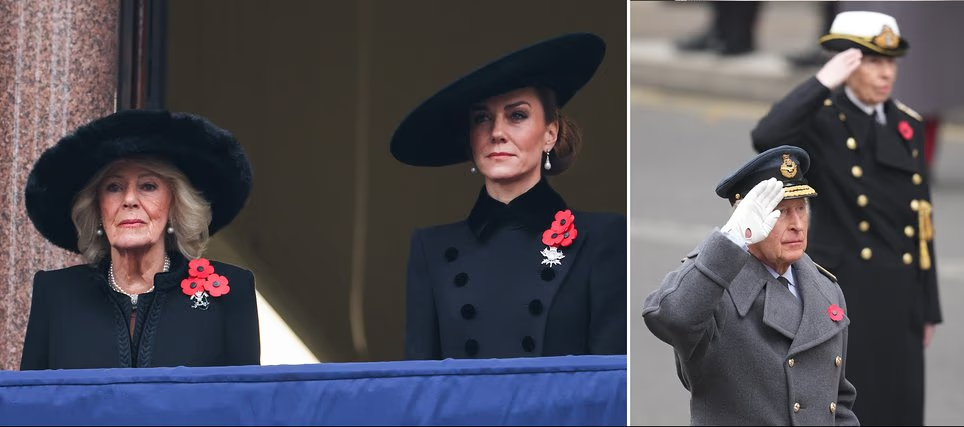
The British royal family came together on Sunday, November 8, 2026, to honor the men and women who lost their lives serving the United Kingdom and the Commonwealth. Catherine, Princess of Wales, joined Queen Camilla at the annual Remembrance Sunday service in London, while King Charles III and Prince William led the nation’s solemn tribute at the Cenotaph in Whitehall.
The deeply moving ceremony brought together senior members of the royal family, political leaders, military representatives, veterans, and members of the public. As the country observed its traditional two-minute silence, the occasion served as a powerful reminder of the sacrifices made by generations of service personnel in conflicts around the world.
For the royal family, Remembrance Sunday remains one of the most important engagements of the year. The annual service reflects the monarchy’s longstanding connection with the Armed Forces and its responsibility to remember those who made the ultimate sacrifice for their country.
Kate Middleton and Queen Camilla Stand Together at the Cenotaph Ceremony
The Princess of Wales attended the Remembrance Sunday service alongside Queen Camilla, watching the proceedings from the balcony of the Foreign, Commonwealth and Development Office overlooking Whitehall.
Both women wore elegant black outfits in keeping with the solemn nature of the occasion. Kate completed her look with a black hat and traditional poppy decorations, while her choice of pearl earrings, which once belonged to Diana, Princess of Wales, added a subtle personal touch.
The Princess of Wales has consistently demonstrated her commitment to remembrance events throughout her royal life. Her attendance alongside Queen Camilla also highlighted the importance of the women supporting the monarchy as the King and Prince William carried out their ceremonial duties below.
Standing together on the balcony, Kate and Camilla watched as wreaths were laid at the Cenotaph and veterans gathered to honor their fallen comrades.
Their presence reflected the royal family’s shared commitment to ensuring that the sacrifices of previous generations remain an important part of Britain’s national identity.
For Kate, the occasion also represented another significant public appearance as she continues to undertake her responsibilities as Princess of Wales.
King Charles Leads the Nation in a Moving Tribute
King Charles III led the national act of remembrance, laying the first wreath at the Cenotaph before stepping back and saluting in honor of those who died during military service.
The monarch wore his field marshal uniform, reflecting his longstanding relationship with the British Armed Forces and his position as head of state.
His participation followed a tradition maintained by British sovereigns for generations. The annual ceremony allows the monarch to represent the nation in remembering the fallen, while also recognizing the courage and dedication of serving military personnel.
After laying his wreath, Charles stood in silence as the ceremony continued around him.
The King’s presence carried particular significance as the United Kingdom continues to recognize the sacrifices made during the two World Wars and subsequent conflicts.
For many veterans and their families, seeing the monarch lead the ceremony is an important reminder that their service and personal losses have not been forgotten.
Charles has consistently emphasized the importance of the Armed Forces and the need to support veterans, serving personnel, and their families.
His participation in Remembrance Sunday therefore represents more than a ceremonial responsibility. It is a visible expression of the monarchy’s continuing relationship with those who serve the country.
Prince William Lays a Wreath in Honor of Britain’s Fallen Heroes
Prince William also played a prominent role in the ceremony, laying a wreath at the Cenotaph as the future king paid tribute to generations of British service personnel.
The Prince of Wales wore the distinctive uniform of a Lieutenant Colonel of the Household Cavalry, accompanied by his military decorations.
His wreath featured the Prince of Wales feathers and a ribbon in Welsh red, reflecting his royal title and historic connection with Wales.
After placing the wreath, William stepped back and saluted the memorial in a solemn moment that attracted considerable attention.
His participation was particularly meaningful because of his own military background. William served in the British Armed Forces between 2006 and 2013, undertaking training at the Royal Military Academy Sandhurst before serving with the Household Cavalry.
He later worked as a search-and-rescue pilot with the Royal Air Force and also served with the East Anglian Air Ambulance.
Those experiences have helped shape his understanding of military life, teamwork, and the challenges faced by people working in demanding service environments.
As Prince of Wales, William has increasingly taken on responsibilities traditionally associated with the heir to the throne. His prominent role at the Cenotaph demonstrated his commitment to preserving royal traditions while preparing for his future position as monarch.
The Royal Family Observes the Two-Minute Silence
One of the most emotional moments of Remembrance Sunday came at 11 a.m., when Big Ben marked the beginning of the traditional two-minute silence.
The King, Prince William, other members of the royal family, political leaders, and veterans stood in complete silence as the nation remembered those who lost their lives in military conflicts.
The Last Post sounded as the ceremony continued, creating a deeply moving atmosphere around the Cenotaph.
For many people attending the event, the silence represented an opportunity to remember relatives, friends, and fellow service members who never returned home.
The tradition dates back to the aftermath of the First World War and remains one of the most recognizable elements of Britain’s annual remembrance commemorations.
Although the ceremony focuses heavily on historical conflicts, it also acknowledges the sacrifices made by military personnel in more recent operations.
Families of those who served continue to carry personal memories of loss, making Remembrance Sunday an important occasion for reflection and national unity.
The royal family’s participation helped reinforce the significance of the moment, with several generations represented during the ceremony.
Around 10,000 Veterans Take Part in the March Past
Following the wreath-laying service, approximately 10,000 veterans participated in the traditional March Past at the Cenotaph.
More than 300 Armed Forces and civilian organizations were represented, creating a remarkable gathering of people whose lives have been connected to military service.
Veterans from different generations marched through Whitehall, many wearing medals earned during their time in uniform.
Some participants had served in the Second World War, while others represented more recent military operations and service organizations.
The march also included younger participants, demonstrating how the responsibility of remembrance continues to pass from one generation to another.
For many veterans, taking part in the ceremony is an emotional experience. It offers an opportunity to reconnect with former comrades, remember those who died, and receive recognition for their service.
The presence of so many participants also demonstrated the continuing importance of supporting the Armed Forces community.
King Charles, Prince William, and other royal representatives observed the procession as the veterans marched past the memorial.
Their participation helped create a powerful connection between the monarchy and the people whose service has contributed to Britain’s military history.
Why Remembrance Sunday Is So Important to Kate and the Royal Family
Remembrance Sunday is held on the Sunday closest to November 11, marking the anniversary of the Armistice that brought fighting in the First World War to an end in 1918.
The Cenotaph in Whitehall has served as the focal point of the national ceremony for more than a century.
Originally constructed as a temporary memorial, it became a permanent monument and one of Britain’s most important symbols of remembrance.
For the royal family, attending the annual service is a longstanding tradition that reflects the monarchy’s close relationship with the Armed Forces.
The sovereign traditionally leads the national tribute, while other senior royals participate by laying wreaths, attending commemorative events, and representing military organizations.
Kate’s attendance alongside Queen Camilla demonstrates the important supporting role played by senior royal women during these national occasions.
Although they do not take part in the wreath-laying ceremony at the Cenotaph in the same way as the King and Prince of Wales, their presence adds to the collective expression of respect.
The occasion also allows the royal family to recognize veterans and military families whose experiences are often overlooked outside the annual commemorations.
Kate and William Continue to Represent the Future of the Monarchy
The 2026 Remembrance Sunday service also highlighted the increasingly important roles played by William and Kate within the modern monarchy.
As heir to the throne, Prince William is gradually assuming greater responsibility at major national events alongside King Charles.
His appearance at the Cenotaph demonstrated his understanding of the traditions associated with the position of Prince of Wales.
Meanwhile, Kate continues to establish herself as one of the most recognizable and influential members of the royal family.
Her attendance with Queen Camilla reflected the continuity of royal service and the importance of supporting the monarch during significant national occasions.
Together, William and Kate represent the next generation of the monarchy, balancing longstanding traditions with a modern approach to public service.
Their involvement in Remembrance Sunday also demonstrates that honoring the country’s history remains an important responsibility for the future King and Queen.
A Powerful Reminder of Britain’s Sacrifices
The 2026 Remembrance Sunday ceremony was an emotional occasion that brought together the royal family and the nation in a shared act of remembrance.
From King Charles and Prince William laying their wreaths to Kate and Queen Camilla standing together on the balcony, every moment reflected the importance of honoring those who made the ultimate sacrifice.
The two-minute silence, the sound of the Last Post, and the march involving thousands of veterans provided powerful reminders of the human cost of war.
Beyond the royal appearances and ceremonial traditions, the heart of the occasion remained the men and women whose courage and service helped protect future generations.
As Britain continues to mark Armistice Day on November 11, the royal family’s participation at the Cenotaph reinforces a message that remains as important today as it was a century ago.
Their tribute was not simply an annual royal engagement. It was a reminder that the sacrifices of Britain’s fallen heroes must never be forgotten.