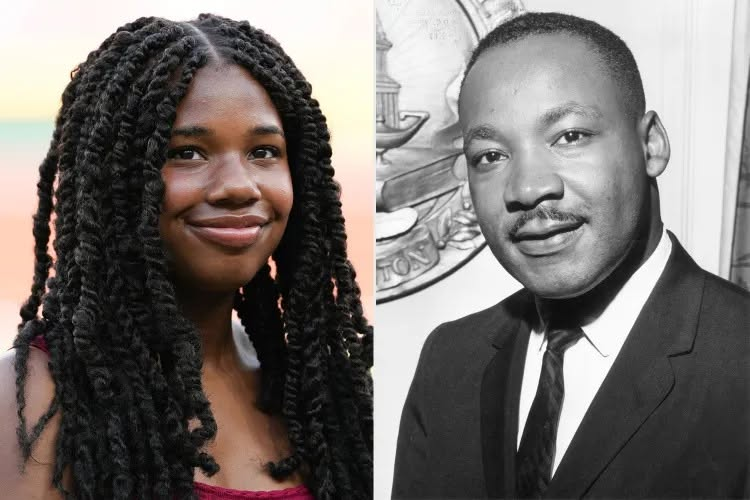
For Yolanda Renee King, casting her first vote was about much more than participating in an important democratic tradition. It was a deeply personal moment that connected her to the extraordinary legacy of her grandparents, civil rights icons Martin Luther King Jr. and Coretta Scott King.
The young activist marked the milestone with a heartfelt message: “This is for my grandparents.” Her words reflected the significance of a moment that carried generations of history, sacrifice, and hope. As the only grandchild of Martin Luther King Jr. and Coretta Scott King, Yolanda understands that her family’s name represents far more than a place in American history. It carries the memory of a movement that transformed the country and continues to inspire people around the world.
Her first experience at the ballot box offered a powerful reminder that the fight for voting rights did not end with the passing of the civil rights leaders who helped make those rights possible. For Yolanda, voting was an opportunity to honor their work while embracing her own responsibility to help shape the future.
Yolanda Renee King Makes Her First Vote a Tribute to Her Grandparents
Casting a first ballot is an unforgettable experience for many young Americans. It represents independence, civic participation, and the opportunity to have a voice in decisions that affect their communities.
For Yolanda Renee King, however, the occasion carried an additional emotional dimension.
As the granddaughter of Martin Luther King Jr. and Coretta Scott King, she grew up surrounded by the legacy of two individuals whose lives were dedicated to equality, justice, and human dignity.
Her words, “This is for my grandparents,” captured the connection between her personal milestone and the historical struggle that shaped her family’s story.
The statement was more than an expression of admiration. It reflected an understanding that the right to vote was something previous generations had fought tirelessly to protect.
For families whose histories are closely connected to the civil rights movement, participating in elections can carry a special meaning.
Yolanda’s decision to acknowledge her grandparents during such an important moment demonstrated how personal experiences can become reminders of a much larger historical journey.
Her first vote also represented a new chapter in the King family’s continuing connection to civic engagement and social justice.
The Extraordinary Legacy of Martin Luther King Jr.
Yolanda’s emotional tribute begins with the extraordinary life and work of her grandfather, Martin Luther King Jr.
Born on January 15, 1929, King became one of the most influential leaders of the American civil rights movement.
A Baptist minister and powerful public speaker, he dedicated his life to challenging racial segregation, discrimination, and inequality through nonviolent protest.
During the 1950s and 1960s, King emerged as a central figure in the struggle for equal rights.
His leadership during the Montgomery Bus Boycott helped bring national attention to the fight against racial segregation.
He later became one of the most recognizable voices of the movement, delivering speeches that challenged Americans to imagine a society built on justice and equality.
His historic “I Have a Dream” speech during the 1963 March on Washington remains one of the most important moments in American political and cultural history.
King also played a significant role in the campaign for voting rights.
He believed that democracy could not be complete while Black Americans were prevented from exercising their constitutional rights through discriminatory laws and practices.
His leadership helped build momentum for major legislative changes, including the Civil Rights Act of 1964 and the Voting Rights Act of 1965.
King was assassinated in Memphis, Tennessee, on April 4, 1968.
Although his life ended at the age of 39, his ideas and influence continued to shape generations of activists, political leaders, and ordinary citizens.
For Yolanda, carrying his legacy means recognizing both the progress achieved and the responsibilities that remain.
Coretta Scott King: The Woman Who Continued the Fight
Yolanda’s tribute also honors her grandmother, Coretta Scott King, whose contributions to the civil rights movement extended far beyond her role as the wife of Martin Luther King Jr.
Coretta was an influential activist, organizer, and advocate who dedicated much of her life to social justice.
She supported her husband’s work throughout the civil rights movement while also developing her own voice on issues involving racial equality, peace, women’s rights, and economic justice.
Following Martin Luther King Jr.’s assassination, Coretta continued his mission with remarkable determination.
She worked to preserve his legacy and helped establish the Martin Luther King Jr. Center for Nonviolent Social Change in Atlanta, creating an institution dedicated to education, research, and nonviolent activism.
Her efforts also played an important role in the campaign to establish Martin Luther King Jr. Day as a federal holiday.
Coretta passed away in January 2006, but her influence remains visible through the organizations, initiatives, and social justice movements she helped inspire.
For Yolanda, remembering both grandparents is especially meaningful because their shared commitment to equality helped create opportunities that younger generations can exercise today.
Her first vote became a symbolic connection to two individuals who believed deeply in the power of ordinary people to influence the direction of their country.
Why Voting Rights Were So Important to the King Family
The connection between Yolanda’s first vote and her grandparents’ legacy becomes even more significant when considering the history of voting rights in the United States.
For generations, Black Americans faced barriers designed to prevent them from participating fully in elections.
Discriminatory practices included literacy tests, poll taxes, intimidation, and other methods used to restrict access to the ballot box.
Although the Fifteenth Amendment prohibited racial discrimination in voting, its protections were frequently undermined through state and local practices.
The civil rights movement challenged these barriers through organizing, demonstrations, legal action, and public campaigns.
One of the most important moments came in March 1965, when activists marched from Selma to Montgomery, Alabama, demanding equal voting rights.
The violence against peaceful demonstrators on Bloody Sunday shocked the nation and helped intensify pressure for federal action.
Later that year, President Lyndon B. Johnson signed the Voting Rights Act of 1965 into law.
The legislation represented a historic victory, providing stronger federal protections against discriminatory voting practices.
Martin Luther King Jr. was among the prominent leaders who helped bring national attention to the struggle.
Decades later, Yolanda’s first vote served as a reminder of how deeply the right to participate in democracy is connected to the sacrifices of previous generations.
Yolanda Renee King Is Building Her Own Identity as a Young Activist
Although her family name carries enormous historical significance, Yolanda has also begun establishing her own identity as an advocate for social change.
Born on May 25, 2008, she is the daughter of Martin Luther King III and Arndrea Waters King.
Growing up as the only grandchild of Martin Luther King Jr. and Coretta Scott King has placed her in a unique position.
Her family history is recognized internationally, and her public appearances often attract attention because of the legacy she represents.
However, Yolanda has increasingly demonstrated that she wants to contribute to important conversations in her own right.
She has participated in events connected to racial equality, youth empowerment, and the continuing struggle for justice.
One particularly memorable appearance came during the March for Our Lives demonstration in Washington, D.C., in 2018.
At just nine years old, Yolanda delivered an emotional speech calling for an end to gun violence.
Her words demonstrated a confidence and awareness that impressed audiences and reminded many people of her grandfather’s powerful public speaking abilities.
Rather than simply repeating the messages of previous generations, she has shown an interest in addressing issues that affect young people today.
Her first vote represents another important step in that journey.
A New Generation Carries the Civil Rights Movement Forward
Yolanda’s milestone also reflects a broader transition taking place within the civil rights movement.
The generations that witnessed the major demonstrations of the 1950s and 1960s are gradually giving way to younger activists who must decide how to continue the work.
For many young Americans, the challenges may look different from those faced by their grandparents.
However, conversations surrounding racial inequality, economic opportunity, access to education, voting rights, and social justice remain important.
Yolanda’s generation has grown up in a world shaped by digital communication, social media, and new forms of political participation.
Young people can now use online platforms to organize campaigns, share information, and bring attention to issues affecting their communities.
Yet the fundamental principle remains the same: meaningful change requires participation.
Voting is one important way citizens can influence public policy and hold elected officials accountable.
Yolanda’s first ballot therefore represents more than a family tribute. It symbolizes the continuing importance of young people becoming informed and engaged members of society.
The Meaning Behind Her Words: ‘This Is for My Grandparents’
The simplicity of Yolanda’s statement is what makes the moment especially moving.
“This is for my grandparents” expresses gratitude without requiring a lengthy explanation.
It acknowledges that the ability to participate in democracy is connected to a history of struggle that should never be forgotten.
For Martin Luther King Jr. and Coretta Scott King, voting rights were not abstract political ideas.
They were fundamental elements of citizenship and human dignity.
Their work helped create a country in which more Americans could exercise their voices, even as the struggle for equal access to the ballot continues.
Yolanda’s words also demonstrate how historical legacies can remain relevant through everyday decisions.
She did not need to deliver a major speech or organize a public demonstration to honor her grandparents.
Simply participating in an election became a meaningful expression of the values they spent their lives defending.
Yolanda Renee King Honors the Past While Looking Toward the Future
Yolanda Renee King’s first vote represents an emotional intersection between family history and personal responsibility.
As the only grandchild of Martin Luther King Jr. and Coretta Scott King, she carries a name associated with one of the most transformative movements in American history.
However, her journey is not simply about preserving the past.
Through her interest in activism, public engagement, and civic participation, she is gradually shaping her own contribution to the causes her grandparents championed.
Her heartfelt words at the ballot box offer a reminder that the achievements of the civil rights movement should never be taken for granted.
The right to vote was defended through decades of courage, organizing, and sacrifice. Each generation has a responsibility to understand that history and protect the democratic opportunities it helped create.
For Yolanda, casting her first ballot was a personal milestone filled with pride, gratitude, and remembrance.
It was also a quiet tribute to two grandparents whose influence continues to reach far beyond their lifetime.
As a new generation takes its place in American civic life, her message carries a timeless lesson: honoring those who fought for equality means using the opportunities they helped make possible.
And for Yolanda Renee King, that journey began with one meaningful vote.