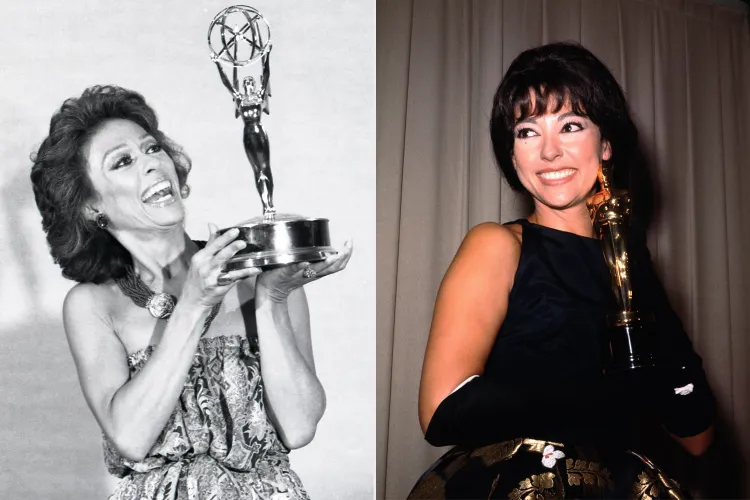
Rita Moreno has spent more than seven decades entertaining audiences, breaking barriers, and making history across film, television, theater, and music. As one of the rare performers to achieve EGOT status, earning an Emmy, Grammy, Oscar, and Tony Award, she has collected some of the entertainment industry’s most prestigious honors. Yet despite the extraordinary significance of those achievements, Moreno has revealed a surprisingly simple way of keeping them: all of her awards are displayed together in one room.
The revelation offers a charming glimpse into the life of a performer whose career has been defined by talent, determination, and an enduring passion for her craft. For Moreno, the awards represent important milestones, but they also tell the story of a long journey through an industry that has changed dramatically since she first began performing.
Her decision to keep the honors in one place is also a reminder of how much history can be contained within a single room. Each trophy represents a different performance, project, or moment of recognition, creating a personal collection that reflects one of Hollywood’s most remarkable careers.
Rita Moreno’s EGOT Achievement Makes Her a Hollywood Legend
Rita Moreno belongs to an exceptionally small group of entertainers who have achieved EGOT status. The term refers to performers who have won all four major American entertainment awards: an Emmy, a Grammy, an Oscar, and a Tony.
The achievement is especially impressive because these awards recognize different areas of the entertainment industry. An Oscar celebrates achievement in film, a Tony recognizes excellence in theater, a Grammy honors music, and an Emmy celebrates television.
Moreno completed her EGOT collection through a career that crossed all these creative fields. Her success was not the result of a single breakthrough but rather decades of performances that demonstrated her versatility.
She won the Academy Award for Best Supporting Actress for her unforgettable portrayal of Anita in the 1961 film adaptation of West Side Story. The performance became one of the defining moments of her career and helped establish her as a major talent in Hollywood.
Her later achievements in television, music, and theater further demonstrated that she was far more than an actress known for one iconic role.
For Moreno, the collection of awards represents an extraordinary professional journey, with each honor reflecting a different chapter in a career that has continued to evolve.
Why Rita Moreno Keeps Her Awards Together in One Room
Keeping all her awards in one room may sound like a simple organizational decision, but it creates an interesting picture of how Moreno views her accomplishments.
Rather than treating each trophy as a separate decoration scattered throughout her home, she has chosen to bring them together in a dedicated space. The arrangement allows her to see the different milestones of her career in one place.
For someone with such an extensive professional history, the collection must represent an impressive range of experiences. Each award is connected to a particular project, performance, or period in her life.
The room also serves as a visual reminder of how far she has come. Moreno began her career at a time when opportunities for Latina performers in Hollywood were extremely limited. Her eventual recognition across multiple entertainment industries reflects not only her ability but also her persistence.
Awards are often presented during glamorous ceremonies, surrounded by applause and public attention. However, their meaning can change once the excitement of the evening has passed. At home, they become personal reminders of hard work, collaboration, and memorable experiences.
For Moreno, keeping them together creates a place where the history of her career can be appreciated as a whole.
From Puerto Rico to Hollywood: The Early Years of Rita Moreno
Rita Moreno was born Rosita Dolores Alverío in Humacao, Puerto Rico, in 1931. She moved to New York City with her mother as a young child, beginning a new chapter that would eventually lead her into the entertainment industry.
Her interest in performing emerged early. As a child, she studied dance and developed the skills that would help her find opportunities on stage and screen.
Her early career included work as a dancer and performer, and she entered Hollywood while still very young. Like many actors beginning their careers during that era, she faced a system in which Latina performers were frequently offered narrow roles based on stereotypes.
Moreno later spoke openly about the challenges she experienced as a Latina actress. Although she found work, the opportunities did not always allow her to demonstrate the full range of her talent.
The limitations of the industry could have prevented her from reaching her potential. Instead, she continued working, developing her craft, and searching for roles that offered greater artistic depth.
Her determination eventually led to performances that challenged expectations and helped change the way audiences viewed Latina women in entertainment.
The Role That Changed Everything: Anita in West Side Story
For many audiences, Rita Moreno will always be associated with Anita in West Side Story.
The 1961 film adaptation of the celebrated musical brought her international recognition. Her portrayal of Anita combined energy, emotional depth, humor, and strength, creating a character who remains one of the most memorable figures in musical film history.
Moreno’s performance earned her the Academy Award for Best Supporting Actress, making her the first Latina actress to win an Oscar in that category.
The achievement was historic, but its significance went beyond the ceremony itself. At a time when Hollywood offered limited opportunities to performers from underrepresented backgrounds, Moreno’s success demonstrated the power of a performance that refused to be overlooked.
Her portrayal of Anita also showed that a Latina character could be complex, confident, funny, vulnerable, and central to a major film.
Although the Oscar brought enormous recognition, Moreno’s career continued well beyond West Side Story. She worked across film, television, and theater, refusing to be defined by one role.
Her return to the world of West Side Story decades later, through the 2021 film directed by Steven Spielberg, offered another connection to the story that had shaped so much of her professional life.
A Career That Reached Beyond the Big Screen
Moreno’s EGOT achievement reflects her ability to move comfortably between different forms of entertainment.
Her Emmy Awards recognized her work in television, including performances that demonstrated her comic and dramatic range. She became familiar to younger audiences through projects such as The Electric Company, where her lively personality and expressive performances helped make educational television entertaining.
Her Grammy recognition came through her contribution to the recording associated with The Electric Company. The award added another important achievement to a career that had already reached major milestones in film and theater.
In 1975, Moreno won a Tony Award for her performance in The Ritz, completing another significant chapter in her stage career.
These accomplishments show why her EGOT status is so remarkable. Rather than concentrating on one entertainment medium, she built a career that crossed several industries and connected with audiences of different generations.
Her awards room therefore represents much more than a collection of trophies. It reflects a body of work that has reached moviegoers, television viewers, theater audiences, and music listeners.
Rita Moreno’s Influence on Latina Representation in Hollywood
Moreno’s legacy cannot be measured only by the awards she has won. Her career also carries considerable cultural significance.
During the early decades of her work, Latina performers were frequently restricted to stereotypical roles. Characters were often written with little complexity, and opportunities for actors from diverse backgrounds were limited.
Moreno experienced these barriers firsthand. Her willingness to speak about the industry’s treatment of Latina performers has helped bring attention to the difficulties faced by generations of actors.
Her success in West Side Story was an important achievement, but she also continued to challenge the expectations placed upon her throughout her career.
Over time, she became an influential figure for performers who wanted to see more authentic and varied representations of Latino communities on screen.
Her presence at major award ceremonies and her continued work in entertainment have helped keep these conversations alive.
Moreno’s story demonstrates that individual success can have an impact beyond personal recognition. By continuing to work and speak openly about her experiences, she has contributed to a broader understanding of representation in Hollywood.
Still Working, Still Inspiring New Generations
One of the most remarkable aspects of Moreno’s career is its longevity. Many performers gradually step away from the industry after decades of work, but she has continued to take on projects and remain part of public conversations about entertainment.
Her later appearances have introduced her to audiences who may not have experienced her early career firsthand. She has also continued to demonstrate that age does not have to mean an end to creativity or professional ambition.
In addition to acting, Moreno has participated in documentaries, interviews, and projects celebrating her life and career. Her story has become an important part of conversations about Hollywood history, perseverance, and the changing opportunities available to women and performers of color.
Her continued visibility also gives younger entertainers an example of how a career can develop over many decades. Success does not always follow a straight path, and recognition may arrive at different stages of life.
Moreno’s achievements show the value of remaining curious, adaptable, and committed to one’s craft.
The Meaning Behind a Room Full of Awards
For many celebrities, awards are displayed as symbols of success. But a collection as extensive as Moreno’s carries a deeper meaning.
Each trophy represents a moment when her work connected with audiences or received recognition from her peers. Some may recall the excitement of a historic win, while others may bring back memories of a production, a group of collaborators, or a challenging period in her career.
Together, they create a timeline of professional achievement.
The room also reflects the remarkable range of her work. From the dancing and dramatic intensity of West Side Story to her television appearances and theater performances, the awards represent a career that cannot be reduced to a single genre or generation.
Yet the most important part of Moreno’s legacy is not necessarily what sits on a shelf. It is the influence she has had on entertainment and the opportunities her achievements have helped open for others.
The Bottom Line
Rita Moreno’s decision to keep all her awards in one room offers a charming glimpse into the life of an entertainment icon. As an EGOT winner with achievements spanning film, television, music, and theater, she has every reason to be proud of the remarkable collection.
From her historic Oscar win for West Side Story to her Emmy, Grammy, and Tony recognition, each honor represents a different part of a career built through talent, determination, and resilience.
But Moreno’s story is about far more than trophies. She has challenged stereotypes, helped expand opportunities for Latina performers, and continued working long after many entertainers might have chosen to retire.
Her awards room may bring together decades of recognition, but the legacy behind those awards is even more impressive. It belongs to a woman who has repeatedly demonstrated that talent, perseverance, and a willingness to keep moving forward can leave a lasting mark on Hollywood history.