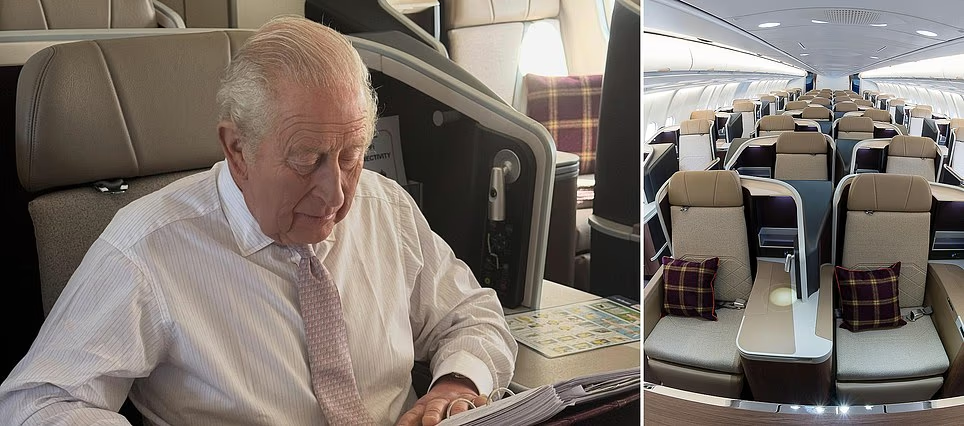
King Charles has given royal fans an unusually intimate look inside the luxurious aircraft transporting him across the Caribbean, offering a rare glimpse of life behind the scenes during an official royal tour. The monarch, who recently turned 77, was photographed sitting comfortably in a spacious cabin while reviewing an impressive collection of briefing papers, revealing how he uses long-haul flights to keep up with his demanding royal responsibilities.
The photographs, shared through the Royal Family’s official social media account, offered a look at the Royal Air Force VIP Voyager, an aircraft that serves as the principal long-distance transport for senior members of the Royal Family and the UK government. Featuring elegant grey and cream seating, privacy curtains and distinctive tartan cushions, the plane combines practical government transport with a noticeably comfortable interior.
However, it is the aircraft’s reported running cost that has attracted particular attention. Previous estimates have placed the cost of operating the RAF Voyager at approximately £2,000 per hour, meaning a nine-hour journey could amount to around £18,000 in flight-hour costs.
The rare images have prompted fresh interest in how the King travels, what happens during official flights and why the aircraft is an important part of Britain’s royal and government transport arrangements.
King Charles Offers a Rare Look Inside His Royal Aircraft
King Charles began his latest Caribbean tour on October 27, arriving in Nassau, The Bahamas, for the first stage of a nine-day visit to the region.
Ahead of his engagements, the Royal Family shared photographs showing the monarch onboard the aircraft. Dressed smartly in a pink shirt and matching tie, Charles appeared relaxed as he sat in a dark grey leather seat, concentrating on a substantial collection of briefing documents.
The image offered a glimpse of a side of royal travel that is rarely seen by the public. Rather than simply relaxing during the long journey, the King appeared to be making full use of the time to prepare for the diplomatic and public engagements ahead.
The accompanying social media caption explained that Charles uses his travel time to read briefing papers, continue his Government red box duties, write and review correspondence, and discuss projects with members of his support team.
For a monarch whose diary includes international visits, meetings with political leaders, charitable engagements and constitutional responsibilities, time spent travelling can become an important extension of the working day.
The photograph also highlighted the spacious nature of the cabin, with comfortable seating and a large table providing an environment suitable for reviewing documents and holding discussions.
Inside Vespina: The RAF Voyager Used by the Royal Family
The aircraft featured in the photographs is the Royal Air Force VIP Voyager, commonly known by its nickname, Vespina.
Unlike a privately owned business jet reserved exclusively for one individual, the Voyager is a government-operated aircraft used for official journeys by members of the Royal Family, the Prime Minister and senior government representatives.
The aircraft is based on the Airbus A330 Voyager, a military transport and air-to-air refuelling aircraft adapted to accommodate passengers travelling on official business.
Its VIP configuration includes 58 business-class-style seats and additional premium-economy-style seating for accompanying personnel, officials and other members of travelling delegations. This makes it considerably larger than the smaller private jets commonly associated with wealthy individuals and celebrities.
The interior seen in the Royal Family’s photographs features a restrained colour palette of grey and cream, creating a comfortable but professional atmosphere. Privacy curtains and generous seating arrangements provide passengers with space during long journeys.
One particularly noticeable detail was a tartan cushion placed on one of the seats. The pattern offered a subtle Scottish touch, which royal observers may associate with Charles’s longstanding affection for Scotland and its traditions.
Although the cabin is designed to provide comfort, the aircraft’s primary purpose remains official transport rather than luxury travel for its own sake. Its size allows the government and Royal Family to move larger delegations together while maintaining the security and operational arrangements required for international visits.
Why the £2,000-Per-Hour Running Cost Has Attracted Attention
The reported operating cost of the RAF Voyager has become one of the most discussed details surrounding the King’s latest journey.
Previous estimates have put the cost of operating the aircraft at approximately £2,000 per flying hour. Based on that figure, a flight lasting around nine hours would represent an estimated £18,000 in flight-hour costs.
It is important to understand that this figure is an estimate rather than a confirmed invoice for Charles’s specific journey. The total cost of an official trip can involve several additional expenses, including ground handling, security, accommodation, airport arrangements and the logistical support required for a large travelling party.
The £2,000 figure also has a historical context. When the government announced plans to convert an RAF Voyager for VIP transport in 2015, the aircraft was presented as a more economical alternative to repeatedly chartering commercial aircraft for official long-distance journeys.
At the time, government estimates suggested that using the Voyager could reduce the cost of official air travel compared with certain charter arrangements.
The conversion itself reportedly cost around £10 million. Ministers argued that adapting an existing RAF aircraft would provide greater flexibility while making better use of equipment already operated by the military.
Consequently, the Voyager is not simply a royal luxury aircraft. It is part of a broader government transport arrangement designed to serve several official purposes.
Why the King Works During Long-Haul Flights
The photograph of Charles reading briefing papers offers an interesting insight into how the monarch manages his responsibilities while travelling.
Official royal tours often involve tightly scheduled programmes. A single visit can include meetings with heads of state, speeches, receptions, cultural events, charitable visits and conversations with local communities.
Preparing for these engagements requires detailed information about the countries being visited, the people involved and the issues likely to arise during discussions.
The King’s Government red box duties are another important part of his working routine. The red box is traditionally associated with official documents and government papers that the monarch receives as part of his constitutional role.
Although Charles does not personally direct the elected government’s political decisions, he has regular meetings with the Prime Minister and receives official information as head of state.
The Royal Family’s social media caption also noted that he uses travel time to read and write correspondence and discuss projects with his support team.
This explanation challenges the popular image of royal travel as an extended holiday. While the aircraft provides comfortable surroundings, the King appears to treat much of the journey as working time.
For Charles, a long flight can offer an opportunity to review documents without the interruptions that often accompany a busy schedule on the ground.
A Special Passenger in the Cockpit: Geoffrey the Giraffe
The Royal Family’s photographs included another charming detail that caught the attention of followers.
A separate image showed the aircraft’s pilots in the cockpit alongside Geoffrey the Giraffe, a soft toy whose travels have helped raise money for Great Ormond Street Hospital.
The appearance of the toy was connected to the Giraffes on Tour fundraising campaign, which uses Geoffrey’s travels to support the renowned London children’s hospital.
The photograph offered a lighter moment alongside the more formal image of the King reviewing official papers.
It also demonstrated how royal social media posts can combine glimpses of official duties with small personal or charitable details that make the institution feel more accessible.
Great Ormond Street Hospital has a long history of charitable support and is one of the UK’s best-known specialist children’s hospitals. Fundraising initiatives such as Geoffrey’s travels help draw attention to its work and encourage public engagement.
For royal followers, the cockpit photograph provided a reminder that even a government aircraft travelling on an important international mission can carry a little personality.
King Charles and Queen Camilla’s Caribbean Tour
The aircraft photographs were shared as Charles began a busy programme of engagements across the Caribbean.
The nine-day visit includes The Bahamas, Guyana and Antigua and Barbuda, with the King also expected to attend the Commonwealth Heads of Government Meeting.
The tour provides an opportunity to strengthen relationships between the United Kingdom and Caribbean nations, celebrate shared cultural connections and discuss issues affecting the Commonwealth.
However, the visit also takes place against the background of difficult historical questions, particularly calls for Britain to address its role in the transatlantic slave trade.
During his early engagements in The Bahamas, Charles acknowledged the suffering and injustice associated with the past. His comments reflected the sensitivity of the subject, although he did not announce an apology or financial reparations.
The King’s position is shaped by his constitutional role. On political questions, he acts in accordance with the advice of his government, while his speeches and public engagements can provide opportunities to acknowledge historical experiences and encourage dialogue.
The tour therefore carries both ceremonial and diplomatic significance. The aircraft is an essential part of the logistics, allowing the monarch and his team to travel between countries while continuing preparations for the programme.
How Royal Travel Has Changed Over the Years
The use of the RAF Voyager reflects a broader evolution in the way the British monarchy and government organise international travel.
For much of modern royal history, members of the Royal Family have relied on a combination of military aircraft, chartered planes and other official transport arrangements.
The Voyager provides a long-distance option capable of carrying a substantial delegation. Its dual military and transport background also distinguishes it from a conventional private jet.
The aircraft entered VIP service in 2016 following its conversion, and it has since become a familiar part of official travel arrangements.
Its nickname, Vespina, is associated with the aircraft’s official role, while the wider VIP Voyager has also attracted informal nicknames in the media.
The arrangement allows the Royal Family and government to share access to an aircraft without maintaining an entirely separate long-haul fleet exclusively for royal use.
That practical consideration is important when evaluating the cost of the plane. The aircraft is not used solely for the King’s personal convenience; it supports official government and royal travel as required.
The Bottom Line
King Charles’s rare glimpse inside the RAF VIP Voyager has offered royal fans an unusual look at the aircraft that carries him on important international journeys.
With its spacious seating, privacy curtains and tartan cushions, Vespina provides a comfortable environment for the monarch and his travelling team. Yet the photographs also show that the King uses much of his time in the air to review briefing papers, manage official correspondence and prepare for upcoming engagements.
The reported £2,000-per-hour operating cost has inevitably attracted attention, particularly as the monarch travels across the Caribbean on a major official tour. However, the figure is an estimate based on previous reporting, not a confirmed cost for the specific flight.
More than a glimpse of luxury, the photographs reveal the practical side of modern royal travel: a combination of security, government responsibilities, diplomatic preparation and logistical planning.
For King Charles, even thousands of feet above the ground, the work of the Crown continues.