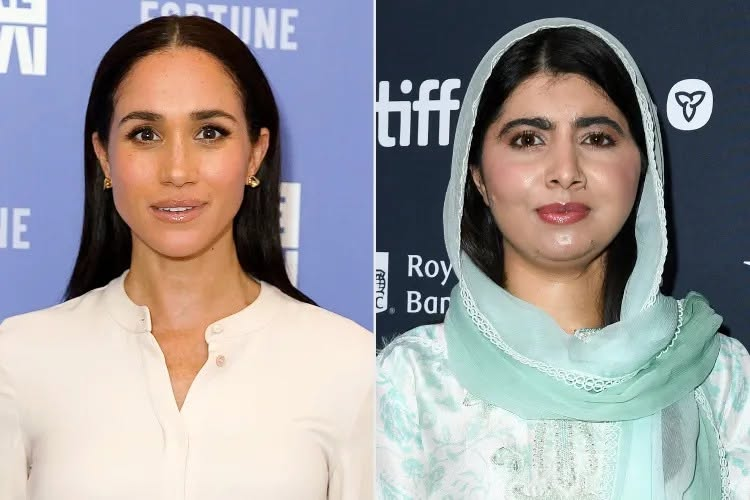
Meghan Markle has long attracted international attention for her work in women’s empowerment, mental health awareness and gender equality. Malala Yousafzai, the Nobel Peace Prize laureate and education activist, has built a global reputation through her determination to champion every girl’s right to learn. When two prominent advocates are linked through a London dinner, it is hardly surprising that public interest follows.
The headline, Meghan Markle’s London Dinner with Malala Yousafzai Draws Attention!, raises questions about the significance of their connection, their shared interests and the wider conversations surrounding women who use their public platforms to support social change.
However, the precise circumstances of any particular dinner, including its date, location, guest list and purpose, should not be assumed without reliable confirmation. What makes the prospect of an encounter between Meghan and Malala compelling is the overlap between their public advocacy and the different paths that brought them into the international spotlight.
From education and gender equality to women’s leadership and the influence of celebrity activism, their respective stories offer plenty of reasons for the public to take an interest.
Why Meghan Markle and Malala Yousafzai Attract Attention
Meghan Markle and Malala Yousafzai come from different backgrounds, yet both have become internationally recognized figures associated with issues affecting women and girls.
Meghan first became widely known as an actress before her relationship with Prince Harry brought her into the British royal family. Following their marriage in 2018, she undertook royal engagements and supported causes including gender equality, women’s empowerment and community development.
After stepping back from their roles as senior working royals in 2020, Meghan and Harry established a different approach to their public work. Through their independent projects and the Archewell organization, they have continued to engage with humanitarian and social issues.
Malala’s public journey has been shaped by a very different experience. Born in Pakistan, she became an international advocate for girls’ education after speaking out against restrictions imposed by the Taliban. In 2012, she survived a Taliban attack because of her activism. Her recovery and continued determination brought worldwide attention to the importance of educational access.
In 2014, Malala received the Nobel Peace Prize, becoming the youngest Nobel laureate at the time.
Their stories illustrate two distinct forms of public influence. Meghan’s work often draws on her experience in entertainment, media and royal life, while Malala’s advocacy is rooted in education, human rights and her personal experience of resisting efforts to deny girls schooling.
Any confirmed meeting between them would naturally invite discussion about the causes that connect their public work.
Meghan Markle’s Continued Focus on Women’s Empowerment
Women’s empowerment has remained an important theme throughout Meghan’s public life.
Before joining the royal family, she spoke about gender equality and the importance of challenging assumptions about women’s roles. Her advocacy included a widely discussed speech at the United Nations on International Women’s Day in 2015, when she spoke about the importance of women’s participation in decisions affecting their lives.
As a member of the royal family, Meghan supported initiatives related to women’s employment, community support and social inclusion. She also participated in projects highlighting the experiences of women from different backgrounds.
Her approach has continued to evolve since she and Prince Harry established an independent life in the United States.
Through media projects, public appearances and philanthropic initiatives, Meghan has sought to maintain a connection with issues that she considers important. Her work has also attracted scrutiny, reflecting the complicated relationship between celebrity, philanthropy and public opinion.
Supporters often view her willingness to speak about gender equality as an extension of her longstanding interests. Critics, meanwhile, question the relationship between public visibility and meaningful social impact.
That debate is part of a wider conversation about modern advocacy. Public figures can bring significant attention to social issues, but the long-term value of their work depends on more than recognition alone. Sustainable programs, practical resources and measurable results are equally important.
A discussion involving Meghan and Malala would therefore carry significance beyond celebrity interest, particularly if it focused on education, opportunity or the challenges facing women and girls.
Malala Yousafzai’s Mission to Educate Girls
Malala’s work has made her one of the most recognizable advocates for girls’ education worldwide.
Her activism began while she was still a schoolgirl. At a time when girls’ education in parts of Pakistan’s Swat Valley faced severe restrictions, she spoke publicly about the right of girls to attend school.
The 2012 attack that nearly killed her transformed her personal story into an international symbol of resistance and determination. Rather than abandoning her campaign, Malala continued to advocate for education and human rights.
In 2013, she co-founded the Malala Fund with her father, Ziauddin Yousafzai. The organization works to advance girls’ access to education, particularly in communities where poverty, conflict, discrimination and restrictive policies prevent children from attending school.
Malala’s Nobel Peace Prize in 2014 brought further attention to her mission. She subsequently continued her education and graduated from the University of Oxford in 2020.
Her activism has also developed beyond the traditional image of a campaigner delivering speeches. Through advocacy, partnerships, public engagement and support for local education initiatives, she has worked to keep girls’ education on the international agenda.
The challenge remains substantial. Millions of girls worldwide continue to face barriers to secondary education, and the obstacles differ across regions. Some are linked to poverty and conflict, while others stem from discrimination, inadequate school infrastructure or restrictions on girls’ participation in public life.
These challenges explain why Malala’s work continues to attract attention long after the events that first brought her to international prominence.
What Could Connect Meghan and Malala?
The most obvious point of connection between Meghan Markle and Malala Yousafzai is their interest in improving opportunities for women and girls.
Although their approaches differ, both have used public recognition to bring attention to social questions that might otherwise receive less coverage.
Education is particularly important because it influences almost every aspect of a girl’s future. Access to schooling can expand employment opportunities, improve health outcomes and increase participation in civic life. It can also help communities break cycles of poverty.
Women’s empowerment is closely linked to those outcomes. Girls who receive an education are better positioned to make informed decisions about their futures, while women who gain access to employment and leadership opportunities can contribute to stronger communities and economies.
A conversation between two prominent advocates could explore how public attention can be converted into practical support. It might also raise questions about collaboration between charitable organizations, international institutions and local communities.
Nevertheless, shared interests should not be mistaken for proof of a formal partnership. Unless an official announcement or credible reporting confirms a specific initiative, it would be premature to suggest that Meghan and Malala are working together on a new project.
The value of their public profiles lies partly in their ability to draw attention to important causes. Whether that attention leads to collaboration depends on the details of any confirmed engagement.
Why a London Dinner Would Generate Interest
London remains an important meeting place for international figures in politics, philanthropy, entertainment and humanitarian work.
The city has a long history of hosting charity dinners, cultural gatherings and events connected to global causes. Such occasions can bring together people who might otherwise work in separate professional circles.
For Meghan, London also carries a personal connection to her years as a working member of the British royal family. Her departure from senior royal duties in 2020 changed the nature of her relationship with the United Kingdom’s royal institutions and public life.
As a result, any reported London appearance can attract attention beyond the immediate event. Observers may consider what the visit means for her public profile, her relationship with Britain and her continuing philanthropic interests.
Malala, meanwhile, has an international presence that extends across education, human rights and public advocacy. Her work regularly connects her with leaders, campaigners and institutions committed to expanding educational access.
A dinner involving both women would therefore be interesting not simply because of their individual fame, but because it could bring together different experiences of public influence.
Still, the significance of any particular gathering depends on verified details. A private dinner does not automatically indicate a formal initiative, a major announcement or a change in either woman’s professional plans.
The Power and Limitations of Celebrity Advocacy
The attention surrounding high-profile figures often creates an opportunity to discuss a broader issue: how much difference can celebrity advocacy make?
Public recognition can help charities reach new audiences, encourage donations and bring overlooked issues into mainstream conversation. When influential figures highlight a campaign, their audiences may learn about problems they had not previously considered.
However, visibility alone cannot resolve complex social challenges.
Girls’ education, for example, requires more than international awareness. It may involve building schools, training teachers, supporting families, addressing safety concerns and challenging laws or social practices that prevent girls from learning.
This is where organizations with local knowledge and long-term commitments become essential. Public figures can help draw attention to their work, but lasting progress depends on resources, implementation and accountability.
Meghan’s advocacy and Malala’s education campaign reflect different ways of approaching social change. Their public profiles can create opportunities for conversation, but the outcomes of any collaboration would need to be assessed through concrete actions rather than headlines alone.
For audiences following their work, the most useful question is not simply whether two famous women have met. It is whether their efforts help improve opportunities for the people whose lives they aim to support.
What Happens Next for Meghan Markle and Malala Yousafzai?
Interest in Meghan Markle and Malala Yousafzai is likely to continue because both remain associated with issues that have global relevance.
Meghan’s future public projects may continue to reflect her interests in women’s empowerment, family well-being and social inclusion. Malala’s work is expected to remain closely connected to girls’ education and the broader effort to ensure that every child has access to learning.
If a London dinner involving the two women is confirmed, further details about its purpose and participants could help clarify whether it was a private social occasion, a philanthropic discussion or part of a larger initiative.
Until those details are established, it is important to separate the interest generated by the headline from claims about what actually took place.
Final Thoughts
The headline Meghan Markle’s London Dinner with Malala Yousafzai Draws Attention! brings together two women whose public lives have been shaped by advocacy, international recognition and a commitment to issues affecting women and girls.
Meghan’s experience in entertainment and royal life has given her a distinctive platform, while Malala’s determination to defend girls’ education has made her a leading voice in global human rights advocacy.
Their shared interests help explain why a reported encounter would attract attention. Yet the true significance of any dinner depends on confirmed facts, the conversations that took place and whether any practical initiatives emerged.
Ultimately, the most important story is larger than celebrity connections. It is about the continuing need to expand educational opportunities, support women’s leadership and ensure that public attention contributes to meaningful progress.
For readers interested in Meghan Markle, Malala Yousafzai and modern philanthropy, any confirmed meeting between them would offer an opportunity to revisit those goals—and to consider how influential voices can help turn awareness into lasting change.