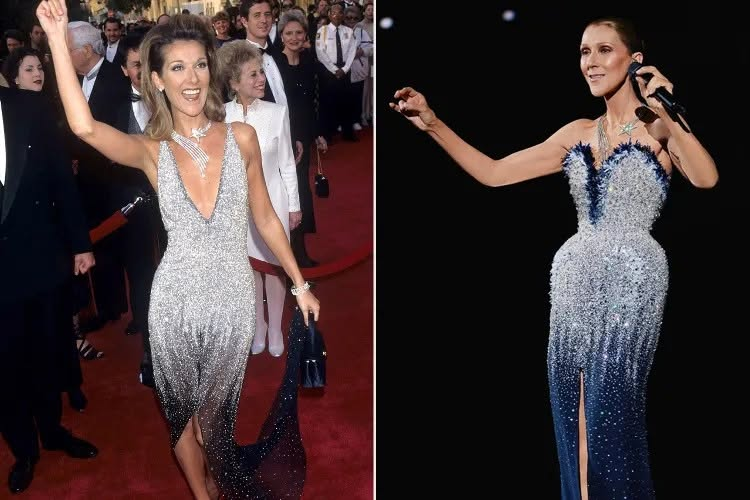
Some iconic fashion moments deserve to be remembered decades later, and Céline Dion has once again demonstrated why certain outfits become part of fashion history. The legendary singer returned to the spotlight in a breathtaking dress inspired by her unforgettable 1997 Oscars look, bringing a beloved chapter of her style journey into a new era.
Reportedly requiring more than 1,380 hours to create, the elaborate design celebrates not only Dion’s timeless elegance but also the extraordinary craftsmanship that transforms clothing into wearable art. Every detail contributes to a look that reaches beyond conventional glamour, connecting a modern fashion statement with a moment that remains deeply associated with the singer’s remarkable career.
For Dion, fashion has always been more than simply choosing what to wear. Throughout her decades in the public eye, she has embraced dramatic silhouettes, daring combinations, and unexpected styling choices that reflect her confidence as a performer. Her latest appearance continues that tradition while paying tribute to an outfit that helped establish her place in red carpet fashion history.
The result is a compelling celebration of music, memory, and design, reminding fans that the most meaningful fashion moments are not always the newest ones. Sometimes, their power comes from the stories they carry.
Céline Dion’s 1997 Oscars Look Remains a Fashion Landmark
To understand the significance of a dress inspired by Céline Dion’s 1997 Oscars appearance, it is worth revisiting the original moment.
At the 1997 Academy Awards, Dion wore an unconventional white satin suit designed by John Galliano for Dior. The outfit featured a dramatic reverse-worn jacket and a distinctive wide-brimmed hat, creating a silhouette that challenged traditional expectations of red carpet dressing.
At a ceremony where elegant gowns and classic eveningwear were the familiar choices, Dion’s look stood apart.
The outfit was daring, architectural, and unmistakably memorable. Rather than blending into the established glamour of the event, it presented a different vision of formal fashion, one that prioritized individuality and artistic expression.
Not everyone immediately understood the look, but that is often what makes fashion history interesting. Some outfits generate attention because they follow the prevailing trends, while others become memorable precisely because they challenge them.
Dion’s 1997 ensemble has endured as an example of the latter.
Over the years, the look has been revisited in discussions about celebrity fashion, unconventional red carpet choices, and the relationship between music stars and haute couture. Its lasting relevance demonstrates how a single outfit can become inseparable from the public image of the person wearing it.
The modern interpretation takes inspiration from that legacy, allowing a celebrated fashion moment to be reconsidered through contemporary craftsmanship and a fresh creative perspective.
A Dress That Takes More Than 1,380 Hours to Create
One of the most striking details surrounding the reported new design is the extraordinary amount of time required to produce it.
More than 1,380 hours represents an enormous investment of skilled labor, planning, and precision. Spread across a standard eight-hour working day, that amount of time would equal more than 170 working days for one person, although a couture project may involve multiple specialists working on different stages simultaneously.
Such figures help illustrate why elaborate fashion creations can be so different from garments produced on a mass scale.
A highly detailed dress may require extensive research, initial sketches, pattern development, fabric testing, fitting sessions, and countless hours of hand-finishing. Depending on the design, specialist artisans may also contribute embroidery, embellishment, draping, or other intricate techniques.
Each stage requires attention to detail because even a small alteration can affect the overall balance of the finished piece.
The goal is not simply to make an expensive dress. It is to create a garment in which the materials, construction, and artistic vision work together seamlessly.
When a design draws inspiration from a historic outfit, the process becomes even more complex. The creators must consider which elements deserve to be preserved and which can be reinterpreted for a new setting.
The challenge lies in honoring the original without producing a simple replica.
For a performer with Dion’s extraordinary public profile, that distinction matters. A successful homage should evoke the spirit of the original while presenting something distinctive enough to stand on its own.
The reported 1,380-hour creation therefore represents more than a dramatic statistic. It points toward the patience and specialized expertise that can turn a fashion concept into a remarkable finished design.
Haute Couture: Where Fashion Becomes Art
The craftsmanship associated with elaborate statement dresses highlights the enduring appeal of haute couture.
Unlike mass-produced clothing, couture emphasizes exceptional construction, carefully selected materials, and a high degree of individual attention. Many couture garments involve handwork that cannot easily be replicated by automated manufacturing.
Embroidery, intricate beadwork, complex draping, and delicate finishing techniques can transform a garment into something that resembles a sculpture as much as a piece of clothing.
The process often begins with an idea that must be translated into a wearable form. Designers consider how the fabric will move, how the garment will sit on the body, and how its proportions will appear under different lighting conditions.
A dress intended for a major performance or public appearance must also work in motion. It needs to look extraordinary in photographs while allowing the wearer to move comfortably and confidently.
These practical considerations become particularly important when the design includes substantial embellishment or an unconventional silhouette.
The appeal of couture lies in the balance between creativity and technical ability. An idea may be visually impressive on paper, but turning it into a finished garment requires a deep understanding of fabric, structure, and construction.
For audiences, the finished result can appear almost effortless. Behind the scenes, however, it may represent months of planning and collaboration.
A dress inspired by Dion’s iconic fashion history offers an opportunity to celebrate the artisans whose work makes such moments possible.
Although the celebrity wearing the design naturally attracts attention, the finished garment is also a testament to the many skilled hands involved in bringing it to life.
Céline Dion Has Never Been Afraid to Make a Fashion Statement
Dion’s enduring fashion appeal comes from her willingness to experiment.
For much of her career, she was primarily recognized for her extraordinary vocal ability, powerful ballads, and emotional live performances. Over time, however, her public image increasingly became associated with bold fashion choices that demonstrated a playful and adventurous side.
She has appeared in sculptural gowns, sharply tailored suits, dramatic coats, and eye-catching accessories, often embracing silhouettes that would be difficult to overlook.
Her fashion evolution has also reflected a broader transformation in the way audiences perceive performers.
A singer’s identity is no longer shaped exclusively by recordings and live performances. Styling, photography, fashion partnerships, and public appearances all contribute to the larger artistic image.
Dion has embraced that reality without abandoning the elegance that has defined much of her public presence.
What makes her style particularly interesting is its range. She can appear in a refined, classic ensemble one day and a striking, unconventional creation the next.
That flexibility makes her an appealing subject for fashion retrospectives, because her wardrobe reflects not only changing trends but also the confidence that comes with years of experience.
The dress inspired by her 1997 Oscars look fits into this larger story. It acknowledges a moment when Dion stepped beyond conventional red carpet expectations and reminds audiences that fashion can be a form of self-expression.
Rather than treating the past as something fixed, the new interpretation brings an established visual memory back into contemporary conversation.
Why Revisiting Iconic Fashion Moments Matters
Fashion moves quickly, with new collections and celebrity appearances constantly competing for attention. Yet certain looks continue to resonate long after the original event has passed.
Revisiting an iconic outfit allows audiences to appreciate it from a different perspective.
When an outfit first appears, its reception is shaped by the trends, expectations, and cultural conversations of that particular moment. Years later, people can view it with greater distance and consider how it influenced the broader fashion landscape.
Some designs become famous because they perfectly capture their era. Others remain relevant because they challenge the assumptions of the time.
Dion’s 1997 Oscars look belongs to a category that invites discussion about individuality and risk-taking.
Its unconventional construction and styling demonstrated that red carpet dressing did not have to follow a single formula. A formal event could also become a place for experimentation, provided the wearer had the confidence to embrace a distinctive vision.
A modern dress inspired by that moment allows the original idea to be explored again.
It also illustrates how fashion history can remain alive through reinterpretation. Designers continually draw inspiration from earlier decades, adapting familiar shapes, fabrics, and ideas for contemporary audiences.
This process does not necessarily diminish the originality of the source. Instead, it can introduce historic designs to people who were too young to remember their first appearance or who are discovering them for the first time.
In that sense, fashion becomes a conversation between generations rather than a sequence of disconnected trends.
The Power of Fashion to Tell a Personal Story
An outfit can communicate much more than a preference for a particular color or silhouette.
For public figures, clothing often becomes part of the way they express their identity, mark significant occasions, and connect with audiences. A familiar design can evoke memories of a performance, an award ceremony, or a defining period in someone’s career.
That emotional dimension helps explain why recreating or reinterpreting an iconic outfit can be so powerful.
The inspiration behind Dion’s reported dress connects a contemporary appearance with a moment from her past, creating a visual link between the artist she was then and the enduring figure she remains today.
For longtime fans, that connection may evoke memories of the 1997 Oscars and the many performances that followed. For newer audiences, it offers an opportunity to discover an earlier chapter of her public image.
The craftsmanship adds another layer to the story. When hundreds of hours of work are devoted to a single garment, the finished piece represents an investment in artistic expression rather than simply a fleeting trend.
Of course, the significance of a dress ultimately depends on how it is experienced. Some people may admire the technical skill, others may appreciate the historical reference, and some may simply enjoy its visual impact.
That variety of responses is part of what makes fashion so compelling.
Final Thoughts: Céline Dion Proves Iconic Style Never Truly Disappears
Céline Dion’s reported return to the spotlight in a spectacular dress inspired by her 1997 Oscars look offers a celebration of fashion that reaches beyond a single appearance.
The original outfit remains memorable because it challenged conventional expectations and reflected the confidence of an artist willing to take a risk. The new interpretation brings that spirit into the present while drawing attention to the extraordinary craftsmanship required to create an elaborate couture design.
With more than 1,380 hours reportedly devoted to its creation, the dress highlights the patience, technical skill, and creative vision behind fashion at its most ambitious.
It also reinforces Dion’s enduring influence as a performer whose public identity extends beyond music into the world of personal style.
Trends will continue to change, and new red carpet moments will inevitably capture the attention of future generations. Yet the most meaningful designs will always have something more to offer than novelty alone.
They tell stories, preserve memories, and remind us that creativity can leave a lasting impression long after the cameras stop flashing.
For Céline Dion, the return of an iconic fashion inspiration is a fitting reminder that true style does not simply belong to one moment in time. When a look carries enough personality, imagination, and history, its influence can continue for decades.