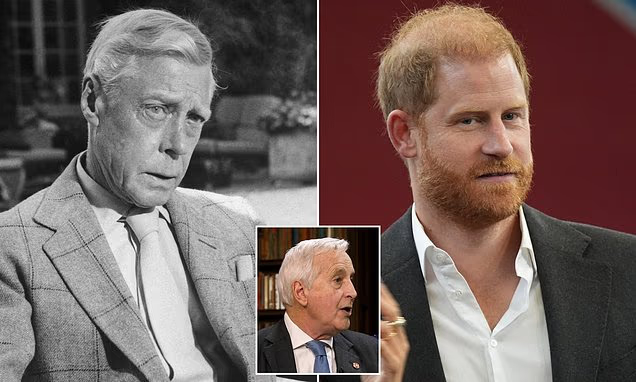
The British royal family has long been shaped by the tension between personal happiness and public duty. For generations, its members have faced difficult choices involving love, marriage, family expectations, and the responsibilities that come with being born into one of the world’s most closely watched institutions. Few modern figures illustrate this tension more clearly than Prince Harry, whose decision to step back from royal duties has continued to spark debate about the meaning of freedom, responsibility, and fulfillment.
Royal author Hugo Vickers has drawn attention to a striking historical comparison between Prince Harry and Edward VIII, the former king who abdicated the British throne in 1936. The comparison raises a provocative question: can the pursuit of personal happiness sometimes lead to a more complicated reality than expected? For Vickers, the contrast between royal duty and individual desire offers a powerful lesson about the emotional rewards that can come from serving a larger purpose.
The claim that Prince Harry looks unhappy, or resembles Edward VIII in his apparent dissatisfaction, is an interpretation rather than an established fact about either man’s private emotional state. Nevertheless, the comparison provides an opportunity to examine two very different royal journeys, the consequences of choosing a life outside traditional expectations, and why the debate over duty versus personal freedom remains relevant today.
Prince Harry’s Decision to Step Away From Royal Duties
Prince Harry, the Duke of Sussex, spent much of his early life as one of the most recognizable members of the British royal family. As the younger son of King Charles III and the late Princess Diana, he grew up under intense public scrutiny, with his personal relationships, military service, charitable activities, and family life frequently attracting international attention.
For many years, Harry performed official royal duties alongside his brother, Prince William, and other senior members of the royal family. He developed a public profile through charitable initiatives, veterans’ causes, and projects focused on mental health and social issues.
However, the pressures associated with royal life became an increasingly prominent part of his public story. In January 2020, Harry and his wife, Meghan Markle, announced their intention to step back as senior working royals and pursue greater financial independence.
The decision marked a significant turning point for the monarchy. The couple subsequently established a life primarily in California, where they pursued commercial projects, philanthropic work, and media ventures outside the traditional structure of royal service.
Supporters viewed the move as an understandable effort to protect their family, gain independence, and establish boundaries around their private lives. Critics, meanwhile, questioned the consequences of leaving official responsibilities while retaining public recognition associated with royal status.
This divide has continued to shape discussions about Harry’s choices. For some observers, his departure represents the possibility of building a life according to personal priorities. For others, it raises questions about whether the freedom to choose a different path necessarily brings lasting satisfaction.
Who Is Hugo Vickers, and Why Does His Perspective Matter?
Hugo Vickers is a British royal biographer and historian known for writing about members of the royal family, aristocratic life, and significant figures in modern British history.
His work frequently examines the personalities, relationships, and historical circumstances behind royal events. By looking at the experiences of earlier generations, royal historians can place contemporary controversies within a broader historical framework.
Vickers’s reported comparison between Prince Harry and Edward VIII connects two individuals separated by decades but linked by their relationships with royal duty. Both have become subjects of public debate over the extent to which personal happiness should take priority over established responsibilities.
The comparison is particularly interesting because the circumstances surrounding the two men are not identical. Edward VIII was king when he decided to abdicate, while Harry was not the monarch and did not possess the constitutional responsibilities of the sovereign.
Nevertheless, their stories raise related questions about the relationship between individual choice and institutional expectations.
Vickers’s argument, as reflected in the headline, presents royal duty as a potential source of purpose and fulfillment. That view is not universally accepted, however. Others argue that a meaningful life depends on personal autonomy, healthy relationships, and the freedom to make choices without being constrained by inherited obligations.
Edward VIII: The King Who Chose Love Over the Crown
Edward VIII remains one of the most significant figures in modern British royal history because of his decision to give up the throne in December 1936.
Born in 1894, Edward became king following the death of his father, King George V, in January 1936. His reign lasted less than a year, ending when he chose to abdicate rather than abandon his intention to marry Wallis Simpson, an American woman who had been divorced and was seeking another divorce.
At the time, the proposed marriage created a constitutional and political crisis. The British government and the leadership of the Church of England opposed the arrangement under the circumstances then prevailing, and the government of the day would not support Edward remaining king while marrying Simpson.
Faced with a choice between retaining the crown and pursuing the relationship, Edward decided to abdicate. His younger brother succeeded him as King George VI, beginning a new chapter in the monarchy’s history.
Edward subsequently married Simpson in 1937. The couple lived largely outside Britain and became known as the Duke and Duchess of Windsor.
The decision was presented by Edward as a deeply personal choice. In his abdication broadcast, he explained that he could not carry out the responsibilities of kingship without the woman he wished to marry.
Yet the consequences extended far beyond his private life. His departure transformed the royal succession, placed unexpected responsibilities on his brother, and altered the course of the monarchy.
Edward’s story is therefore often used to explore the difficult relationship between love, personal ambition, and public obligation.
Did Edward VIII Find the Happiness He Expected?
Whether Edward VIII ultimately found happiness after his abdication remains a matter of historical interpretation. His marriage to Wallis Simpson endured, but their life away from the British throne was not free from controversy, disappointment, or public scrutiny.
The Duke and Duchess of Windsor lived in France for much of their later lives. Their relationship with the British royal family remained complicated, and Edward’s legacy was affected by his conduct before, during, and after the Second World War.
Edward’s abdication is often portrayed as a dramatic romantic decision, but reducing his life to a simple story of love versus duty overlooks the political and personal complexities surrounding it.
His decision also cannot prove that abandoning public responsibility inevitably leads to unhappiness. A person’s emotional well-being depends on many factors, including relationships, personal circumstances, health, and the expectations they place on themselves.
Still, the historical episode offers a useful reminder that a choice promising immediate freedom may carry consequences that become apparent only over time.
The crown represented far more than a title for Edward. It came with constitutional responsibilities, public expectations, and a role that connected his personal life to the stability of the state. Giving it up solved one problem while creating others.
For those who believe duty can provide a deeper sense of purpose, Edward’s story serves as a cautionary example. For others, it illustrates the importance of being willing to make difficult personal choices when established institutions conflict with individual values.
Prince Harry and Edward VIII: Similarities and Important Differences
Comparisons between Prince Harry and Edward VIII attract attention because both men have been associated with decisions that placed personal priorities in tension with royal expectations.
However, the historical differences between them are substantial.
Edward VIII was the reigning monarch. His marriage plans became a constitutional issue because the sovereign’s position carried specific legal, religious, and political responsibilities. His abdication directly changed the succession and made his younger brother king.
Prince Harry, by contrast, was a senior member of the royal family but not the monarch. His decision to step back from official duties did not involve surrendering the throne or creating a comparable constitutional crisis.
The two men also made their decisions in different social environments. Edward’s abdication took place in a Britain where the monarchy’s public role, the Church of England, and established social conventions carried considerable political weight.
Harry’s departure occurred in a modern media environment shaped by social networks, international celebrity culture, debates about privacy, and changing public attitudes toward mental health and family relationships.
These distinctions matter because historical comparisons can illuminate common themes without establishing that two people share the same motives, personalities, or emotional experiences.
The suggestion that Harry looks ‘utterly miserable’ is therefore best understood as a commentator’s judgment, not objective evidence that his life outside royal duties has made him unhappy.
Public photographs and appearances reveal only limited information about a person’s inner life. Without direct and reliable evidence, it is impossible to determine how fulfilled someone feels simply by examining their expression or interpreting selected moments in public.
Why Royal Duty Can Offer a Sense of Purpose
The argument that duty can bring greater joy than the pursuit of personal happiness rests on the idea that purpose sometimes comes from commitments beyond the self.
For members of the royal family, official responsibilities can involve representing the country, supporting charities, meeting communities, attending public ceremonies, and maintaining traditions that connect generations.
Such work may provide structure and a sense of belonging. It can also allow individuals to contribute to causes that matter to them and build relationships with people outside their immediate social circles.
In this view, duty is not simply an obligation imposed by tradition. It can become a meaningful part of a person’s identity, offering a clear role and opportunities to serve others.
The concept is not exclusive to royalty. People may find fulfillment through raising children, caring for relatives, supporting their communities, pursuing meaningful careers, or contributing to organizations larger than themselves.
These responsibilities can be demanding, and they do not guarantee happiness. Yet they can create a sense of direction that is difficult to measure through personal freedom or material success alone.
For supporters of Vickers’s reported argument, the central lesson is that lasting satisfaction may emerge from commitment, perseverance, and service rather than from the expectation that happiness will automatically follow a major life change.
The Problem With Pursuing ‘Perceived Happiness’
The phrase ‘perceived happiness’ suggests a distinction between the happiness people imagine they will achieve and the more complicated experience of living with the consequences of their choices.
A major life decision can appear liberating from the outside. Leaving a demanding job, ending a relationship, moving to a new country, or rejecting family expectations may seem to offer an immediate route to a better future.
Sometimes, such decisions do improve a person’s life. In other cases, the new circumstances introduce challenges that were difficult to anticipate.
Freedom does not necessarily eliminate stress, conflict, or uncertainty. Equally, fulfilling a responsibility does not automatically make someone content.
This distinction is important when discussing Prince Harry. His departure from royal duties involved practical, personal, and professional considerations that cannot be reduced to a single question about whether he appears happy.
He and Meghan have pursued projects outside the monarchy, raised their children away from the United Kingdom, and spoken publicly about their experiences. Whether their choices have delivered the life they hoped for is ultimately a personal question that cannot be answered reliably through speculation.
The broader lesson is not that choosing independence is wrong. Rather, it is that meaningful decisions often involve trade-offs, and no path can promise permanent happiness.
The Monarchy’s Changing Relationship With Personal Freedom
The debate surrounding Harry and Edward also reflects the monarchy’s changing relationship with individual freedom.
Historically, royal life was governed by strict expectations concerning marriage, succession, public conduct, and service. Members of the royal family were often expected to subordinate personal preferences to the institution’s needs.
Modern society places greater emphasis on personal choice, emotional well-being, privacy, and the right to establish boundaries. These values can conflict with an institution built around continuity, tradition, and public obligation.
The challenge for the monarchy is to maintain its role while adapting to changing expectations. Its members must balance the demands of public service with the reality that they are individuals with private lives, relationships, and personal ambitions.
Harry’s decision has become a prominent example of this tension, while Edward’s abdication remains a historical reminder of what can happen when personal and institutional priorities collide.
Neither story provides a universal answer. Instead, both demonstrate how difficult it can be to reconcile private desires with roles that carry responsibilities extending beyond the individual.
Conclusion: Does Duty Bring More Joy Than Freedom?
The comparison between Prince Harry and Edward VIII, highlighted by royal author Hugo Vickers, raises enduring questions about duty, independence, and the search for happiness.
Edward VIII’s abdication changed the course of British royal history. His decision to marry Wallis Simpson demonstrated the power of personal conviction, but his subsequent life also revealed that giving up a position of responsibility does not remove every difficulty.
Prince Harry’s decision to step back from senior royal duties represents a different situation in a very different era. His life outside the monarchy continues to attract intense public interest, but claims about his private happiness remain interpretations rather than established facts.
The idea that duty can bring joy has considerable appeal. Serving others, maintaining meaningful commitments, and contributing to something larger than oneself can provide a lasting sense of purpose. At the same time, personal independence can be essential to a healthy and fulfilling life.
Ultimately, neither duty nor freedom guarantees happiness. The more important question may be whether individuals can build lives that reflect their values while accepting the responsibilities and consequences of their choices.
For the British royal family, that question remains especially significant. As its members navigate tradition and modern expectations, the stories of Edward VIII and Prince Harry continue to illustrate the complicated balance between personal desire and public duty.