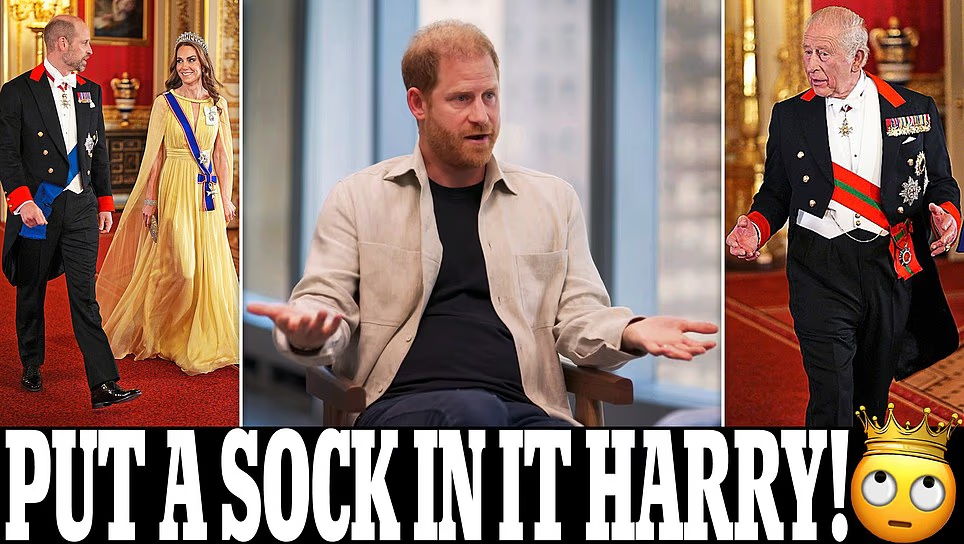
Prince Harry’s hopes for reconciliation with the Royal Family have once again become a subject of public debate after an interview in which he spoke about the possibility of repairing strained family relationships aired during a state visit. While the Duke of Sussex has expressed a desire for greater understanding and a way forward, the timing and tone of his remarks have reportedly prompted criticism from royal commentators who question whether public interviews are the best route toward a private family resolution.
The issue touches on one of the most persistent stories surrounding the British monarchy: the continuing distance between Prince Harry and several members of his family. Since stepping back from senior royal duties with Meghan, Duchess of Sussex, in 2020, Harry has spoken openly about his experiences, his concerns about media coverage, and the relationships that have become strained over the years.
For supporters, his calls for reconciliation may reflect a genuine wish to move beyond years of disagreement. Critics, however, argue that public statements about family tensions can complicate efforts to rebuild trust, especially when they coincide with major royal occasions that are intended to focus on diplomacy and international relationships.
The reaction illustrates the difficult balance between Harry’s right to speak about his own life and the Royal Family’s longstanding preference for discretion. It also raises a broader question: can reconciliation become possible when private grievances continue to play out in the public arena?
Prince Harry’s Call for Reconciliation
Prince Harry’s comments about reconciliation have attracted attention because they suggest that, despite years of tension, the possibility of improving relations with his family remains important to him.
The Duke of Sussex has previously spoken about his desire for a better relationship with members of the Royal Family. Yet the path toward repairing those relationships has been complicated by public interviews, the release of his memoir Spare, and disagreements over how events from his life should be understood.
Reconciliation is a complicated process, particularly when disagreements involve deeply personal experiences and competing accounts of what happened. It requires more than a public declaration of goodwill. Family members may need time to rebuild trust, establish boundaries, and decide whether they are ready to have difficult conversations away from cameras and headlines.
Harry’s supporters may see his comments as an attempt to leave the door open to future dialogue. They may also argue that speaking publicly is part of his effort to explain experiences that he believes have been misunderstood.
Others take a different view. Royal commentators who favor discretion often argue that statements about family relationships can make private discussions more difficult, especially when other relatives have not publicly responded.
Neither perspective alone can establish what individual family members feel privately. Without direct confirmation from those involved, it is important to distinguish public commentary from the actual state of personal relationships.
Why the Timing of the Interview Became a Talking Point
The timing of an interview can influence how its message is received. When a discussion about family reconciliation airs during a state visit, the conversation may be viewed alongside an event carrying diplomatic and ceremonial significance.
State visits are among the most formal occasions in the royal calendar. They typically involve meetings with national leaders, official welcomes, banquets, and carefully organized public engagements. Their purpose is to strengthen international relationships and demonstrate the diplomatic role played by the British monarchy and government.
Because these occasions receive extensive media coverage, other royal stories can quickly become part of the same news cycle. An interview about Harry’s relationship with his family may therefore attract attention even when the state visit itself concerns entirely separate matters.
Some observers may regard the timing as unfortunate, believing that a major diplomatic occasion should remain the focus of public discussion. Others may argue that broadcasters and journalists make independent decisions about when interviews are aired and that the timing does not necessarily reflect an attempt by Harry to overshadow the event.
Without clear evidence about the planning and scheduling of the interview, it would be inappropriate to assume that its broadcast date was deliberately chosen to provoke a reaction.
Nevertheless, the overlap helps explain why the interview has become part of a wider conversation about royal publicity, media strategy, and the difficulty of separating family matters from official royal business.
The Meaning Behind the Reported Royal Eye-Rolling
The phrase “royal eye-rolling” suggests frustration, skepticism, or weariness with the latest round of public discussion about Harry’s family relationships. It is a vivid description, but it should not automatically be interpreted as a confirmed account of how individual members of the Royal Family reacted.
Royal relatives rarely provide detailed public commentary on every interview or statement involving the Duke of Sussex. Their silence can be interpreted in different ways, but it does not establish whether they are angry, indifferent, disappointed, or privately open to reconciliation.
Commentators may offer their own assessments of the likely reaction, drawing on the history of the dispute and the monarchy’s public preference for restraint. Such assessments can contribute to debate, but they remain commentary unless supported by direct, reliable evidence.
The expression also reflects the public fatigue that can develop when a family disagreement becomes a recurring headline. Some readers may feel that the same questions have been discussed repeatedly without a clear resolution. Others continue to follow the story because it concerns a prominent family whose personal relationships intersect with questions about duty, identity, and the future of the monarchy.
Ultimately, the public reaction is not the same as the private response of the people involved. The most reliable way to understand the situation is to separate verified statements from assumptions about what the King, the Prince of Wales, or other relatives may think.
Prince Harry’s Complicated Relationship With the Royal Family
Harry’s relationship with the Royal Family has undergone significant changes since he and Meghan announced in 2020 that they would step back from their roles as senior working royals.
The couple later established their lives in California and developed independent projects through media, charitable, and commercial work. Their decision marked a major change in the modern monarchy, where senior royals traditionally carry out official duties on behalf of the institution.
The transition was followed by public interviews and other accounts in which Harry discussed his experiences within the family and his concerns about press treatment. His memoir, Spare, published in 2023, provided further details about his upbringing, relationships, and perspective on royal life.
These revelations intensified debate about the balance between personal expression and family privacy. Some readers welcomed Harry’s willingness to discuss difficult experiences, while others felt that public disclosures made an eventual reconciliation more complicated.
The disagreement has never been only about one interview or one statement. It involves different expectations about loyalty, privacy, public responsibility, and how family members should address conflict.
For Harry, speaking about his experiences may be part of asserting his own perspective. For relatives who prefer not to discuss private disagreements publicly, the same approach may be difficult to accept.
Reconciliation would likely require the people involved to navigate those differences rather than simply agree on one public account of the past.
King Charles and the Question of Family Reconciliation
The relationship between Prince Harry and King Charles has drawn particular attention because it combines a father-son relationship with the responsibilities of the monarchy.
Family disagreements can be difficult under any circumstances. When they involve a reigning monarch and a son who remains a globally recognized public figure, the pressure is magnified by media coverage and institutional expectations.
Harry has spoken publicly about his father in different contexts, including his hopes for improved family relations. Yet the private details of their conversations and the King’s personal feelings cannot be reliably inferred from interviews or commentary alone.
Any meaningful reconciliation would require both sides to determine what they are willing to discuss, what boundaries they need, and how to move forward without continually reopening every disagreement in public.
It would also be important to distinguish a personal relationship from the formal responsibilities associated with the Crown. A family conversation does not necessarily imply a change in Harry’s official status, while a public appearance or brief meeting would not automatically mean that deeper differences have been resolved.
The possibility of reconciliation remains a personal matter for the family members involved. Public interest may be intense, but it cannot determine the pace or terms of a private relationship.
Prince William and the Wider Family Rift
Harry’s relationship with his brother, Prince William, has also been a major focus of public attention. The brothers once appeared together regularly at official events and were often presented as a close family partnership shaped by their shared experiences.
Their lives have since taken different directions. William remains a senior working royal and heir to the throne, while Harry has built a life outside the formal structure of the monarchy.
Their disagreements have been discussed in interviews, books, and media reports, but the full private context remains unavailable to the public. It is therefore difficult to determine whether a particular statement or event has improved or worsened their relationship.
For the brothers, reconciliation would involve more than managing public appearances. It could require rebuilding personal trust and finding a way to relate to one another beyond the expectations attached to their royal positions.
There is also a difference between the public’s desire for a dramatic reunion and the reality of resolving long-standing family tensions. A photograph of the brothers together might generate headlines, but it would not necessarily reveal the quality of their relationship behind the scenes.
Any lasting improvement would need to be judged by the people involved rather than by public speculation about their body language or occasional encounters.
Can Public Interviews Help or Hinder Reconciliation?
Public interviews can serve several purposes. They allow people to explain their experiences, correct accounts they believe are inaccurate, and reach audiences who may otherwise hear only one version of a story.
For someone in Harry’s position, public communication may also feel necessary because his life has been discussed extensively by the media for much of his adulthood. Sharing his own perspective can be a way to exercise control over his personal narrative.
However, interviews can also make reconciliation more challenging. Statements made in public can be replayed, quoted, and interpreted long after the original conversation. Relatives may feel pressured to respond, while audiences may treat every comment as evidence of a larger dispute.
Private discussions offer a different environment. They allow family members to speak without the immediate pressure of public reaction and can provide room for misunderstandings to be addressed more carefully.
Neither public communication nor private dialogue guarantees a successful outcome. Much depends on the willingness of everyone involved to listen, acknowledge differences, and respect boundaries.
The central question is not whether Harry should speak at all, but whether the way these issues are discussed supports the kind of relationship he says he wants to build.
The Royal Family’s Preference for Privacy
The British Royal Family has traditionally maintained a cautious approach to personal disagreements. While individual members sometimes speak publicly about their lives, the institution generally avoids providing detailed commentary on internal family tensions.
That approach is intended, in part, to protect private relationships and prevent personal disputes from overwhelming official responsibilities. It also reflects the monarchy’s broader communication strategy, which places emphasis on continuity, public service, and ceremonial duties.
Harry’s approach has been different in several respects. Since leaving his role as a senior working royal, he has offered more direct accounts of his experiences and concerns.
This difference in communication style is one reason the family’s tensions have proved so difficult to resolve publicly. One side may see openness as a way to explain the past, while another may regard discretion as necessary for protecting relationships and the institution.
Neither approach automatically resolves the underlying issues. The challenge is finding a way for personal concerns to be heard without turning every disagreement into a new public confrontation.
Conclusion: Reconciliation Remains a Personal Journey
Prince Harry’s interview calling for reconciliation with his family has renewed debate about the possibility of repairing relationships that have been strained for years. The fact that the interview aired during a state visit has added another layer to the discussion, prompting questions about timing, publicity, and the monarchy’s preference for discretion.
The reported reaction described as royal eye-rolling captures the skepticism surrounding yet another public chapter in the family dispute. However, commentary about possible reactions should not be confused with confirmed statements from individual royals.
For Harry, reconciliation would mean finding a way to move forward despite years of disagreement. For the wider family, it may require balancing personal feelings with privacy and public responsibilities.
There is no guarantee that a public expression of goodwill will lead to immediate change. Genuine reconciliation usually takes time, honest communication, and a willingness to rebuild trust in ways that cannot be measured through headlines alone.
Ultimately, the future of Harry’s relationships with his family will be determined by the people involved, not by the intensity of public speculation. While audiences may continue to follow every development, the most meaningful progress may happen away from cameras, where family members can decide for themselves whether a new chapter is possible.