Grand Central Terminal is one of New York City’s most recognizable landmarks, celebrated for its magnificent architecture, celestial ceiling, and bustling concourse. Every day, thousands of commuters and visitors pass through the historic transportation hub, often unaware that its design reflects a much larger transformation in American urban planning. The terminal did not simply provide a grand entrance to Manhattan. Its development helped demonstrate how cities could separate transportation infrastructure from crowded streets, reclaim valuable urban land, and create public spaces around the needs of pedestrians.
Remarkably, the push toward this new vision was accelerated by a deadly railroad accident near the turn of the 20th century. A train crash that killed more than a dozen commuters exposed the dangers of the railroad system operating through Manhattan and intensified pressure for change. What followed was an ambitious engineering and construction project that transformed the area around Grand Central and influenced the way Americans thought about railways, buildings, streets, and urban development.
The result was more than a new terminal. It became an example of how a public disaster could force a city to reconsider its infrastructure—and how a solution to one local problem could help shape the future of American cities.
The Railroad Accident That Changed New York
By the late 19th century, New York City was expanding rapidly. Railroads connected Manhattan with growing communities beyond the city, carrying workers, shoppers, and travelers into one of the country’s busiest commercial centers.
However, the railway infrastructure had not kept pace with the city’s development. Steam-powered trains traveled through areas that were becoming increasingly crowded, creating serious problems involving smoke, noise, congestion, and passenger safety.
The New York Central Railroad operated trains into Manhattan along the Park Avenue corridor. In this section of the city, railway tracks ran through an increasingly urban environment, where trains and ordinary street life existed in uncomfortable proximity.
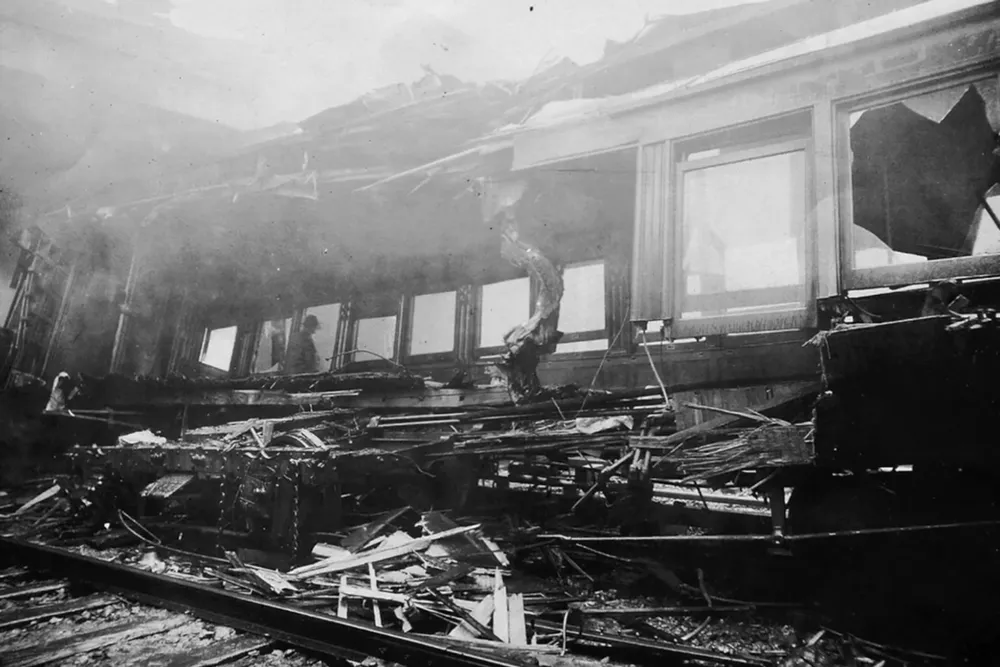
A major accident in 1902 brought the dangers into sharp focus. On January 8, an express train collided with another train near the Park Avenue tunnel, killing 15 people and injuring others. The crash became a turning point in public debate over railroad operations in Manhattan.
The accident was not simply a transportation failure. It revealed a broader conflict between industrial-era infrastructure and a modern city that was becoming denser, more valuable, and more dependent on safe, efficient movement.
Public pressure for reform increased, and New York’s leaders faced a difficult question: How could the railroad continue bringing passengers into Manhattan without exposing commuters and nearby residents to the same risks?
The answer would require a fundamental change in how trains entered the city.
Why Steam Trains Became a Problem in Manhattan
Steam locomotives had powered the expansion of American railroads throughout the 19th century. They made long-distance travel faster and more reliable, helped industries move goods, and connected cities to distant markets.
Inside a densely populated city, however, their disadvantages became increasingly difficult to ignore.
Steam trains produced smoke, soot, and exhaust. When operating through enclosed or partially enclosed spaces, these emissions could create especially unpleasant and hazardous conditions. Rail lines also occupied valuable land and interrupted the movement of pedestrians and vehicles.
Manhattan’s growth made the problem more urgent. As residential neighborhoods, businesses, and commercial buildings expanded around the railway corridor, the tracks became an obstacle to the city’s continued development.
Railway crossings could disrupt traffic, while the physical presence of the tracks divided areas that might otherwise have been connected by streets and buildings. The railway’s operation was essential to the city’s economy, but its existing form imposed substantial costs on the surrounding urban environment.
The 1902 crash strengthened the case for a different approach. Rather than making only small operational adjustments, the railroad would need to reconsider the relationship between its trains and the city above them.
That challenge helped inspire a monumental reconstruction of the Grand Central area.
The Vision Behind Grand Central Terminal’s Transformation
Grand Central’s history began before the famous terminal that stands today. Earlier railroad facilities occupied the site, including Grand Central Depot, which opened in 1871. A larger replacement, Grand Central Station, followed in 1900.
The 1902 accident helped accelerate the next stage of redevelopment. New York Central Railroad president William H. Newman and railroad executive William J. Wilgus became associated with plans to modernize the complex and fundamentally change how trains operated in Manhattan.
One of the most consequential ideas was to eliminate the routine use of steam locomotives within the terminal area and move much of the railroad infrastructure underground.
Electric trains could operate more effectively in enclosed spaces than steam locomotives, reducing the problems associated with smoke and exhaust. Placing tracks below street level would also allow the city to reclaim the surface for other uses.
This approach required extraordinary engineering. The project involved constructing tunnels, reorganizing tracks, accommodating different train levels, and building a terminal capable of handling large numbers of passengers.
The scale of the undertaking reflected the importance of the railroad to New York’s economy. Rather than treating transportation infrastructure as something that had to remain exposed at street level, planners began to see the ground beneath the city as a resource that could be developed more efficiently.
The new Grand Central Terminal opened on February 2, 1913. Its completion marked a major milestone in the transformation of Manhattan’s railroad system.
How Building Underground Changed the Urban Landscape
The decision to move railway operations underground had consequences far beyond the terminal itself.
By placing tracks beneath the surface, the railroad helped free up land that could be used for streets, buildings, and other urban purposes. This created opportunities to integrate transportation infrastructure with commercial development instead of allowing the railway to dominate the landscape.
The approach was especially significant because land in central Manhattan was becoming increasingly valuable. Space that had once been occupied by tracks and railway facilities could support offices, businesses, and other developments.
The transformation also improved the relationship between the railroad and the surrounding neighborhood. Instead of treating the railway corridor as a major physical barrier, planners could create a more continuous urban environment above the tracks.
This idea became associated with the development of Terminal City, a collection of buildings and commercial properties constructed around Grand Central. The area demonstrated how transportation infrastructure could support a larger urban development strategy.
Buildings could rise above or near railway facilities, allowing the railroad to generate economic value from land that would otherwise have been difficult to use. The terminal became an anchor for offices, hotels, retail spaces, and other businesses.
The project helped establish an influential principle in urban development: infrastructure does not have to consume valuable city space without providing other benefits. With careful planning and engineering, it can become part of a more integrated and productive urban environment.
Grand Central Terminal as a Blueprint for Modern Cities
Grand Central’s influence extended beyond its architectural appearance. Its development illustrated how major transportation projects could reshape the organization of an entire district.
One important lesson was the value of separating different forms of movement. By moving trains below ground, planners reduced conflicts between railroad operations and the activities taking place at street level.
Another was the potential to combine transportation with commercial development. A busy station could attract enormous numbers of people, making the surrounding area valuable for businesses and services. Coordinating the terminal with nearby buildings allowed the transportation hub to become an economic center rather than an isolated facility.
The project also demonstrated the importance of long-term infrastructure planning. A railway terminal needed to accommodate more than the immediate demands of arriving and departing trains. It had to consider passenger circulation, street access, connections to other transportation systems, and the future growth of the surrounding neighborhood.
These principles remain relevant to modern cities. Urban planners continue to examine how railways, highways, pedestrian routes, and commercial districts can be coordinated to reduce congestion and make better use of limited land.
Grand Central did not single-handedly create the modern American city, and many other transportation and planning projects contributed to urban development. Nevertheless, it provided a powerful example of how solving a transportation problem could create opportunities for broader change.
Its legacy lies partly in the realization that infrastructure decisions influence not only how people travel but also where businesses locate, how neighborhoods connect, and how cities use their land.
The Architectural Grandeur of the 1913 Terminal
Although engineering was central to Grand Central’s transformation, the terminal was also designed to make a powerful architectural statement.
The building’s monumental Beaux-Arts style conveyed a sense of civic importance. Its vast Main Concourse, grand staircases, large windows, and carefully organized circulation areas created a space that was both functional and visually impressive.
The ceiling, decorated with a representation of the constellations, became one of the terminal’s most recognizable features. The design helped transform a transportation facility into a public interior with a distinctive identity.
Grand Central’s architecture reflected an era when major American cities increasingly used monumental public buildings to express confidence, prosperity, and civic ambition.
Yet the terminal’s grandeur served practical purposes as well. Its spacious interior helped accommodate crowds, while its layout organized the movement of passengers through a complex transportation system.
The building demonstrated that a railway station could be more than a place to board a train. It could serve as a landmark, a meeting place, and a defining part of the city’s public realm.
That combination of engineering, architecture, and urban planning helped distinguish Grand Central from a purely utilitarian transportation facility.
The Legacy of Grand Central in American Urban Planning
Over the decades, Grand Central Terminal became an enduring example of how infrastructure can influence a city’s physical and economic development.
The Terminal City concept showed how railroad property could be integrated with surrounding commercial buildings. The underground tracks made it possible to develop valuable space above and around the railway system, creating a dense district closely connected to public transportation.
The project also demonstrated that large infrastructure investments can have effects lasting far beyond their original purpose. The terminal was built to improve railroad operations and passenger safety, but it also helped shape the development of Midtown Manhattan.
Later debates about urban transportation continued to raise similar questions. Should major roads divide neighborhoods or be designed to preserve local connections? How can cities make room for growing populations without sacrificing public space? Can transportation facilities support surrounding development rather than functioning as barriers?
There is no single answer to these questions, and the circumstances of each city differ. However, Grand Central remains a useful historical example of the relationship between engineering decisions and urban form.
Its survival is also significant. During the 20th century, changing transportation patterns and redevelopment pressures threatened many historic buildings. Grand Central itself faced proposals that could have altered or replaced parts of the complex.
Preservation efforts eventually helped secure its future, reinforcing the idea that major transportation landmarks can possess cultural and architectural value in addition to their practical function.
Today, the terminal continues to serve commuters while attracting visitors interested in its history and design.
Conclusion: A Tragedy That Helped Reshape an American City
Grand Central Terminal’s story illustrates how an urgent transportation problem can lead to a transformation far larger than anyone might initially expect.
The deadly 1902 train collision near Park Avenue exposed the risks associated with operating steam-powered railroads through a growing urban environment. In response, railroad leaders pursued a sweeping reconstruction that moved train operations underground, improved the terminal’s infrastructure, and opened new possibilities for development above the tracks.
When the present Grand Central Terminal opened in 1913, it represented both an engineering achievement and a new way of thinking about the city. The project helped connect transportation planning with commercial growth, architectural ambition, and the more efficient use of valuable urban land.
Its influence should not be overstated: Grand Central was one important example among many that shaped American urban development. But its transformation demonstrated that infrastructure could do more than solve an immediate problem. It could change how a city grew.
More than a century later, Grand Central remains a working transportation hub and a landmark of New York history. Its enduring lesson is that the most consequential urban changes sometimes begin with an unexpected crisis—and that a carefully designed response can reshape a city for generations.