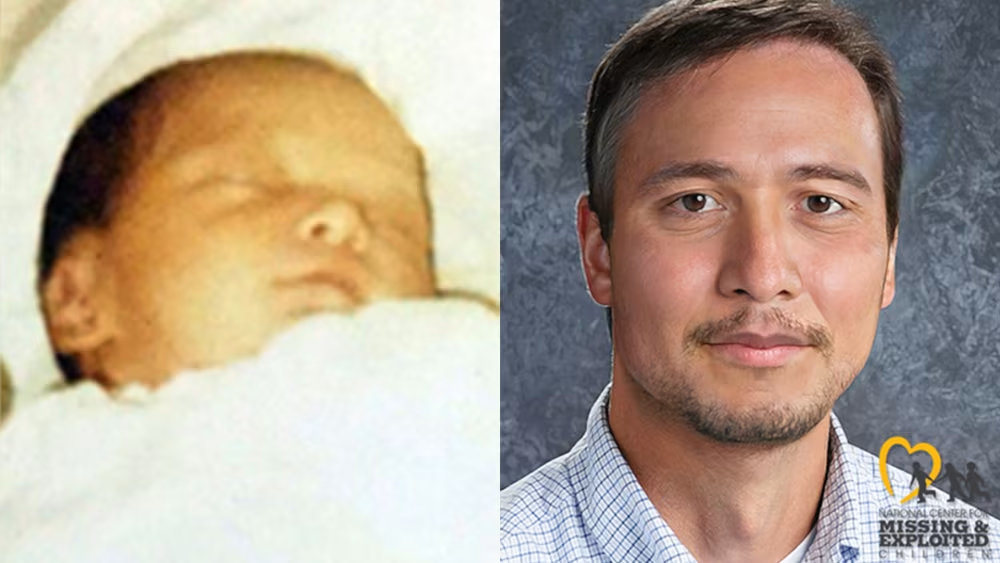
Kevin Verville Jr. was abducted on July 1, 1980, by a woman calling herself “Sheila.” Authorities believe Kevin Jr., who would be 45 years old today, may be out there, unaware he was kidnapped.
More than four decades after an infant disappeared under disturbing circumstances, investigators are hoping that a new age-progression image could help solve a case that has remained unresolved for generations. Kevin Verville Jr. was reportedly abducted on July 1, 1980, by a woman who identified herself as “Sheila.” At the time, he was only a baby, leaving him unable to understand what was happening or remember the circumstances surrounding his disappearance.
Today, the search for Kevin continues with renewed attention from the National Center for Missing and Exploited Children (NCMEC), an organization that works with families and law enforcement agencies to locate missing children. An age-progression image offers a possible way to help the public recognize Kevin as an adult, even though the photographs taken during his infancy may look nothing like the man he would be today.
The passage of time presents enormous challenges in cases involving abducted infants. A child taken before developing lasting memories may grow up without knowing their original name, family history, or the circumstances of their disappearance. Investigators therefore face a difficult question: Could Kevin be living an ordinary life somewhere, completely unaware that his family has spent decades searching for him?
Although an age-progression image cannot guarantee an identification, it may provide an important new lead. For those still hoping to find Kevin Verville Jr., even a single credible tip could make a meaningful difference.
Who Is Kevin Verville Jr.?
Kevin Verville Jr. is the subject of a long-running missing-child case dating back to July 1, 1980. According to the information associated with the case, he was abducted as an infant by a woman using the name “Sheila.”
Because Kevin was so young when he disappeared, the case presents challenges that differ from those involving older children. An infant cannot provide investigators with memories of the person who took them, the location where the abduction occurred, or the events that followed.
As the years pass, the missing child’s physical appearance also changes dramatically. A photograph of a baby provides only limited information about what that person might look like as an adult. Hair color, facial proportions, and other identifying features can change throughout childhood and adolescence.
This is why investigators sometimes turn to age-progression imagery. By using available photographs and information about physical development, specialists create an approximation of how a missing person might look many years later.
For Kevin, the goal is to give the public a recognizable image of the adult he might be today. Someone who remembers a family story, suspects that their identity may be different from what they were told, or recognizes a connection to the historical case might see the image and come forward.
However, it is important to remember that the image represents an estimate rather than a photograph of Kevin’s actual appearance. Its purpose is to encourage recognition and generate investigative leads, not to establish identity on its own.
The Disappearance on July 1, 1980
The date July 1, 1980, marks the beginning of a mystery that has endured for more than four decades. The woman reportedly involved in the abduction called herself “Sheila,” a name that investigators may use when describing the case.
The use of an assumed name can complicate an investigation because it may make it more difficult to establish a person’s real identity, background, or relationship to the child. Investigators must rely on the available evidence to determine who the individual was and what happened after Kevin disappeared.
The circumstances surrounding an infant’s abduction can leave investigators with very few direct witnesses. A baby cannot describe the person who took them, and if the abductor leaves the area, authorities may have to reconstruct events using statements, records, photographs, and other available information.
As time passes, the search can become even more complicated. People who witnessed an event may have moved away or forgotten details, while documents and other evidence may be difficult to locate decades later.
Nevertheless, the passage of time does not necessarily mean a case can never be solved. Modern investigative techniques, public awareness, and new information can sometimes create opportunities that did not exist when a child first went missing.
For Kevin’s case, the hope is that renewed attention will encourage someone with relevant information to contact the authorities.
How an Age-Progression Image Could Help Find Kevin
An age-progression image is designed to estimate how a missing person might look at a later stage of life. For children who disappear at a young age, these images can be especially important because their appearance changes substantially as they grow.
Specialists may examine photographs of the missing child, consider known family characteristics, and use techniques intended to approximate changes in facial structure and other visible features.
The resulting image can help investigators communicate a case to the public. Rather than asking people to recognize an infant from a decades-old photograph, authorities can present an approximation of the adult the child might have become.
In Kevin’s case, an updated image could reach people who would never have connected an old baby photograph with someone they know today.
A person might recognize a resemblance, recall an unusual adoption story, or remember a family member whose early history was never fully explained. Even if the image does not produce an immediate identification, it may prompt someone to investigate their own family records or share information with law enforcement.
There are, however, limitations. Age progression cannot predict every aspect of a person’s appearance. Genetics, health, lifestyle, and normal individual variation all influence how someone looks as an adult.
Two people may also resemble one another without being related. For that reason, visual recognition should be treated as a possible lead rather than proof that someone is Kevin.
Any identification would require additional investigation and appropriate verification, potentially including records and DNA analysis where suitable.
The Role of the National Center for Missing and Exploited Children
The National Center for Missing and Exploited Children plays an important role in raising awareness about missing children and supporting efforts to locate them.
The organization works with law enforcement agencies, families, and members of the public to circulate information about missing children and encourage people to report relevant tips. It also helps make case information accessible to audiences who may have knowledge that investigators do not yet possess.
Age-progression images are one of the tools used in some long-term missing-child cases. They can help bring an old case into the present by showing the public how a missing person might look years after the original disappearance.
For cases involving infants, this approach can be particularly valuable. A person who was taken before they could speak or form lasting memories may have no independent understanding of their early life. They may not realize that a missing-child report exists or that another family has been searching for them.
Public awareness can therefore serve two purposes: reaching people who may have information about the abduction and reaching the missing person themselves, if they are alive and unaware of their history.
The organization’s involvement does not mean that a new image will necessarily solve the case. Instead, it creates another opportunity for the public to recognize the name, face, or circumstances associated with Kevin’s disappearance.
Could Kevin Be Living Without Knowing He Was Abducted?
One of the most difficult possibilities in infant-abduction cases is that the missing person may have grown up without knowing their true origins.
Because Kevin was reportedly taken as a baby, he would have been too young to understand the events surrounding his disappearance. If he grew up under a different identity, he might have no personal memories connecting him to his birth family.
That possibility is part of what makes the search so emotionally complex. The person investigators are trying to locate could be an adult with a job, relationships, and a family of his own, entirely unaware that his early childhood is connected to an unresolved missing-person case.
It is also possible that someone in his life knows something about his early history without recognizing its significance. An unexplained change of name, incomplete childhood records, or an unusual account of an adoption could potentially become relevant if it aligns with verified details from the case.
However, such circumstances should not automatically be treated as evidence of an abduction. Adoption, family separation, and incomplete records can have many explanations. Investigators must evaluate any potential connection carefully and respectfully.
If Kevin is alive and unaware of his identity, discovering the truth could raise difficult personal questions. Reconnecting with a biological family after decades apart can be emotionally complicated, and any contact would need to be handled with sensitivity.
The priority remains establishing the facts, protecting everyone’s privacy, and allowing qualified investigators to determine whether a credible connection exists.
Why Missing-Child Cases Can Remain Unresolved for Decades
Missing-child investigations can continue for many years when investigators lack sufficient evidence to determine what happened.
In some cases, there may be few witnesses. In others, the person responsible may have used false information, traveled to another jurisdiction, or changed the child’s identity. When the missing child is an infant, the absence of personal memories makes it particularly difficult to obtain information directly from the person being sought.
Historical cases may also have been investigated using methods that are less effective than modern forensic techniques. Records once stored in paper files may need to be reviewed, and information from different jurisdictions may need to be compared.
Advances in DNA analysis have helped resolve some long-standing cases by connecting unidentified individuals with biological relatives. Digital databases and online publicity have also made it easier to circulate information beyond the communities where a disappearance originally occurred.
Nevertheless, each case is different. The availability of DNA evidence, the quality of historical records, and the cooperation of relevant agencies can all affect whether a breakthrough becomes possible.
Kevin’s case demonstrates why it remains important to preserve information about missing children and periodically revisit unresolved investigations. A lead that seemed insignificant decades ago may become more meaningful when considered alongside new information.
How the Public Can Help the Search
Public assistance can be valuable in long-term missing-person cases because investigators cannot know everything that happened in a person’s life after their disappearance.
Anyone who believes they have credible information about Kevin Verville Jr. should contact the appropriate law enforcement agency or the National Center for Missing and Exploited Children through its official channels.
Potentially useful information could relate to the woman who called herself “Sheila,” the circumstances surrounding the reported abduction, or records that may help establish Kevin’s identity and whereabouts.
People should avoid posting unverified accusations or attempting to confront someone they suspect might be connected to the case. A resemblance to an age-progression image is not proof of identity, and speculation can cause unnecessary distress.
Instead, any possible lead should be passed to investigators, who can assess the information and determine whether further action is warranted.
Even a detail that seems minor may be worth reporting if it can be checked against the case’s established facts. Investigators can determine whether the information is relevant and whether it provides a useful direction for the search.
The most helpful response is a responsible one: share accurate information, respect the privacy of individuals who may be involved, and allow authorities to verify any possible connection.
Conclusion: A New Image Offers Renewed Hope for Kevin Verville Jr.
More than four decades after Kevin Verville Jr. was reportedly abducted on July 1, 1980, the search for answers continues. Taken as an infant by a woman who called herself “Sheila,” Kevin may have grown into adulthood without knowing the circumstances of his disappearance.
A new age-progression image offers a way to bring his case to public attention again. By showing an approximation of what he might look like today, the image may help someone recognize a possible connection and provide information that investigators have not previously received.
The image alone cannot solve the case. It cannot establish Kevin’s identity, confirm what happened after the abduction, or replace the careful work required to verify evidence. But it can help make an old case visible to a new generation of people who might hold an important clue.
The work of the National Center for Missing and Exploited Children and law enforcement agencies reflects a central principle of missing-child investigations: time may pass, but the search for a missing person does not have to end.
For Kevin’s family and everyone hoping for answers, the possibility of a breakthrough remains meaningful. A photograph, a remembered conversation, or a previously overlooked record could provide the information needed to move the investigation forward.
If Kevin is alive, he may still be out there, unaware that his early life is part of a decades-old search. The hope is that renewed awareness will help bring his name and story to the person who can finally provide an answer.