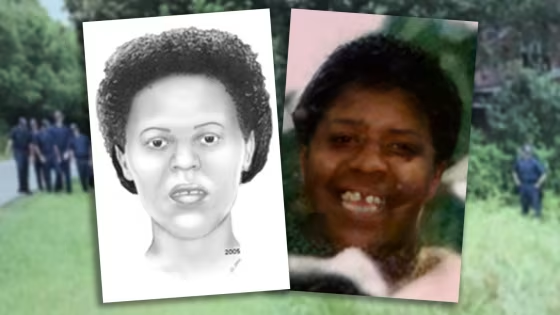
For decades, the identity of a woman found dead on an abandoned property in Bel Alton, Maryland, remained a mystery. Known only as a Jane Doe, she was unable to be identified by investigators, and the circumstances surrounding her death left authorities with more questions than answers. Now identified as LaQuanda Williams, the woman is at the center of renewed efforts to solve a homicide that has remained unresolved for years.
The discovery occurred in June 1998, when the woman’s body was found on an abandoned property in Charles County. Investigators began working to establish who she was, what had happened to her, and whether someone could be held responsible for her death. Despite the passage of time, the case remained important to law enforcement and to those who believed the victim deserved to be remembered by her name.
The Charles County Sheriff’s Office Cold Case Team continues to work toward answers. Identifying Williams was an essential step, but it did not automatically resolve the homicide. Investigators must still examine the available evidence, revisit the circumstances of her death, and seek information that could help establish what happened in 1998.
Her case illustrates the challenges faced by cold case investigators and the importance of continuing to pursue answers for victims whose identities and stories have been lost for years.
The Discovery on an Abandoned Property in Bel Alton
In June 1998, authorities discovered the body of a woman on an abandoned property in Bel Alton, a community in Charles County, Maryland.
The discovery began an investigation into a death that would remain difficult to solve. At the time, investigators did not have a confirmed identity for the woman. Without a name, it was harder to establish her personal history, identify relatives, reconstruct her final movements, or determine who might have information about her life.
The circumstances surrounding the discovery made identifying the victim an immediate priority. Investigators needed to determine whether she had been reported missing, locate people who might recognize her, and establish a timeline of events leading up to her death.
When a victim cannot be identified, even basic investigative questions can become difficult to answer. Detectives may have no confirmed family members to interview, no reliable account of the victim’s recent activities, and no clear starting point for understanding why the person might have been targeted.
The absence of a name can also complicate efforts to connect a homicide with other reports of missing people. A person may have disappeared from one community while their remains are discovered in another, and the connection may not be immediately apparent.
For the woman found in Bel Alton, the initial investigation did not quickly provide the answers authorities needed. She became known as Jane Doe, a temporary designation used when a person’s identity is unknown.
Behind that designation was an individual with a life, relationships, experiences, and a history that investigators could not yet reconstruct.
What It Means to Be Known as a Jane Doe
The term Jane Doe is commonly used in the United States to identify an unidentified female person in medical, legal, and law enforcement records. It allows authorities to document a case while continuing efforts to establish the person’s identity.
However, a placeholder name can also reflect a painful investigative reality. Without a confirmed identity, authorities may struggle to connect a victim to missing-person reports or determine which family members should be notified.
For families, the uncertainty can be devastating. Someone may have been searching for a missing relative for years without knowing that the person’s remains had already been discovered. In other cases, relatives may not realize that an unidentified person could be connected to someone they once knew.
The passage of time creates additional obstacles. Witnesses may move away, memories may fade, records may become difficult to locate, and people who knew the victim may no longer be available to speak with investigators.
Even when physical evidence survives, detectives must determine whether modern investigative techniques can provide information that was unavailable when the case first opened.
For the woman discovered in Bel Alton, the Jane Doe designation remained part of the case for approximately 25 years, according to the account of the investigation. During that period, the absence of a confirmed name represented one of the most significant barriers to understanding her story.
Her eventual identification as LaQuanda Williams changed that part of the investigation. It gave authorities a name to work with and created the possibility of connecting the case with information about her life.
But identification and solving a homicide are two different achievements.
LaQuanda Williams: Restoring a Name to the Case
The identification of LaQuanda Williams was a major development in a case that had remained unresolved for decades.
For years, investigators had been attempting to determine who the woman was. Once her identity was established, authorities could begin exploring questions that had previously been difficult or impossible to answer.
A confirmed identity can help detectives examine a victim’s personal connections, establish a more accurate timeline, and compare the case with information held in missing-person databases or historical records.
It can also help investigators reach people who may have known the victim before her death. Former friends, acquaintances, coworkers, and relatives may remember details that seemed insignificant at the time but could become important when viewed in the context of a homicide investigation.
The identification may also offer relatives an answer to a question that has remained unresolved for years. Knowing what happened to a missing family member cannot erase the loss, but it can end the uncertainty surrounding that person’s identity.
At the same time, investigators must be careful not to assume that identifying Williams explains the circumstances of her death. Her name is a critical piece of the puzzle, but detectives still need evidence that establishes how the homicide occurred and who was responsible.
The renewed focus on Williams reflects an important principle in cold case work: a victim’s identity is not the end of the investigation. It is often the beginning of a more focused effort to reconstruct the events surrounding the crime.
How the Charles County Sheriff’s Office Cold Case Team Approaches the Investigation
Cold case investigations require patience, careful documentation, and a willingness to reconsider evidence collected years earlier.
The Charles County Sheriff’s Office Cold Case Team works on unresolved cases with the goal of identifying leads that may help investigators establish what happened and determine whether a crime can be solved.
In a case such as Williams’s, detectives may review original reports, examine witness statements, reassess physical evidence, and look for information that was not available or fully understood during the initial investigation.
They may also compare details from the case with other records to determine whether previously unknown connections exist. A witness who was not identified in 1998 may be located years later, while someone who was reluctant to speak at the time may eventually come forward with new information.
Advances in forensic science can also provide opportunities to revisit older evidence. Depending on what was collected and preserved, modern testing may reveal information that investigators could not obtain using the methods available at the time.
However, not every cold case contains evidence suitable for new forensic analysis. The condition of the material, how it was stored, and the type of evidence originally collected all affect what can be accomplished.
Investigators must therefore combine scientific methods with traditional detective work. Physical evidence may establish important facts, but witness accounts, historical records, and a reliable timeline can also play essential roles.
The objective is not simply to generate new theories. It is to identify information that can be tested against the evidence and help establish a clearer account of the crime.
Why Homicide Cases Can Remain Unsolved for Decades
A homicide can remain unsolved for many reasons, particularly when investigators initially lack a confirmed identity for the victim.
In Williams’s case, the Jane Doe designation created an obvious obstacle: detectives could not immediately use her name to trace her personal history or contact people who knew her.
Other challenges commonly affect older homicide investigations. Witnesses may have seen only a brief encounter, making it difficult to remember a suspect or vehicle years later. People may have moved, changed contact information, or died before investigators could interview them.
Evidence can also be limited. Investigators working in 1998 did not have access to every forensic technology available today, and some types of analysis have become more sophisticated over time.
Yet the passage of time does not guarantee that a case is impossible to solve. Advances in forensic science, improved databases, and renewed public attention can generate leads long after a crime occurred.
A single credible tip may help investigators identify a person who was previously unknown to them. A witness may remember a conversation, a suspicious event, or a detail about the victim’s final days that becomes meaningful when combined with other evidence.
That is why cold case teams continue to ask the public for assistance. Investigators may possess information that has never been widely publicized, while someone outside law enforcement may hold a detail that fills an important gap.
The Importance of Public Assistance
Community cooperation can be especially valuable when investigators revisit a crime that occurred decades ago.
Someone who lived or worked near the Bel Alton property in 1998 may remember activity that seemed ordinary at the time. A former acquaintance of Williams may recall a conversation or encounter that was never reported. Another person may have information about the circumstances surrounding her death but may not have realized its significance.
Even apparently minor details can help investigators evaluate a timeline or determine whether a person should be interviewed.
Anyone considering providing information should distinguish between what they personally remember and what they may have heard from someone else. Investigators need accurate details, not speculation, and even uncertain recollections can be useful when clearly described as such.
People with information about Williams or the circumstances of her death should contact the Charles County Sheriff’s Office through its official channels. They should avoid confronting anyone they suspect of involvement or attempting to investigate the case themselves.
The responsibility for evaluating evidence belongs to law enforcement. Public tips can help identify leads, but investigators must establish whether those leads are credible and consistent with the facts.
For Williams’s family and everyone seeking answers, renewed attention to the case offers an opportunity for someone with relevant information to come forward.
Remembering LaQuanda Williams Beyond the Case
Cold case reporting often focuses on the circumstances of a victim’s death, the investigation, and the search for a suspect. Those details matter, but they do not represent the entirety of a person’s life.
LaQuanda Williams was more than an unidentified woman in a law enforcement file. She had a name and a personal history, even during the years when investigators could not establish her identity.
Restoring her name to the case is an important step toward recognizing her as an individual rather than an anonymous victim.
Identification can also help return a case to public attention. When a victim is identified, people who knew her may learn what happened and realize that information they possess could assist investigators.
The process may also help relatives understand the fate of someone whose disappearance left unanswered questions. Although an identification cannot undo the harm caused by a homicide, it can provide a foundation for remembrance and further investigation.
The work of a cold case team is therefore about more than closing files. It is about preserving the possibility of accountability and ensuring that the passage of time does not erase a victim from public memory.
Williams’s case remains unresolved, but the continued effort to investigate her death demonstrates that the search for answers has not been abandoned.
Conclusion: The Search for Justice Continues
LaQuanda Williams was found dead on an abandoned property in Bel Alton, Maryland, in June 1998. For approximately 25 years, she was known as Jane Doe while investigators worked to establish her identity.
Her identification marked an important development, allowing the case to be approached with a name and the possibility of uncovering new connections to her life. However, the homicide remains a separate investigative challenge, and the circumstances surrounding her death still require answers.
The Charles County Sheriff’s Office Cold Case Team continues working to move the investigation forward. Reviewing historical evidence, seeking new witnesses, and evaluating information from the public may help investigators develop leads that were unavailable during the original inquiry.
Cold cases can be difficult to solve, but the passage of time does not make the search for truth less important. Evidence can be reassessed, memories can be revisited, and people who know something relevant may still come forward.
For LaQuanda Williams, the effort represents a continued search for accountability. Her identity is no longer a mystery, but the story of what happened to her remains incomplete.
The hope is that someone, somewhere, has information that can help investigators answer the questions that have remained for decades—and bring the case closer to resolution.