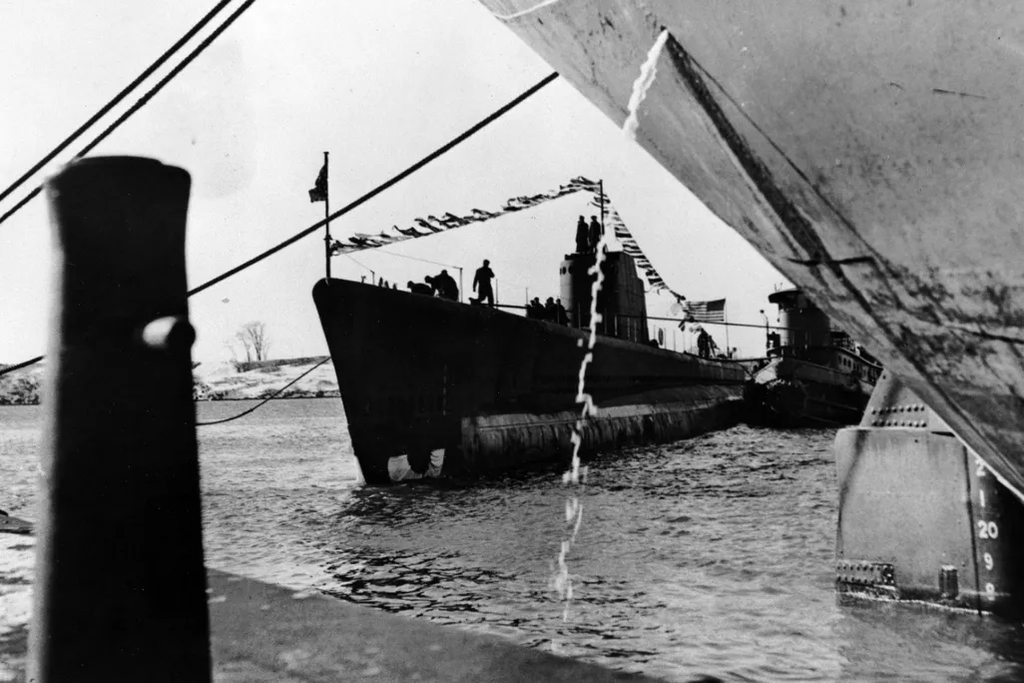
The discovery of a long-lost American submarine in the Pacific Ocean has brought renewed attention to one of the many tragic stories of World War II. The USS Herring (SS-233), a U.S. Navy submarine that disappeared during combat in 1944, was lost along with all 83 members of its crew. More than eight decades later, the vessel remains a powerful reminder of the dangers faced by American submariners during the war and the sacrifices made far from home.
Commissioned in 1942, the Herring served during a period when submarine warfare played a critical role in the Pacific theater. American submarines targeted Japanese merchant vessels and naval ships, disrupting supply lines and challenging Japan’s ability to sustain its military operations across the vast ocean. The Herring participated in these dangerous missions before its final patrol ended in tragedy.
Historical accounts indicate that the submarine was lost in June 1944 after engaging Japanese forces near the Kuril Islands. Japanese shore batteries reportedly attacked the vessel after it had struck enemy shipping, leaving the submarine and its crew unable to return home. Its disappearance became part of the extensive record of American naval losses during World War II.
The discovery of a wartime wreck can help historians reconstruct the final moments of a vessel, preserve the memory of those who served aboard it, and provide a measure of closure for families and descendants. However, identifying a wreck requires careful examination of its location, physical characteristics, and historical records.
The story of the USS Herring is not simply about a submarine found beneath the waves. It is also about courage, naval strategy, and 83 sailors whose final mission became part of the history of the Pacific War.
The USS Herring: An American Submarine Built for War
The USS Herring was a Gato-class submarine, a type of American fleet submarine designed for long-range operations during World War II. These submarines became essential components of the U.S. Navy’s Pacific campaign, operating thousands of miles from American bases and targeting Japanese shipping routes.
The Gato class combined substantial endurance with the ability to carry torpedoes and operate for extended periods at sea. Its submarines could travel long distances, remain submerged to evade detection, and launch attacks against enemy vessels. Their effectiveness depended on skilled crews, reliable equipment, and the ability to navigate waters where Japanese naval and air forces remained active.
The Herring was commissioned in October 1942. Like other American submarines operating in the Pacific, it faced demanding conditions, including long patrols, limited supplies, mechanical challenges, and the constant threat of counterattack.
Submarine crews worked in confined spaces where privacy was scarce and daily life depended on discipline and teamwork. A patrol could last for weeks, with sailors spending much of their time monitoring instruments, maintaining equipment, tracking enemy movements, and preparing for possible engagements.
The danger was particularly severe when submarines operated near enemy-controlled islands and coastal installations. Although submarines could attack without being easily seen, they were vulnerable when detected by surface ships, aircraft, mines, or shore-based defenses.
For the sailors aboard the Herring, these risks were part of the mission. Their work contributed to the broader American effort to weaken Japan’s ability to move troops, fuel, food, and military equipment across the Pacific.
The USS Herring’s Role in the Pacific War
During World War II, Japan relied heavily on maritime transportation to maintain its far-flung military positions. Supplies had to travel between the Japanese home islands, occupied territories, and military outposts scattered across the Pacific.
American submarines increasingly targeted these shipping networks. By attacking merchant vessels and selected naval targets, U.S. submariners helped reduce the flow of essential resources available to Japanese forces.
The Herring carried out multiple wartime patrols, operating in waters where enemy ships and defensive forces could pose a serious threat. Each mission required careful planning and the ability to make difficult decisions under pressure.
Submarine commanders had to assess potential targets, determine whether an attack was worthwhile, and decide when to withdraw. A successful engagement could damage the enemy’s supply system, but lingering near a target could expose the submarine to retaliation.
The Pacific’s immense size created additional challenges. Distances between bases were considerable, weather conditions could change quickly, and accurate information about enemy movements was not always available. Even experienced crews could find themselves operating in unfamiliar waters with limited opportunities for assistance.
American submarines ultimately made a major contribution to the Allied victory by attacking Japanese merchant shipping and disrupting maritime logistics. Their achievements came at a high cost, however. Submarines lost during the war often disappeared with their entire crews, leaving families with few details about what had happened.
The Herring became one of those vessels.
The Final Patrol: What Happened to the USS Herring?
In May 1944, the Herring departed on its final war patrol under the command of Lieutenant Commander David Zabriskie Jr. Its assigned operating area included waters around the Kuril Islands, a strategically important island chain north of Japan.
The region was significant because it contained Japanese military installations and lay along maritime routes used during the war. Operating there meant entering an area where the submarine could potentially attack enemy shipping but also face substantial defensive risks.
On June 21, 1944, Japanese records indicated that the Herring had attacked and sunk two Japanese vessels near Matsuwa Island, now known as Matua Island. The submarine was subsequently engaged by Japanese coastal defenses.
Historical accounts report that Japanese shore batteries fired on the submarine after the attacks. The vessel was struck and lost, taking all 83 crew members with it.
The precise sequence of events has been reconstructed from surviving records, including Japanese wartime reports and American naval documentation. As with many wartime losses, some details remain difficult to establish independently because the submarine and its crew did not return to provide firsthand accounts.
The Herring was officially presumed lost after the patrol ended without its return. Its disappearance left the Navy and the families of its sailors without the kind of detailed explanation that might have followed a surviving crew’s report.
The loss also illustrates the risks of submarine warfare near hostile territory. Even after achieving a successful attack, a submarine could be exposed to enemy fire while withdrawing from the area.
For the 83 sailors aboard the Herring, the June 1944 engagement was their final mission.
The Discovery of the Lost Submarine in the Pacific
The discovery of a missing wartime submarine can be an important moment for naval historians and maritime archaeologists. Deep-sea surveys, remotely operated vehicles, sonar mapping, and comparisons with historical records have made it increasingly possible to locate vessels that disappeared decades ago.
When researchers encounter a suspected wreck, they must establish its identity through several lines of evidence. These may include the vessel’s dimensions, hull configuration, surviving structural features, location, and consistency with known accounts of its final voyage.
For submarines, distinctive characteristics can be particularly useful. The shape of the hull, the position of the conning tower, and other structural details may help experts distinguish one vessel from another.
The surrounding seabed can also provide clues. A wreck’s position may be compared with historical reports of an engagement, known navigation routes, and records describing where a vessel was last seen.
Nevertheless, an announcement that a wreck has been discovered should be distinguished from a fully confirmed identification. The strongest conclusions generally depend on documented survey results and clear evidence linking the remains to the missing vessel.
In the case of the USS Herring, any newly reported discovery should be assessed against the historical record and the evidence released by the researchers involved. The exact location, identification method, and condition of the wreck are important details that should not be assumed without confirmation.
If the submarine’s identity is conclusively established, the discovery could provide valuable information about its final moments and help preserve the story of its crew for future generations.
Why Deep-Sea Discoveries Matter
Finding a lost submarine is about much more than locating a historical object. A wreck can provide physical evidence that complements written records, helping researchers better understand how a vessel was damaged and what happened during its final hours.
Underwater archaeology can reveal details that were never recorded in official reports. Structural damage, the position of the wreck, and the distribution of debris may help researchers develop a more complete picture of the circumstances surrounding a loss.
Modern technology has expanded the possibilities for such investigations. High-resolution sonar can map the seabed, while remotely operated vehicles can capture images of wrecks at depths that would be dangerous or impossible for human divers to reach.
These technologies also allow researchers to document wrecks without immediately disturbing them. Photographs, video, and three-dimensional mapping can create detailed digital records that support future study and public education.
For military historians, discoveries like these help connect the strategic history of the Pacific War with the experiences of individual sailors. A submarine may have been one small part of a vast military campaign, but the people aboard it had families, friendships, and lives that extended far beyond the war.
A confirmed wreck can therefore become an important memorial, even when recovering human remains is neither possible nor appropriate.
Honoring the 83 Sailors Who Never Came Home
The loss of the USS Herring meant that 83 sailors never returned to their families. Their disappearance was part of the enormous human cost of World War II, when naval personnel faced danger on every patrol.
Submarine service demanded a distinctive combination of technical skill, patience, and courage. Crews worked in cramped compartments, endured long periods of uncertainty, and knew that a single encounter with enemy forces could leave them with little chance of escape.
For families waiting at home, the loss of a submarine was especially painful. When an entire vessel disappeared, relatives could be left with unanswered questions about where their loved ones had died and what they had experienced in their final hours.
Remembering the Herring means recognizing those individual lives rather than focusing only on the vessel’s military achievements. Its crew members were sailors carrying out a mission during a global conflict, and their sacrifice remains part of the history of the U.S. Navy.
A wreck discovery may help bring renewed attention to their story. It can also create an opportunity to preserve names, photographs, service records, and historical accounts so that the crew is not reduced to a statistic.
The ocean may have concealed the submarine for decades, but historical research and modern technology can help ensure that the people who served aboard it are remembered.
The USS Herring and the Enduring Legacy of World War II
More than 80 years after the Herring was lost, its story continues to illustrate the dangers of the Pacific campaign and the importance of preserving maritime history.
The submarine’s final patrol occurred during a pivotal period of the war, when American forces were intensifying pressure on Japanese shipping and military positions. Its attack on Japanese vessels near the Kuril Islands was part of that larger effort, but the subsequent engagement with coastal defenses ended the lives of all 83 crew members.
Any confirmed discovery of the wreck would add another physical connection to that history. It could help researchers document the submarine’s final resting place and provide a focal point for remembering the men who never returned.
At the same time, such discoveries require care. A military wreck is not merely an archaeological site; it may also be a war grave. Respectful documentation and preservation should take priority over unnecessary disturbance.
The story of the USS Herring reminds us that the history of World War II is preserved not only in battle maps and official reports, but also in the ships and submarines that remain beneath the sea.
Conclusion: A Lost Submarine, 83 Lives, and a Story Worth Remembering
The USS Herring was an American Gato-class submarine that served in the Pacific during World War II. Lost in June 1944 after attacking Japanese vessels near the Kuril Islands, it took all 83 members of its crew with it.
Its history reflects the dangers faced by submariners operating close to enemy-controlled territory, where a successful attack could be followed by a devastating counterstrike. It also illustrates the importance of historical research in reconstructing the fate of vessels that vanished during wartime.
A reported discovery of the submarine offers an opportunity to revisit this chapter of naval history, provided its identity and the details of the find are supported by reliable evidence. Modern underwater technology can help document the wreck and preserve information that might otherwise remain inaccessible.
Ultimately, the significance of the USS Herring lies not only in where it rests beneath the Pacific Ocean, but in the lives of the 83 sailors who served aboard it. Their story deserves to be remembered with accuracy, dignity, and respect for the families and generations who continue to honor those lost at sea.