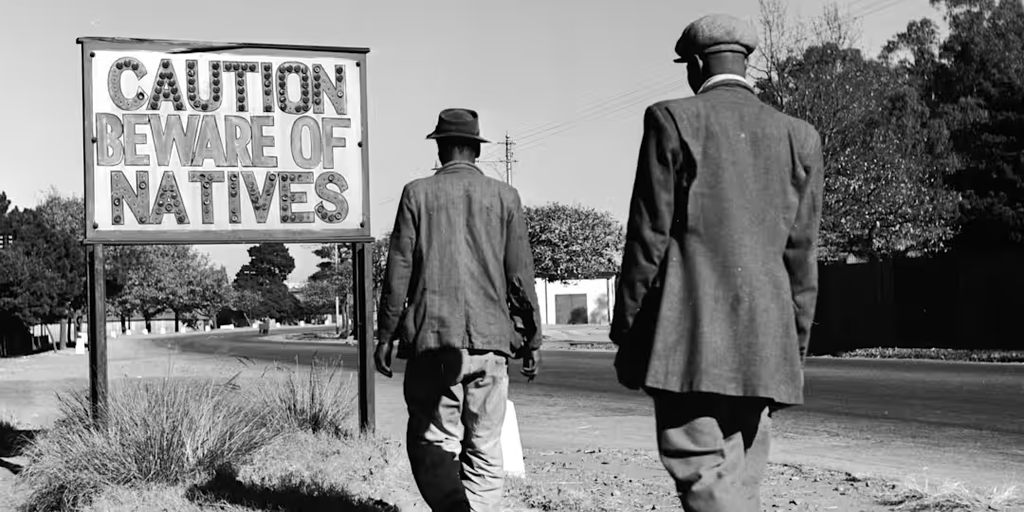
For decades, South Africa lived under one of the most systematic systems of racial discrimination in modern history. Known as apartheid, the system enforced racial separation through laws that controlled where people could live, which schools they could attend, what jobs they could hold, and even whom they could marry. Although white South Africans made up a minority of the population, they held overwhelming political power and enjoyed privileges denied to the country’s Black majority.
Apartheid became official government policy in 1948, when the National Party came to power. Its leaders promoted a vision of separate racial communities, but the reality was a deeply unequal society in which political rights, economic opportunities, and access to public services were distributed according to race. Black South Africans were subjected to restrictions that affected almost every aspect of daily life, while other nonwhite communities also experienced extensive discrimination.
The consequences extended far beyond legal segregation. Families were forcibly removed from their homes, workers traveled long distances to reach employment, children received unequal education, and people who challenged the system faced surveillance, arrest, imprisonment, and sometimes deadly violence.
Apartheid was not simply a collection of prejudiced attitudes. It was a state-enforced structure designed to preserve white minority rule. Understanding how it operated reveals the human cost of institutional racism and explains why the struggle against apartheid became an international movement for equality and human rights.
What Was Apartheid?
The word apartheid comes from Afrikaans and means “apartness.” It described the policy of racial separation developed and enforced by South Africa’s National Party government after 1948.
Racial discrimination existed in South Africa long before apartheid became official policy. Colonial rule, land dispossession, and earlier segregationist laws had already restricted the rights of Black people. The 1913 Natives Land Act, for example, severely limited the areas in which Black South Africans could own or rent land, helping establish a deeply unequal system of land ownership.
The apartheid government expanded and formalized these divisions through legislation. Officials classified people into racial categories, including Black, white, Coloured, and Indian, although the legal classifications and their application were complex and often arbitrary.
These categories determined access to residential areas, education, employment opportunities, and political rights. The system treated racial identity as a legal status that could shape a person’s entire life.
The government claimed that different racial groups should develop separately. In practice, however, white South Africans retained the greatest political and economic advantages, while the Black majority faced the most extensive restrictions.
Apartheid therefore served a clear political purpose: maintaining white minority control over a country in which white people represented a much smaller share of the population.
Pass Laws Controlled Where Black South Africans Could Go
One of the most intrusive features of apartheid was the system of pass laws.
Black South Africans were required to carry documents that regulated their presence in designated areas and helped authorities control their movement. These rules made it difficult for many people to live, work, or travel freely, particularly in urban areas where employment opportunities were concentrated.
A person could be stopped by police and asked to produce the necessary documents. Failure to comply could result in arrest or other penalties.
The system was especially damaging to workers who needed to travel between rural communities and cities. Many Black South Africans were essential to South Africa’s mining, manufacturing, domestic service, and agricultural industries, yet their ability to remain in urban areas was restricted.
Families could be separated when employment rules or residency restrictions prevented relatives from living together. Some workers spent long periods away from their spouses and children because the places where they were permitted to live were far from their workplaces.
Pass laws also created an atmosphere of constant uncertainty. An ordinary journey to work, a visit to a relative, or an attempt to find employment could become a source of fear if a person’s documents were questioned.
The laws were not merely administrative procedures. They were instruments of racial control that limited freedom of movement and reinforced the unequal relationship between white authorities and Black citizens.
Forced Removals and the Destruction of Communities
Apartheid shaped the physical landscape of South Africa by determining where different racial groups could live.
The Group Areas Act of 1950 gave the government extensive powers to designate residential and business areas for particular racial groups. Communities that did not conform to these classifications could be removed, often against their wishes.
Thousands of families lost their homes as authorities cleared areas designated for white occupation or development. People were relocated to townships, peripheral settlements, or designated Black areas that were frequently far from major employment centers.
One of the best-known examples was District Six in Cape Town. Once a vibrant, multiracial community, it was declared a white area under apartheid policies. Beginning in the 1960s, residents were forcibly removed, and much of the neighborhood was demolished.
The destruction of communities involved more than the loss of buildings. Residents lost neighbors, businesses, schools, religious institutions, and familiar networks of support. Streets that had connected generations of families were transformed, while people were forced to rebuild their lives elsewhere.
Relocation also imposed financial burdens. Traveling longer distances to work cost time and money, while access to services and infrastructure in many receiving areas remained inadequate.
For families who had lived in their neighborhoods for decades, forced removal meant losing both property and a sense of belonging. These experiences became a defining feature of apartheid’s human cost.
Unequal Schools and Limited Opportunities
Education was another central mechanism through which apartheid maintained racial inequality.
The Bantu Education Act of 1953 placed Black education under a system designed around the government’s racial policies. The education provided to Black children was generally inferior to that available to white children, with unequal funding, facilities, resources, and opportunities.
Government policy promoted an education system that prepared Black students for a restricted position in society rather than providing equal access to professional and academic advancement.
Many Black schools faced overcrowded classrooms and shortages of books, equipment, and qualified teachers. By contrast, white schools generally benefited from substantially greater public resources.
These inequalities affected more than a child’s immediate experience in the classroom. Education helped determine access to higher education, skilled employment, and economic security later in life.
A child denied adequate schooling faced obstacles that could persist for decades. Families also had to contend with a system that restricted opportunities even for students who performed exceptionally well.
Black South Africans nevertheless continued to pursue education, organize communities, and challenge the policies imposed on them. Students became important participants in resistance movements, demonstrating that education could also provide the tools to question the system and demand change.
The unequal school system was one of apartheid’s most consequential institutions because it helped reproduce racial inequality from one generation to the next.
Work, Poverty, and Economic Inequality
South Africa’s economy depended heavily on Black labor, particularly in mining, agriculture, manufacturing, and domestic service. Yet apartheid restricted the economic opportunities available to many Black workers.
Job reservation and discriminatory employment practices helped preserve better-paid positions for white workers. Black employees frequently performed difficult and dangerous work while receiving lower wages and having fewer opportunities for advancement.
The mining industry provides a particularly stark example. South Africa’s mineral wealth generated enormous economic activity, but Black mineworkers often faced hazardous conditions, harsh labor arrangements, and separation from their families.
The migrant labor system required many workers to travel from rural areas or neighboring territories to industrial centers. They might live in crowded hostels while their families remained elsewhere, creating long periods of separation and social disruption.
Residential segregation also reinforced economic disadvantage. Many Black townships were located far from major employment centers, forcing workers to spend considerable time and money commuting.
These conditions helped create a cycle of inequality. Restricted education limited access to skilled jobs, employment discrimination kept wages low, and residential policies made it harder for families to accumulate wealth.
White South Africans were not all equally wealthy, and some opposed apartheid, but the racial system gave white people broad structural advantages that were denied to the majority.
The resulting inequalities remained one of the most enduring legacies of the apartheid era.
Resistance, Protest, and Government Repression
Despite severe restrictions, South Africans resisted apartheid through political organizing, strikes, demonstrations, community activism, and international campaigns.
The African National Congress (ANC), founded in 1912, became one of the most prominent organizations opposing racial discrimination. Other important movements included the Pan Africanist Congress and the Black Consciousness Movement, alongside trade unions, student organizations, religious groups, and community networks.
Resistance took many forms. Some activists organized peaceful demonstrations and boycotts, while others supported more confrontational methods as the government intensified its repression.
In 1952, the Defiance Campaign challenged discriminatory laws through organized civil disobedience. In 1955, anti-apartheid organizations and their supporters adopted the Freedom Charter, which called for a democratic South Africa in which rights would not be determined by race.
The government responded with surveillance, restrictions on political organizations, arrests, and prosecutions. The ANC and Pan Africanist Congress were banned in 1960, sharply limiting their ability to operate openly.
One of the most notorious events occurred on March 21, 1960, in Sharpeville. Police opened fire on a crowd protesting pass laws, killing 69 people and injuring many others. The massacre became an international symbol of apartheid’s violence.
In June 1976, student protests in Soweto against the use of Afrikaans as a language of instruction in Black schools were met with police violence. The Soweto uprising became a turning point in resistance, drawing renewed attention to the treatment of Black children and the broader education system.
These events demonstrated that apartheid depended not only on legislation but also on coercion to suppress opposition.
Nelson Mandela and the International Campaign Against Apartheid
Nelson Mandela became one of the most recognizable figures in the struggle against apartheid.
A member of the ANC, Mandela opposed the racial system and became involved in efforts to challenge the government’s policies. After the government intensified its repression, he helped support the formation of the ANC’s armed wing, Umkhonto we Sizwe, in 1961.
Mandela was arrested in 1962 and later sentenced to life imprisonment in the Rivonia Trial. He spent 27 years in prison, much of that time on Robben Island.
His imprisonment became an international symbol of the injustice of apartheid. Campaigners around the world demanded his release, while governments, organizations, students, artists, and ordinary citizens called for pressure against the South African regime.
International opposition grew through economic sanctions, cultural boycotts, sporting exclusions, and diplomatic pressure. The extent and effectiveness of these measures varied, but together they helped increase the political and economic costs of maintaining apartheid.
Mandela was released on February 11, 1990, as negotiations toward a new political system gained momentum. His release did not immediately end apartheid, but it marked a major turning point.
The eventual transition depended on many people and organizations, including activists who had been imprisoned, exiled, or killed, as well as community organizers whose work often received less international attention.
The struggle against apartheid was never the achievement of one person alone. It was the result of decades of resistance by South Africans from different backgrounds and the growing international rejection of institutionalized racial discrimination.
How Apartheid Finally Came to an End
By the late 1980s, apartheid faced mounting internal resistance, international pressure, economic difficulties, and political divisions.
The government increasingly recognized that maintaining the existing system was becoming unsustainable. Negotiations began to establish a new political framework that would allow the Black majority to participate in national elections.
In 1990, President F. W. de Klerk announced major reforms, including the unbanning of the ANC and other political organizations. The following years brought difficult negotiations, continued violence in some areas, and efforts to establish a democratic constitution.
In 1993, Mandela and de Klerk received the Nobel Peace Prize for their work toward a peaceful transition. The following year, South Africa held its first democratic national election based on universal adult suffrage.
On April 27, 1994, millions of South Africans voted in an election that allowed citizens of all races to participate on equal terms. The ANC won, and Mandela became the country’s first Black president.
The election marked the end of apartheid as the official political system and the beginning of a new constitutional democracy.
It was a historic achievement, but it did not instantly erase the inequalities created over decades. The effects of unequal education, land dispossession, residential segregation, and discriminatory employment practices continued to shape South African society.
The Lasting Legacy of Apartheid
Apartheid ended legally, but its consequences remain visible in South Africa’s economic and social landscape.
Differences in wealth, access to quality education, housing, employment, and public services reflect both historical injustices and challenges that have continued since the democratic transition.
Land ownership remains a particularly difficult issue because apartheid built upon earlier dispossession and concentrated resources in unequal ways. Residential patterns also continue to reflect decades of forced separation, with many people living far from economic opportunities.
At the same time, South Africa has developed democratic institutions, expanded political participation, and established constitutional protections against racial discrimination.
Remembering apartheid is therefore not simply an exercise in revisiting the past. It helps explain why equal rights require more than changing laws. They also require confronting the lasting effects of policies that restricted people’s opportunities across generations.
The experiences of those who lived under apartheid also demonstrate the importance of protecting civil liberties, ensuring equal access to education, and holding governments accountable when they use the law to deny basic rights.
Conclusion: Remembering the Human Cost of Apartheid
The harsh reality of life under apartheid was defined by laws that made racial identity a determining factor in where people could live, how they could work, what education they received, and whether they could participate fully in political life.
For decades, South Africa’s Black majority endured restrictions on movement, forced removals, unequal schools, economic discrimination, and government repression. Families lost homes and communities, workers faced limited opportunities, and people who challenged the system risked arrest, imprisonment, and violence.
Yet apartheid also produced a determined resistance movement that refused to accept racial inequality as permanent. Through decades of organizing, protest, sacrifice, and international solidarity, South Africans helped bring the system to an end.
The democratic election of 1994 represented a historic victory, but the work of addressing apartheid’s legacy did not end with the arrival of a new government.
Understanding this history means recognizing both the suffering caused by institutional racism and the courage of those who fought for equality. It also serves as a reminder that laws can be used either to protect human dignity or to systematically deny it.
The story of apartheid remains essential to understanding modern South Africa—and to recognizing why freedom, equal rights, and justice must be defended in every society.