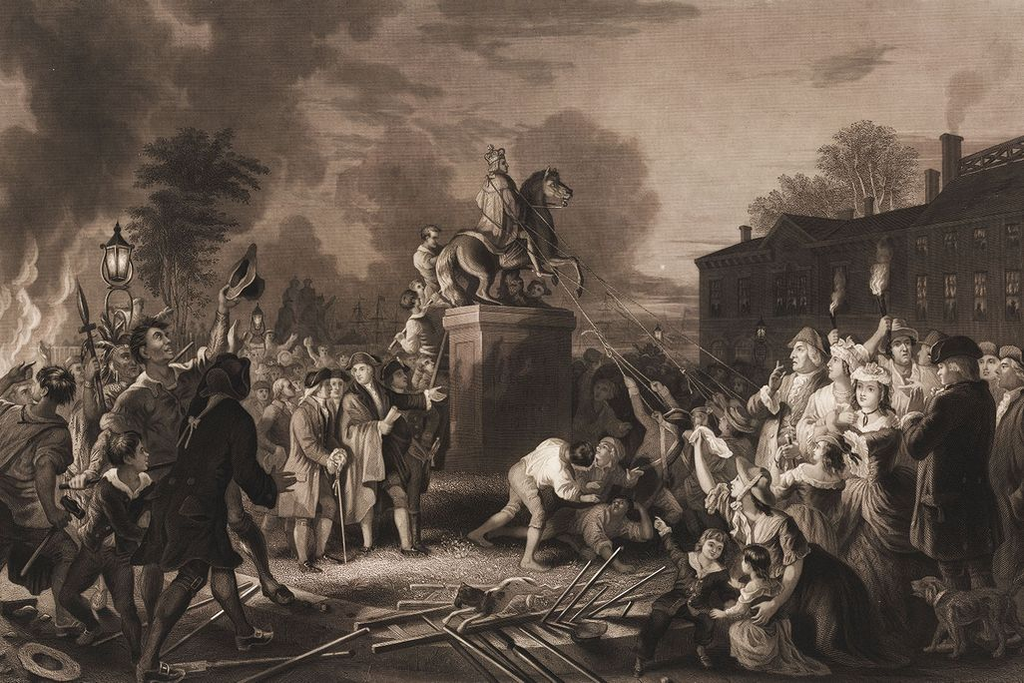
In the summer of 1776, as the American Revolution gathered momentum, New Yorkers made a dramatic statement against British rule by tearing down a statue of King George III. What had once stood as a symbol of royal authority became a target of revolutionary anger, reflecting the growing determination of American colonists to break away from the British monarchy.
Nearly 250 years later, that remarkable moment in American history is receiving a new interpretation through a museum exhibition that invites visitors to explore the Revolutionary era in a more personal and interactive way. Using historical artifacts, immersive environments, and hands-on experiences, the exhibition brings 18th-century New York City to life while encouraging visitors to consider what revolution meant to the people who experienced it.
The opportunity to participate in a recreation of the statue’s destruction offers an unusual way to engage with the past. Rather than simply reading about the event or viewing an image of the fallen monument, visitors can experience an interpretation of the public action that helped define New York’s revolutionary history.
Yet the exhibition is about much more than a statue. It explores a city divided by political loyalties, a population confronting the consequences of rebellion, and the complicated process through which a colonial society began imagining independence.
The Statue of King George III and the Anger of Revolutionary New Yorkers
Before American independence became a reality, New York City was an important center of British colonial power. Its harbor, commercial networks, and strategic location made it valuable to the British Empire. The city also contained residents with sharply different views about the growing conflict between Britain and its North American colonies.
By 1776, tensions had intensified over taxation, political representation, military control, and the authority of the British Crown. Many colonists believed that the government in London had violated their rights, while others remained loyal to the king or feared the consequences of breaking away from Britain.
A statue of George III stood in New York as a public representation of royal authority. Commissioned before the Revolution, the monument depicted the monarch in a manner intended to communicate power and legitimacy.
But the political meaning of the statue changed as opposition to British rule grew. A monument that had once represented imperial leadership increasingly came to symbolize the authority that revolutionaries wanted to reject.
On July 9, 1776, after the Declaration of Independence was read to American troops in New York, a group of soldiers and civilians pulled down the statue in Bowling Green, a public space in lower Manhattan. The destruction was an unmistakable symbolic act: the king’s physical representation was removed from a city whose revolutionary leaders were rejecting his authority.
The event demonstrated how public monuments could become focal points for political anger. A statue is more than a piece of sculpture; it can represent a government’s legitimacy, a community’s values, or the power of an institution. When those meanings change, the monument itself can become a target.
Why New York City Mattered During the American Revolution
New York’s role in the American Revolution extended far beyond the destruction of the statue. Its location made it one of the most strategically important places in the conflict.
The city’s deep harbor and access to major waterways offered military advantages. Control of New York could help an army move troops, transport supplies, and maintain connections between different parts of the region.
British officials understood the city’s importance, as did American military leaders. After the Declaration of Independence, the British launched a major campaign to regain control of New York and its surrounding territory.
The campaign culminated in the Battle of Long Island in August 1776, one of the largest battles of the Revolutionary War. American forces suffered a serious defeat and eventually withdrew from New York City.
The British then occupied the city for the remainder of the war, turning it into a major center of Loyalist activity and a strategic military base. New York did not return to American control until the British evacuation in November 1783.
This history complicates the familiar image of New York as a unified revolutionary community. Although some residents supported independence, others remained loyal to the Crown, and many people had to navigate an uncertain environment in which political decisions could have serious personal consequences.
The city’s experience reveals that revolutions are rarely simple stories of one population acting with a single purpose. They involve competing loyalties, changing circumstances, and decisions that affect communities in different ways.
The Meaning Behind the Destruction of the Statue
The toppling of George III’s statue became one of the most memorable symbolic acts associated with the American Revolution.
Its destruction followed the public reading of the Declaration of Independence, which announced that the colonies considered themselves independent states rather than territories under British rule. Removing the king’s image gave physical expression to that political declaration.
The statue had been made from lead and originally stood on a pedestal in Bowling Green. After it was pulled down, the monument was broken apart. Pieces were reportedly melted down and used to manufacture ammunition for the American war effort.
That transformation added another layer of symbolism to the event. A representation of royal power was converted into material that could be used by those fighting against British authority.
However, the historical episode should not be reduced to a simple celebration of destruction. The statue’s removal reflected the intense emotions of a revolutionary moment, but it also took place during a conflict that would bring suffering, displacement, and uncertainty to many people.
The event illustrates how political change can reshape the meaning of public spaces. Bowling Green was no longer simply a place where a royal monument stood. It became associated with the rejection of monarchy and the emergence of a new political identity.
Today, the story offers an opportunity to consider how communities decide which symbols deserve public recognition and how historical objects become entangled with debates about power and legitimacy.
Inside the Exhibition: Bringing 18th-Century New York to Life
The new exhibition uses a combination of artifacts, immersive settings, and interactive experiences to help visitors understand New York during the Revolutionary era.
Traditional museum displays can communicate historical information through documents, objects, paintings, and explanatory labels. Interactive exhibitions build on that approach by encouraging visitors to engage with the material more directly.
An immersive environment may recreate aspects of an 18th-century street, a colonial interior, or another setting associated with the period. Such spaces help visitors imagine the physical world in which historical events occurred, including the buildings, objects, and public places that shaped everyday life.
Artifacts provide another important connection to the past. Objects created or used during the Revolutionary period can reveal details about commerce, domestic life, political communication, military activity, and the practical challenges faced by people living through the conflict.
The interactive recreation of the statue’s destruction offers a particularly memorable example of this approach. By inviting visitors to participate in a simulated version of the event, the exhibition transforms an abstract historical narrative into a physical experience.
The purpose is not simply to encourage destruction for entertainment. Instead, the activity can prompt questions about why the statue became a target, what its removal represented, and how public acts can communicate political ideas.
For younger visitors, interactive experiences may provide an accessible introduction to a complicated period. For adults, they can offer a different way to reconsider familiar historical events.
Why Interactive History Museums Are Becoming More Popular
Museums have increasingly explored ways to make history engaging without sacrificing historical context. Visitors often want more than a collection of objects displayed behind glass; they want to understand how those objects relate to the people, decisions, and conflicts that shaped the past.
Interactive exhibitions can help meet that expectation by combining historical interpretation with participation. Visitors might examine artifacts, explore recreated environments, respond to questions, or take part in carefully designed activities that illustrate historical processes.
These experiences can be particularly useful when a subject involves abstract ideas such as political legitimacy, colonial authority, or revolutionary identity.
The destruction of George III’s statue is a good example. Reading that New Yorkers pulled down a monument in 1776 provides the essential fact, but experiencing a recreation of the event may encourage visitors to think more deeply about the motivations behind it.
At the same time, interactive displays work best when they are grounded in reliable historical information. The excitement of participation should support learning rather than replace it. Visitors need enough context to understand who was involved, what was at stake, and what consequences followed.
A well-designed exhibition can balance these goals, allowing visitors to explore history actively while recognizing the complexity of the events being presented.
The Revolution Was More Complicated Than a Single Dramatic Moment
The toppling of the statue is memorable because it offers a clear visual expression of revolutionary anger. But the American Revolution involved far more than the rejection of a king’s image.
The struggle raised difficult questions about representation, political authority, rights, property, slavery, and the future structure of government. Different groups experienced the conflict in profoundly different ways.
Some colonists saw independence as a necessary step toward political freedom. Others feared disorder, economic disruption, or retaliation. Loyalists who remained committed to the British Crown faced difficult choices as the war changed the political landscape.
The ideals expressed in the Declaration of Independence also existed alongside major inequalities. Enslaved people, Indigenous nations, women, and others did not experience the new nation’s promises of liberty in the same way as the white male political leaders who shaped its founding institutions.
A thoughtful exhibition can help visitors examine these contradictions rather than treating the Revolution as a straightforward story with a single interpretation.
The statue’s destruction can therefore serve as an entry point into larger questions: Who has the authority to define a nation’s identity? What happens when a political system loses legitimacy? And how do public symbols reflect the values of the people who live alongside them?
These questions remain relevant because debates over monuments and national history continue long after the events that first gave those objects their meaning.
What Visitors Can Learn From the George III Statue Story
The story of the statue offers several lessons about how history unfolds.
First, symbols can carry enormous political power. The monument’s destruction was significant not because removing a statue automatically changed the balance of military power, but because it communicated a public rejection of royal authority.
Second, historical events often become clearer when viewed within their broader context. The statue came down at a moment when the Declaration of Independence was being presented to the public and military conflict was escalating. Its removal reflected that wider transformation.
Third, public memory changes over time. An object that once celebrated a monarch can later become associated with oppression or political resistance. The way communities interpret such objects often reveals as much about the present as it does about the past.
Finally, interactive history can encourage people to ask questions rather than simply memorize dates. Participating in a recreation of the statue’s destruction may prompt visitors to investigate the reasons behind the event and consider its consequences.
That combination of engagement and historical context is what gives an exhibition the potential to become more than a temporary attraction.
Conclusion: Experiencing Revolutionary New York Through a New Lens
In July 1776, the destruction of King George III’s statue in New York City became a powerful symbol of the growing rejection of British rule. The event captured the revolutionary fervor of a moment when political ideas were being transformed into public action.
A new interactive exhibition offers visitors an opportunity to explore that episode through historical artifacts, immersive environments, and a simulated experience of the statue’s removal. By bringing 18th-century New York to life, the exhibition helps connect a dramatic historical moment with the wider realities of the American Revolution.
Yet the story’s importance goes beyond the spectacle of a monument being pulled down. It reveals how public symbols can become contested, how cities can be divided by political loyalties, and how revolutionary movements reshape the spaces in which people live.
New York’s experience during the Revolution was complex, involving military conflict, competing allegiances, and profound changes in political authority. The statue’s destruction offers a memorable starting point for exploring those larger themes.
For visitors, the exhibition provides a chance to encounter the past in a more active way while reflecting on the meaning of independence, protest, and public memory. Nearly 250 years after the statue fell, its story continues to raise questions about how people challenge authority—and how societies choose to remember the moments that change them.