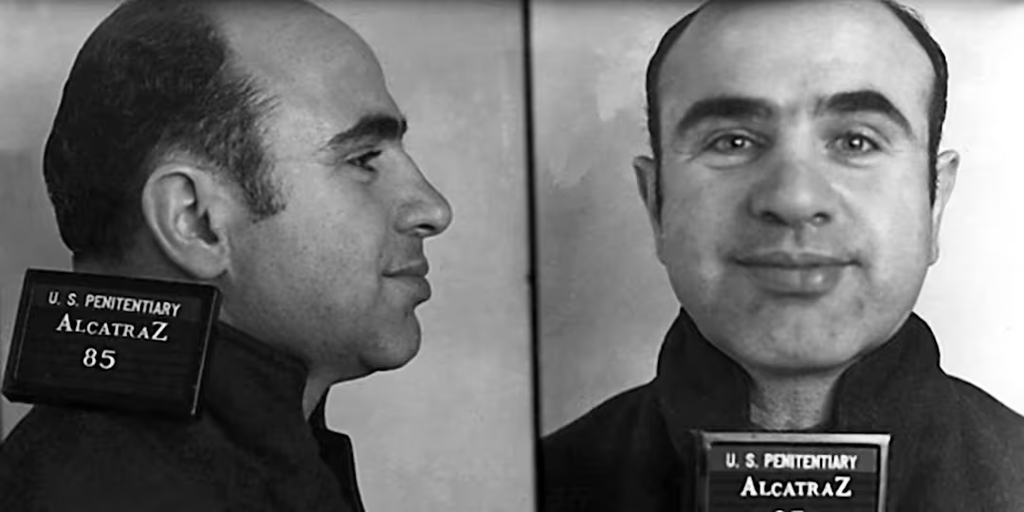
Public Enemy No. 1 was transferred to the now-infamous island prison just weeks after it opened, trading the privileges of his former life for a strict routine of confinement, hard work, and isolation.
When Al Capone arrived at Alcatraz Federal Penitentiary in August 1934, he was already one of the most notorious criminals in American history. The Chicago gangster had built an enormous criminal empire during Prohibition, becoming associated with bootlegging, illegal gambling, bribery, and organized violence. His name inspired fear, fascination, and headlines across the country.
Yet his reputation meant little inside Alcatraz, the heavily secured federal prison on an island in San Francisco Bay. Opened in August 1934, the institution was designed to hold some of the country’s most difficult federal prisoners under exceptionally strict conditions. Capone arrived only weeks after its opening, joining a population of inmates who faced tight schedules, limited privileges, and constant supervision.
His time behind the prison walls was very different from the glamorous image sometimes associated with his criminal career. Instead of directing a powerful organization from a luxurious headquarters, Capone had to follow prison regulations, perform assigned work, and spend much of his day within a rigid institutional routine.
His health also became an increasingly important factor during his imprisonment. Years of illness, including the effects of syphilis, contributed to his physical and mental decline. Although Capone remained a recognizable figure, the prison environment offered little opportunity to restore the influence he had once enjoyed.
Understanding how Al Capone spent his time in Alcatraz reveals not only the daily realities of his imprisonment but also the limitations of his power once he was removed from the criminal world he had controlled.
Why Al Capone Was Sent to Alcatraz
Al Capone’s criminal career expanded during the Prohibition era, when the manufacture and sale of alcoholic beverages were largely prohibited in the United States. Illegal alcohol distribution created enormous profits for organized crime groups, particularly in major cities such as Chicago.
Capone became the most recognizable leader of Chicago’s organized underworld. His organization operated illegal breweries, controlled bootlegging networks, and used bribery and intimidation to protect its business interests. Violent competition between criminal groups contributed to the city’s reputation for gangland conflict.
Despite his notoriety, authorities struggled to convict Capone of many of the violent crimes associated with his organization. His eventual downfall came through a federal prosecution for income-tax evasion rather than a conviction for murder or bootlegging.
In 1931, Capone was convicted of federal tax offenses and sentenced to 11 years in prison. He also received a substantial fine and was ordered to pay court costs. After serving time in federal institutions, including the Atlanta penitentiary, he was transferred to Alcatraz in August 1934.
The move was significant because Alcatraz was intended to prevent powerful inmates from using their outside connections to influence prison life. Its remote location, strict security, and controlled communications made it particularly suitable for prisoners considered difficult to manage elsewhere.
For Capone, the transfer represented a sharp change in circumstances. The man who had once commanded loyalty and influence on the streets now had to live according to rules established by prison officials.
Life Inside the Notorious Island Prison
Alcatraz was built around the principle that prisoners should have few opportunities to exercise influence beyond their cells. The surrounding waters of San Francisco Bay made escape extremely difficult, while the prison’s internal security systems restricted movement and communication.
Inmates followed a carefully organized daily schedule. Meals, work assignments, recreation, and time in their cells were governed by prison regulations. Guards supervised movement throughout the institution, and prisoners were expected to follow instructions promptly.
Capone was no exception. His celebrity status did not exempt him from the basic requirements of prison life. He had to wear prison clothing, obey orders, and live within a system that emphasized discipline over personal privilege.
The adjustment was likely difficult for someone accustomed to exercising authority. Outside prison, Capone had enjoyed access to money, servants, expensive clothing, and influential associates. Inside Alcatraz, many ordinary choices were controlled by the institution.
Prisoners also had limited opportunities to communicate with the outside world. Visits, letters, and telephone access were subject to rules and restrictions. Capone could no longer conduct his daily life as though he were still directing a criminal enterprise.
Alcatraz’s reputation for severity came partly from its strict regulations and the difficulty inmates faced in obtaining additional privileges. Prisoners could not simply demand better treatment because they had once been wealthy or famous.
For Capone, the experience demonstrated that influence outside the prison did not automatically translate into authority inside it.
What Al Capone Did During the Day
Much of Capone’s daily life at Alcatraz revolved around the same routine followed by other inmates. Prisoners were assigned work, expected to maintain orderly behavior, and required to follow schedules set by the administration.
Work assignments varied throughout the institution. Inmates could be involved in laundry operations, kitchen duties, maintenance, or other prison tasks, depending on their assignments and circumstances.
Capone was associated with prison work, including laundry duties. Such work was a world away from the criminal activities that had once occupied his attention. Rather than organizing illegal businesses, he had to perform tasks within a system where his time and movements were closely controlled.
Work served several purposes within the prison environment. It helped maintain the institution, occupied prisoners during the day, and reinforced the expectation that inmates follow a structured routine.
Outside their assignments, prisoners had limited periods for meals and recreation. They could sometimes read, write, or spend time in designated communal areas, depending on their privileges and the regulations in force.
However, Alcatraz was not a place where inmates enjoyed unlimited freedom during their leisure hours. Activities remained supervised, and opportunities to socialize were restricted compared with life outside prison.
For Capone, the ordinary nature of these routines was part of the punishment. His former life had revolved around control, money, and personal influence. Prison replaced those privileges with repetition and a schedule he did not determine.
Did Al Capone Receive Special Treatment?
Because Capone was so famous, stories about his imprisonment have often suggested that he enjoyed privileges unavailable to other inmates. The reality was more complicated.
Prison officials had strong reasons to monitor him carefully. His criminal connections and public reputation made him a potential security concern, and allowing him to operate as a powerful figure inside the prison would have undermined the institution’s purpose.
Alcatraz was specifically intended to restrict the influence of high-profile inmates. Its rules were designed to limit opportunities for communication, intimidation, and the exercise of authority outside established prison procedures.
Capone’s wealth could not buy him the freedom he had enjoyed before his conviction. Money had been central to his ability to influence people outside prison, but its usefulness was sharply limited in a place where privileges depended on institutional regulations.
There were also accounts of Capone attempting to maintain an image of importance among other inmates. His reputation followed him into prison, but notoriety did not guarantee respect or comfort.
The experience of imprisonment also exposed him to a reality that many powerful people find difficult to accept: once a person enters a tightly controlled institution, personal status becomes less important than compliance with its rules.
Although popular stories sometimes exaggerate the details of his life at Alcatraz, the central fact remains clear. Capone was required to live under strict conditions, and his former wealth and criminal authority could not restore his freedom.
Music, Recreation, and Capone’s Personal Interests
One of the more interesting aspects of Capone’s time in prison involved his interest in music. He was known to play the banjo and reportedly participated in musical activities during his incarceration.
Music offered a possible source of distraction from the monotony of prison life. For inmates, reading, writing, recreation, and music could provide limited ways to occupy the mind when much of the day was controlled by institutional schedules.
Capone’s musical interests also reveal a less familiar side of his public image. Although he became famous for organized crime, he had personal interests that existed outside the criminal world.
However, such activities should not be mistaken for a comfortable lifestyle. Recreation took place within the boundaries established by the prison, and prisoners remained subject to supervision and discipline.
For someone who had previously enjoyed access to restaurants, hotels, private entertainment, and social gatherings, the limited opportunities available inside Alcatraz represented a substantial loss of freedom.
The island prison offered few distractions from its central purpose: keeping inmates securely confined. Any music or recreation was therefore a small part of a much larger routine shaped by restrictions.
Al Capone’s Declining Health in Prison
Capone’s health became one of the most significant factors during his imprisonment. He had contracted syphilis years before entering prison, and the disease had progressed without effective treatment during important periods of his life.
By the time he was transferred to Alcatraz, his physical condition was already a concern. Syphilis can affect multiple organs and, when it reaches the nervous system, may cause serious neurological complications. Capone’s later difficulties were associated with advanced disease, although the precise contribution of different medical factors cannot be reduced to a single symptom.
Prison life placed additional demands on his body and mind. The institution’s strict routine continued regardless of his previous fame, and his ability to participate in ordinary activities was affected by his deteriorating health.
Medical care was available within the federal prison system, but treatment options in the 1930s were much more limited than those available today. Penicillin, which transformed the treatment of syphilis, was not yet in routine clinical use during the early part of Capone’s imprisonment.
As his condition worsened, he received medical attention and was eventually transferred away from Alcatraz.
His decline also challenged the popular image of Capone as an untouchable criminal mastermind. Outside prison, his power had depended on his ability to organize people and maintain control. Illness gradually reduced his capacity to do either.
The man who had once dominated headlines for his wealth and influence became increasingly vulnerable to circumstances beyond his control.
Leaving Alcatraz and the Final Years of His Life
Capone spent approximately four and a half years at Alcatraz before being transferred to another federal institution in January 1939. His departure was connected to his declining health and the need for continued medical attention.
He was subsequently released from federal custody in November 1939 after his sentence was reduced in light of his medical condition and the time he had served.
By then, his criminal organization had long since lost much of its former power. Other figures had taken over aspects of the underworld, and Capone was no longer in a position to return to his previous role.
He spent his remaining years largely away from public life at his estate in Florida. His health continued to deteriorate, and he died on January 25, 1947, at the age of 48.
His later life contrasted sharply with the years when he had been one of the most recognizable figures in American organized crime. The wealth and influence that once surrounded him could not reverse the effects of illness or restore the position he had lost.
Capone’s imprisonment at Alcatraz therefore marked an important turning point. It removed him from the environment in which he had accumulated power and placed him within a system designed to limit his influence.
Why Al Capone’s Time at Alcatraz Still Fascinates People
Al Capone remains one of the most widely recognized names in American criminal history, and his imprisonment at Alcatraz continues to attract interest because it combines the story of a famous gangster with the history of a notorious prison.
Part of the fascination comes from the contrast between his public image and the reality of confinement. Capone had once been associated with expensive suits, luxury cars, political corruption, and a vast criminal network. At Alcatraz, his days were shaped by work assignments, supervised recreation, medical concerns, and strict regulations.
His story also illustrates the limits of celebrity. A person may command attention and influence in one setting but lose much of that power when circumstances change.
Alcatraz itself has become a symbol of federal efforts to control dangerous and influential prisoners. Its isolation, security measures, and reputation for strict discipline have helped turn it into one of the most famous former prisons in the United States.
Today, visitors encounter the institution through historical exhibits and preserved facilities that help explain the lives of inmates and prison staff. Capone’s name remains part of that history, although his experience should be understood alongside those of the many other people held on the island.
Conclusion: The Reality Behind Al Capone’s Alcatraz Years
Al Capone’s time at Alcatraz was a period of confinement, routine, and declining health that differed dramatically from the life he had led as Chicago’s most notorious gangster.
Transferred to the island prison in August 1934, he was required to follow strict rules, perform assigned work, and live under constant institutional supervision. His former wealth and criminal reputation offered little protection against the restrictions imposed by the prison.
Although he found limited opportunities for personal interests, including music, his daily life was dominated by the demands of incarceration. His worsening health further complicated his time behind bars and eventually contributed to his transfer away from Alcatraz.
Capone’s story is often remembered through the mythology surrounding his criminal career. Yet his prison years reveal a more sobering reality: power can disappear when a person loses the freedom to exercise it, and fame cannot protect anyone from illness or the consequences of past decisions.
Alcatraz did not erase Capone’s place in American history, but it brought his era of influence to an end. His experience on the island remains a striking example of how dramatically life can change when the person once in control becomes subject to the rules of others.