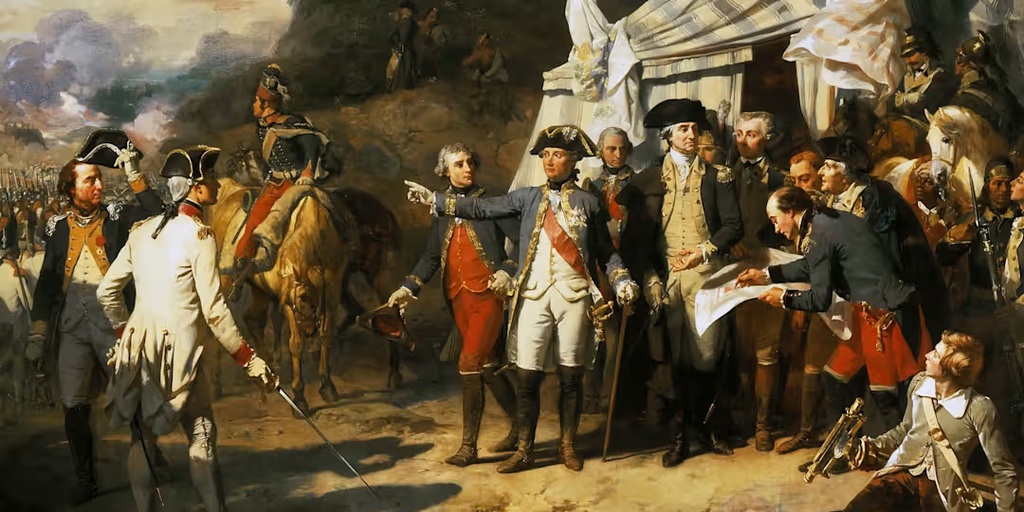
The American victory at Yorktown in 1781 marked one of the most important turning points in the American Revolutionary War. After years of fighting against British rule, American forces and their French allies surrounded a major British army in Yorktown, Virginia, forcing General Charles Cornwallis to surrender. The defeat dealt a devastating blow to Britain’s military campaign in North America and helped pave the way for the creation of the United States as an independent nation.
The Battle of Yorktown was not simply a victory won by American soldiers. It was the result of careful planning, determined leadership, French military support, and a strategic campaign that left British forces with few options for escape. General George Washington played a central role in directing the allied army, while French naval and land forces helped trap the British troops on the Virginia coast.
Although fighting and political negotiations continued after the surrender, Yorktown effectively ended major British offensive operations in North America. Its significance extended far beyond the battlefield, demonstrating the strength of the American-French alliance and changing the political calculations of the British government.
Understanding how the Americans defeated the British at Yorktown reveals why this dramatic victory became a defining moment in the history of the American Revolution.
The American Revolutionary War Before Yorktown
The American Revolutionary War began in 1775, when tensions between Great Britain and its thirteen North American colonies escalated into armed conflict. Colonial resistance had grown in response to British taxation policies, restrictions on self-government, and disputes over the rights of colonists within the British Empire.
In July 1776, representatives of the colonies adopted the Declaration of Independence, formally announcing their separation from Britain. The declaration established the political goal of the revolution, but achieving independence required years of military struggle.
The Continental Army, commanded by George Washington, faced a formidable opponent. Britain possessed a powerful navy, experienced professional soldiers, and extensive financial resources. American forces, meanwhile, often struggled with shortages of supplies, limited training, and difficulties maintaining enlistments.
The war produced both victories and setbacks for the revolutionary cause. American success at Saratoga in 1777 helped persuade France to enter the conflict as an ally in 1778. French military assistance eventually became essential to the American effort, providing troops, naval power, money, weapons, and supplies.
By 1781, the war had become a wider international conflict involving Britain, France, Spain, and the Netherlands in different capacities. British leaders continued to seek ways to defeat the rebellion, but the growing cost of the war made a decisive victory increasingly difficult.
The campaign that culminated at Yorktown would expose the limitations of Britain’s position in North America and demonstrate how coordinated allied operations could overcome a powerful imperial army.
Why the British Army Was in Yorktown
In 1781, British forces under General Charles Cornwallis were operating in the southern colonies. British strategy had increasingly focused on the South, where commanders hoped to gain support from Loyalists—colonists who remained loyal to the Crown—and restore British authority.
Cornwallis had campaigned through parts of the Carolinas and Virginia, fighting American forces and attempting to weaken the revolutionary movement. However, his operations faced persistent resistance from Continental troops and local militia.
American commanders, including Nathanael Greene, used movement and maneuver to challenge British control of the South. Rather than relying exclusively on large set-piece battles, American forces repeatedly pressured British positions and disrupted efforts to secure the countryside.
Cornwallis eventually moved his army toward the Virginia coast. In the summer of 1781, his troops established themselves at Yorktown, a port town on the York River. The position offered access to waterways and appeared suitable for receiving supplies or reinforcements from the British fleet.
Yet Yorktown also created a serious vulnerability. If an enemy army surrounded the town and a hostile navy controlled the surrounding waters, Cornwallis could find himself trapped.
British commanders needed naval access to sustain their forces and preserve a possible route of retreat. Without control of the sea, the army’s position would become increasingly dangerous.
The decision to establish a major British force at Yorktown ultimately gave Washington and his allies an opportunity to concentrate their forces against Cornwallis.
George Washington and the Plan to Trap Cornwallis
George Washington understood that defeating the British required more than courage on the battlefield. The Continental Army needed to exploit strategic opportunities, coordinate with its allies, and choose a moment when British forces could be isolated.
In 1781, Washington had initially focused much of his attention on British forces in and around New York City. However, developments in Virginia changed the strategic situation.
French cooperation made a southern operation increasingly practical. French troops under the Comte de Rochambeau were operating alongside Washington’s army, and French naval power offered a potential advantage against Britain’s Royal Navy.
The plan depended on moving the allied army toward Virginia while preventing British forces from reinforcing or evacuating Cornwallis. This required secrecy, coordination, and considerable logistical effort.
Washington and Rochambeau began moving their combined forces south in August 1781. Their movement helped conceal the true objective from British commanders, who had reason to believe that New York remained a primary target.
As the allied army advanced, American and French forces converged on Virginia. The operation brought together soldiers from different military traditions and countries, all working toward the same immediate objective: trapping Cornwallis at Yorktown.
Washington’s leadership was essential in maintaining the campaign’s direction, but the operation depended on cooperation. French commanders, naval officers, and soldiers played major roles in turning the plan into a realistic military threat.
The strategy demonstrated that the American Revolution had evolved from a colonial rebellion into an international military contest in which alliances and naval control could determine the outcome of land campaigns.
The French Navy Changes the Course of the War
One of the most decisive developments in the Yorktown campaign took place at sea.
On September 5, 1781, a French fleet commanded by Admiral François Joseph Paul de Grasse fought the British fleet under Admiral Thomas Graves near the Chesapeake Bay. The engagement became known as the Battle of the Chesapeake, or the Battle of the Capes.
The naval battle did not produce a dramatic destruction of the British fleet, but its strategic consequences were enormous. The British were unable to secure control of the bay, while the French maintained a position that prevented the Royal Navy from freely supporting Cornwallis.
Control of the Chesapeake was crucial because it limited British opportunities to deliver reinforcements, evacuate troops, or provide supplies by sea. Cornwallis’s army now faced a growing threat from the combined American and French forces approaching by land.
The French naval presence helped transform Yorktown from a defensible coastal position into a trap. Without reliable maritime access, Cornwallis had fewer ways to escape the allied siege.
This outcome illustrates why the American victory cannot be understood as an exclusively American achievement. The Continental Army supplied the core revolutionary force, but French naval power was indispensable to the operation’s success.
The alliance between the United States and France had already changed the course of the war. At Yorktown, it produced a decisive strategic advantage that Britain struggled to overcome.
The Siege of Yorktown Begins
By late September 1781, American and French troops had assembled around Yorktown. Cornwallis’s army was increasingly isolated, with the allied forces preparing to tighten the encirclement.
The siege formally developed into a major operation as the allies established their positions and began constructing artillery batteries. Their objective was to bring concentrated fire against British defenses, weaken the defensive lines, and create openings for an assault.
The allied army possessed a substantial numerical advantage. Thousands of American and French soldiers participated in the siege, supported by artillery and coordinated command arrangements.
British defenders attempted to hold their positions, relying on earthworks and defensive fortifications. However, their ability to respond was limited by the allied army’s growing strength and the loss of dependable naval support.
Artillery played a central role. The allies brought heavy guns into position and bombarded British defenses, gradually damaging fortifications and making life increasingly dangerous for the defenders.
The siege required discipline and persistence. Soldiers had to move artillery, dig trenches, transport ammunition, and maintain positions while exposed to enemy fire. The process was physically demanding and dangerous, but the allied forces continued to advance their lines.
For Cornwallis, the central problem became increasingly clear: his army could continue resisting, but it had limited prospects of receiving reinforcements or escaping the encirclement.
The Assault on British Redoubts
As the siege progressed, the allied commanders identified key British defensive positions that needed to be captured to bring the artillery closer and weaken Cornwallis’s remaining defenses.
Two important British redoubts—small fortified positions protecting parts of the defensive line—became the focus of a coordinated attack on the night of October 14, 1781.
American troops under Lieutenant Colonel Alexander Hamilton attacked Redoubt No. 10, while French troops led by Guillaume de Deux-Ponts assaulted Redoubt No. 9.
The attacks required soldiers to advance toward fortified positions under dangerous conditions. American troops were instructed to rely heavily on bayonets during their assault, helping maintain speed and reduce the confusion that could result from sustained firing in close quarters.
Both redoubts were captured. The allied victory allowed siege operations to move forward and placed additional pressure on British defenses.
The capture of these positions was an important tactical success, but its significance extended beyond the immediate ground gained. The allied army could now bring its siege lines closer to Yorktown, increasing the pressure on Cornwallis’s troops.
With British fortifications damaged and the allied artillery positioned more effectively, the prospect of holding out became increasingly bleak.
The fall of the redoubts demonstrated the discipline and coordination of the American and French forces. It also brought the siege closer to its inevitable conclusion.
Cornwallis Surrenders on October 19, 1781
By October 17, British resistance had become extremely difficult to sustain. Cornwallis’s army was under intense pressure, its defenses had suffered significant damage, and the possibility of relief from the British fleet had diminished.
Cornwallis attempted to explore options for escape, but the allied positions and French naval presence made a successful withdrawal highly uncertain. Continued resistance risked further casualties without offering a realistic prospect of changing the situation.
Negotiations followed, and surrender terms were arranged.
On October 19, 1781, British troops at Yorktown formally surrendered to the American and French forces. Approximately 8,000 British and allied soldiers were included in the capitulation, although the precise number varies depending on which categories of troops are counted.
The surrender was a major humiliation for Britain. A substantial British army had been forced to lay down its arms, and the government faced renewed questions about the cost and purpose of continuing the war.
The event is often remembered through the image of British troops marching out of Yorktown to surrender. The ceremony symbolized the collapse of Cornwallis’s campaign and the success of the allied strategy.
Washington emerged from the victory with his reputation strengthened, while the French alliance received further recognition for its vital role.
Yorktown did not legally establish American independence on its own. Nevertheless, it made the continuation of Britain’s effort to defeat the revolution much more difficult to justify politically and militarily.
Why the Victory at Yorktown Was So Important
The surrender at Yorktown changed the direction of the American Revolutionary War.
First, it deprived Britain of a major field army in the southern theater. The loss reduced Britain’s ability to conduct offensive operations and undermined confidence in the strategy of restoring control over the colonies through military force.
Second, the victory strengthened American political credibility. The Continental Army had demonstrated that it could cooperate with an international ally to defeat a powerful British force through coordinated strategy and disciplined execution.
Third, Yorktown influenced British politics. The cost of the war had become increasingly controversial, and the surrender intensified opposition to continuing the conflict. Political leaders faced growing pressure to seek a negotiated settlement.
The victory also reinforced the importance of the Franco-American alliance. French soldiers and sailors had helped make the siege possible, demonstrating that international cooperation could compensate for some of the disadvantages faced by the American forces.
For the revolutionary cause, Yorktown represented the culmination of years of sacrifice. American soldiers had endured shortages, difficult winters, battlefield losses, and uncertainty about whether independence could ever be achieved.
The surrender offered strong evidence that the British military position was no longer sustainable, even though peace negotiations still lay ahead.
Did Yorktown Immediately End the American Revolutionary War?
Although Yorktown is often described as the decisive battle of the American Revolution, the war did not formally end on October 19, 1781.
British troops remained in other locations, and military operations continued in several theaters. The British still occupied New York City and maintained positions elsewhere in North America.
However, the surrender changed the political environment. The British government faced increasing pressure to negotiate rather than continue an expensive war with uncertain prospects of success.
Peace negotiations eventually produced the Treaty of Paris, signed on September 3, 1783. Under the treaty, Great Britain recognized the independence of the United States and agreed to boundaries for the new nation.
The treaty also addressed other matters arising from the conflict, including fishing rights and debts. Its provisions established the international framework for the United States as an independent country.
Yorktown therefore served as the decisive military turning point, while the Treaty of Paris provided the formal diplomatic recognition of American independence.
The distinction is important: victory on the battlefield created the conditions for a favorable peace, but negotiations and political decisions were still necessary to bring the war to a formal conclusion.
The Lasting Legacy of the Battle of Yorktown
The American victory at Yorktown remains a landmark event in United States history. It illustrates how military planning, international alliances, naval power, and persistence can combine to overcome a stronger opponent.
George Washington’s leadership helped coordinate the allied campaign, while French naval and land forces provided crucial support. The American and French soldiers who fought in the siege demonstrated that cooperation could turn a difficult military situation into a decisive victory.
Yorktown also reminds us that independence was not achieved through a single moment of heroism. It was the result of years of resistance, sacrifice, strategic adaptation, and diplomatic effort.
Today, Yorktown is remembered as the place where the British campaign to suppress the American Revolution suffered its most decisive defeat. The surrender of Cornwallis’s army did not instantly settle every question surrounding the future United States, but it fundamentally changed the course of the conflict.
The victory helped move the American colonies from rebellion toward recognized nationhood. It gave political leaders the opportunity to negotiate from a stronger position and brought the prospect of independence closer to reality.
Conclusion: Yorktown Paved the Way for American Independence
The Americans’ victory over the British at Yorktown in October 1781 was one of the defining achievements of the American Revolution. Through the leadership of George Washington, the determination of the Continental Army, and the essential support of French soldiers and naval forces, the allies surrounded General Cornwallis’s army and forced its surrender.
The Battle of the Chesapeake helped prevent British relief, the siege weakened Cornwallis’s defenses, and the capture of key redoubts brought the campaign to its conclusion. On October 19, the British surrender demonstrated that the revolutionaries and their allies could defeat a major imperial force.
Yorktown did not end the war immediately, but it changed the political and military calculations that shaped its final years. Less than two years later, the Treaty of Paris formally recognized American independence.
More than a military victory, Yorktown became a symbol of the determination of the American revolutionary cause and the power of international cooperation. Its legacy endures as the moment when the struggle for independence moved decisively toward success and the United States took a major step toward becoming a sovereign nation.